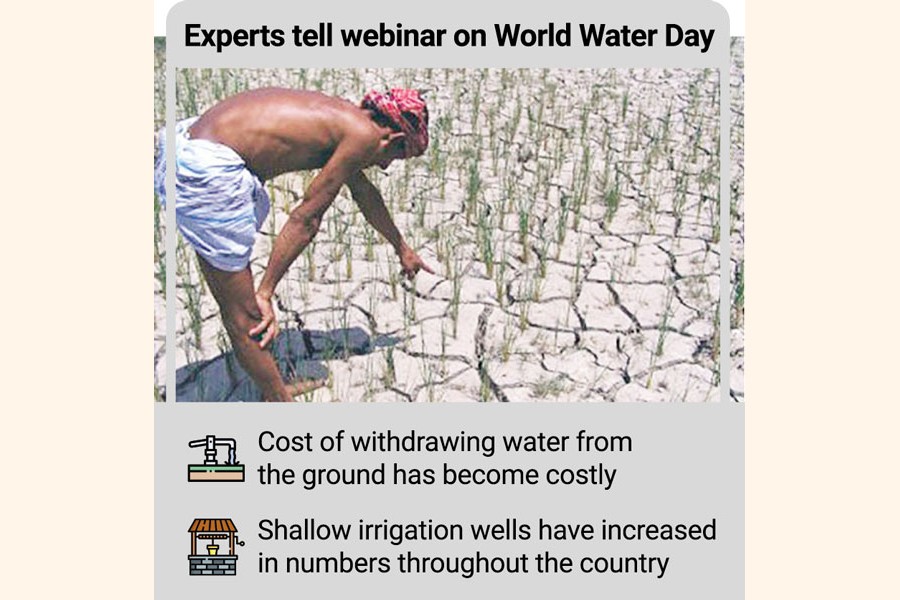
Experts at a webinar on Monday said depletion and contamination of groundwater are key concerns for 'invisible' resource.
They also emphasised the importance of exploring, protecting and using the groundwater sustainably with due importance on this scarce resource.
The webinar was organised by SKS Foundation, the Secretariat of FANSA-Bangladesh. The theme of this year's World Water Day is 'Groundwater-Making the Invisible Visible'.
Dr. Anwar Zahid, Director, Groundwater Hydrology, Bangladesh Water Development Board, highlighted the global and national scenario of groundwater and its use as a very valuable resource.
An estimated 32 cubic km of groundwater is withdrawn annually for irrigation (90 per cent), domestic and industrial (10 per cent), according to the World Bank. The shallow irrigation wells have increased in numbers throughout the country from 133,800 in 1985 to 11,82,525 in 2006 and about 16,00,000 in 2019 (BADC, 2019), he said in his presentation.
As the water table has gone down, the cost of withdrawing water from the ground has become costly and unavailable. Again 24 per cent of the land area is exposed to high risks of elevated arsenic, salinity, and groundwater depletion hazards (The World Bank, 2019), he mentioned.
In the Barind tract, the groundwater crisis has already prevailed and the crisis is getting deeper and deeper.
"We need a crop mapping and good governing in managing the groundwater," Dr. Chowdhury Sarwar Jahan, Professor, Dept. of Geology & Mining, University of Rajshahi, said at the event.
Dr. Dilip Kumar Datta, Professor, Environmental Science Discipline, Khulna University said, "We need nature-based solutions that will take care of nature too in a suitable and sustainable manner. To lessen the dependency on groundwater, we must focus on surface water."
Hasin Jahan, Country Director, WaterAid Bangladesh said as the water table is being lowered and the use of chemicals is increasing, the water quality is being contaminated. "We need to stop it now."
Salahuddin Ahammed, WASH Officer, UN Migration Agency, IOM, Bangladesh Mission said, "To lessen the dependency on groundwater, we need to concentrate on surface water and reservation of surface water is needed."
The virtual seminar was opened by a welcoming speech by Dr. Imrul Kayes Muniruzzaman, Deputy Chief Executive of SKS Foundation. Some 100 participants from development partners, national and international organisations, academia and media took part in the seminar.
However, a global report says groundwater in gaps within soil, sand and rock has the potential to save hundreds of thousands of lives and be the world's insurance policy against climate change.
The report has mentioned that groundwater could help communities cope not only with slow onset impacts like drought and irregular rainfall, but also provide resilience to rapid onset impacts like floods by ensuring safe water is available for all, including in schools and hospitals.
The report titled "Groundwater: The world's neglected defence against climate change" jointly released by WaterAid and the British Geological Survey (BGS) emphasized that investment, knowledge, expertise, finance and institutional support are required for groundwater development to secure lifesaving, sustainable and safe water and sanitation for communities living on the frontline of the climate crisis.
On World Water Day, WaterAid has called to reduce groundwater usage which is often over-extracted by people and industries when it is not regulated. This drives competition for water and impacts the amount of water available for drinking and washing.
The major consequence of unregulated and unsustainable groundwater use is that it deepens inequality and may run out at a time when people need them most, says the report.
The report also recommends that regulations are needed to mitigate the unregulated extraction of groundwater supplies.
nsrafsanju@gmail.com
© 2026 - All Rights with The Financial Express

