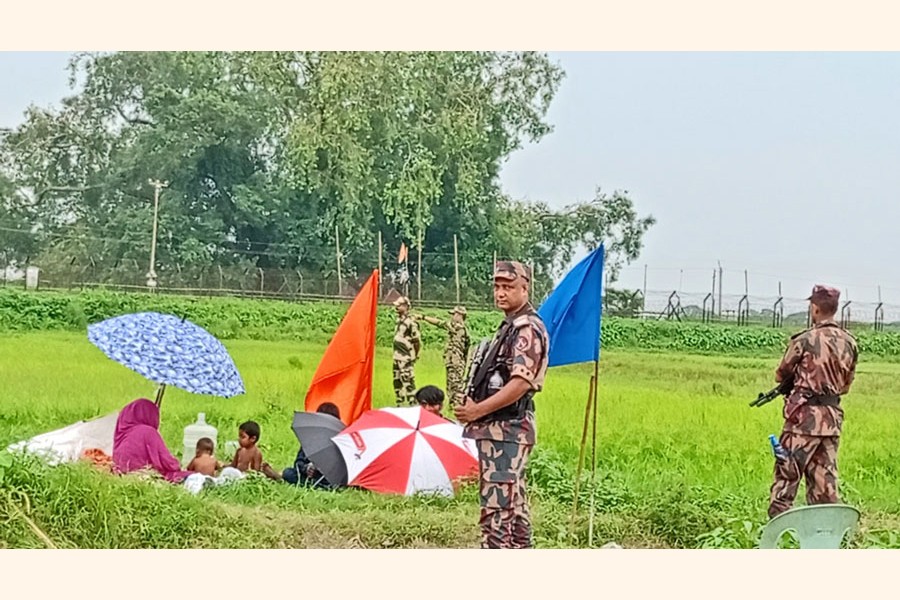
 Border Guard Bangladesh (BGB) personnel remained alert across the Goytapara border in Shaulmari union of Roumari upazila under Kurigram on Wednesday, as India's Border Security Force (BSF) allegedly attempted to push six people, including women and children, into Bangladesh. The six individuals have been positioned there in a pitiable condition for the last four days. — Collected
 Indian authorities have forcibly expelled ethnic Bengali residents, mostly Muslims from West Bengal, to Bangladesh without due process, leaving dozens of families stranded along the border, according to international rights group Human Rights Watch (HRW).
In a statement on Tuesday, HRW said actions by India's Border Security Force (BSF), coupled with efforts by Border Guard Bangladesh (BGB) to prevent unauthorised entry, had left families trapped at the "zero line" between the two countries.
According to Bangladeshi border guards, since Jun 1, 2026, they have thwarted 21 attempts by the BSF to push more than 200 people, including children, into Bangladesh through border districts, reports bdnews24.com.
The chief minister of India's West Bengal state Suvendu Adhikari, who took office after the Bharatiya Janata Party (BJP) won the March elections, said his government's "detect, delete and deport" policy had led to the detention of hundreds of alleged "Bangladeshi infiltrators" and forced nearly 5,000 people "to go back".
"Indian authorities are cruelly dumping families into Bangladesh or leaving them stranded at the border, ignoring their basic human rights," said Meenakshi Ganguly, deputy Asia director at HRW.
"The government should stop unlawfully expelling people, ensure procedural safeguards, engage with Bangladeshi authorities to verify citizenship, and end this dismaying animosity toward Muslims," she said.
HRW said it interviewed nine people who witnessed BSF personnel escorting groups to the border at night and pushing them through cuts in barbed-wire fencing into Bangladeshi territory.
In several instances, the BSF later allowed the individuals to return after BGB denied them entry, it said.
In Bangladesh's northern Panchagarh district, witnesses described a 75-hour standoff after the BSF attempted to push 10 people, including children, into Bangladesh on Jun 5.
"The group had advanced approximately 50 feet inside Bangladeshi territory," said Rubel Hossen, a local resident.
He said villagers alerted the BGB, prompting a confrontation that left the group stranded on an embankment in no man's land.
According to Rubel, those stranded endured severe lightning and heavy rain during the first night and received only limited food from Indian border forces on the second day.
"What I witnessed appeared to be a war-like standoff with large deployments of BSF and BGB," he said, adding that repeated flag meetings failed before the BSF eventually escorted the group back.
HRW also cited an incident on Jun 6 when six members of two Bengali Muslim families, including three men, two women and a child, were pushed toward the Tetulbaria border.
While the BGB prevented their entry into Bangladesh, BSF personnel allegedly stopped them from returning to India.
The families spent a night in the open before being allowed back.
On Jun 8, BGB said the BSF took back 11 people, including a pregnant woman and her child, after they had spent nearly 48 hours stranded at the zero line in Thakurgaon district.
The rights organisation said the incidents came amid concerns over citizenship verification and voter registration in India.
Before the March elections in West Bengal, India's Election Commission revised voter rolls, removing more than nine million names, a move that triggered concerns over detention and deportation.
The HRW noted that a citizenship verification exercise in Assam in 2019 had left more than 1.9 million people stateless. Thousands of Bengali-speaking residents have since been held in detention centres, while others were allegedly expelled unlawfully.
Assam Chief Minister Himanta Biswa Sarma referred to Bengali-speaking Muslims as "illegal immigrants".
HRW cited a recent statement in which he said authorities take people "to a convenient location near the border, and literally push them across the border".
Hasibur Islam, a union council member from Panchagarh Sadar, told HRW that he met a family from Siliguri in West Bengal who possessed Aadhaar identity cards but had been detained after their names were removed from electoral rolls.
"The oldest member of the family has voted four times. This year, none of them were able to vote," he added.
The family was eventually allowed to return to India after spending three days stranded at the border.
© 2026 - All Rights with The Financial Express

