With a view to ensuring a wider social safety net and thus alleviating poverty further, the government has chalked out a long-term Social Safety Net Strategy covering the people of all ages, including children, women and elderly ones, report agencies.
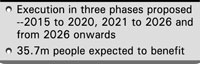
A total of 35.70 million people are expected to benefit from the social safety net programmes.
The draft of the Strategy Paper was placed before the government by the Planning Commission Wednesday for finalisation.
General Economics Division (GED) member of the Planning Commission Prof Dr Shamsul Alam presented the Strategy Paper to Prime Minister (PM) Sheikh Hasina at a meeting on Finalising the National Social Safety Net Strategy Paper at her office.
Finance Minister AMA Muhith, Social Welfare Minister Syed Mohsin Ali, Land Minister Shamsur Rahman Sharif, PM's Economic Adviser Dr Moshiur Rahman, Cabinet Secretary M Musharraf Hossain Bhuiyan and secretaries concerned were present on the occasion.
PM's press secretary AKM Shameem Chowdhuri briefed the journalists after the meeting.
The draft strategy, prepared by the GED contains a proposal for its execution in three phases.
Prime Minister Sheikh Hasina stressed the importance of finalising a well-thought-out strategy for quick poverty alleviation and human resources development.
Sheikh Hasina said her present government attached utmost importance to ensuring the social safety of people, particularly the poor, to make the country free from poverty.
The main vision of the strategy is to build a social safety measure for all citizens by creating employment opportunities, poverty alleviation, reducing discrepancies, development of human resources and finally boosting the country's economic growth.
The first phase of the strategy would be implemented during 2015 to 2020, while the second phase during 2021 to 2026 and the final phase from 2026 onwards.
The PM thanked the GED for preparing the long-term strategy hoping that the policy would be useful in achieving the government's vision to make Bangladesh a middle-income country by 2021 and a developed one by 2041.
The government made an allocation of US$ 3.9 billion in the current budget for as many as 145 types of different social safety net programmes by 35 ministries, divisions and institutions. It is around 2.3 per cent of the country's overall GDP.
© 2026 - All Rights with The Financial Express

