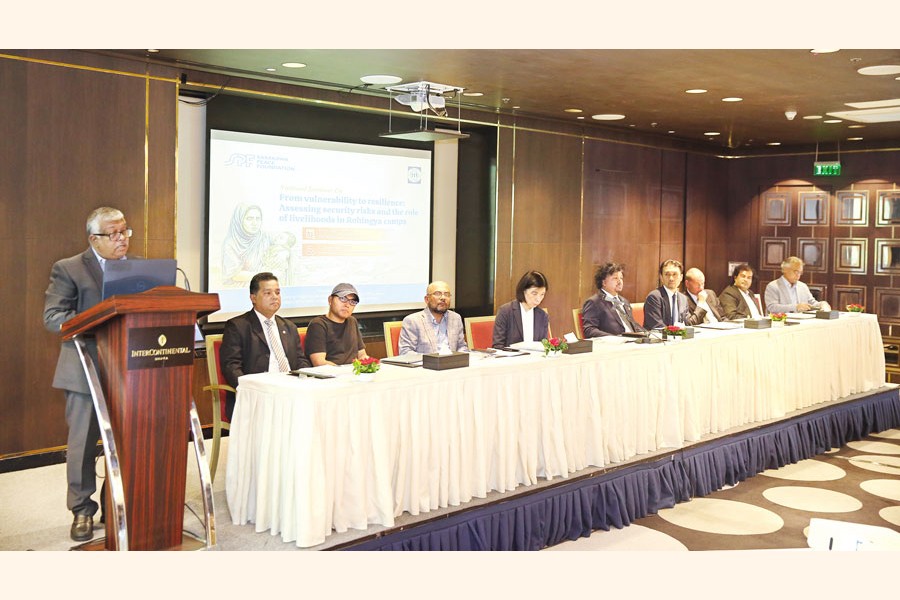
 Foreign Affairs Secretary Asad Alam Siam speaking at the seminar on Sunday. — FE Photo
 Structural exclusions - such as restricted mobility, limited income opportunities, and barriers to economic participation - have significantly increased security risks among the Rohingya refugees living in Bangladeshi camps, according to a recent research study.
It has also found that structural vulnerabilities have not only limited the refugees' economic prospects, but also caused psychological distress and weakened their social cohesion with the host communities, contributing to heightened security concerns.
 The findings were presented at a session of a national seminar titled 'From Vulnerability to Resilience: Assessing Security Risks and the Role of Livelihoods in Rohingya Camps', held at a city hotel on Sunday.
The event was organised by Sasakawa Peace Foundation (SPF) of Japan in collaboration with Young Power in Social Action (YPSA).
Foreign Affairs Secretary Asad Alam Siam attended the seminar as the chief guest.
Dr Khalid Koser, executive director of GCERF; Mohammed Mizanur Rahman, refugee relief and repatriation commissioner (RRRC); and Tomohide Ichiguchi, chief representative of JICA Bangladesh; were present, among others.
Dr Md Arifur Rahman, founder and chief executive of YPSA, delivered the closing remarks at the seminar. Dr Emadul Islam, senior research fellow at SPF; and Dr Mohammad Zainuddin of Australian National University presented the research findings.
According to the study, although humanitarian organisations have introduced livelihood initiatives to create some economic opportunities (in the Rohingya camps), their scale and stability remain limited.
The study suggested that strengthening stability in the camps requires integrated policy approaches to address structural vulnerabilities while promoting meaningful livelihood opportunities, psycho-social well-being, youth engagement, and inclusive governance.
Asad Alam Siam said currently around 1.2 million Rohingya refugees are temporarily residing in the camps of Cox's Bazar and Bhasanchar. "Bangladesh is sharing its limited resources with them, which could otherwise be utilised for our own people."
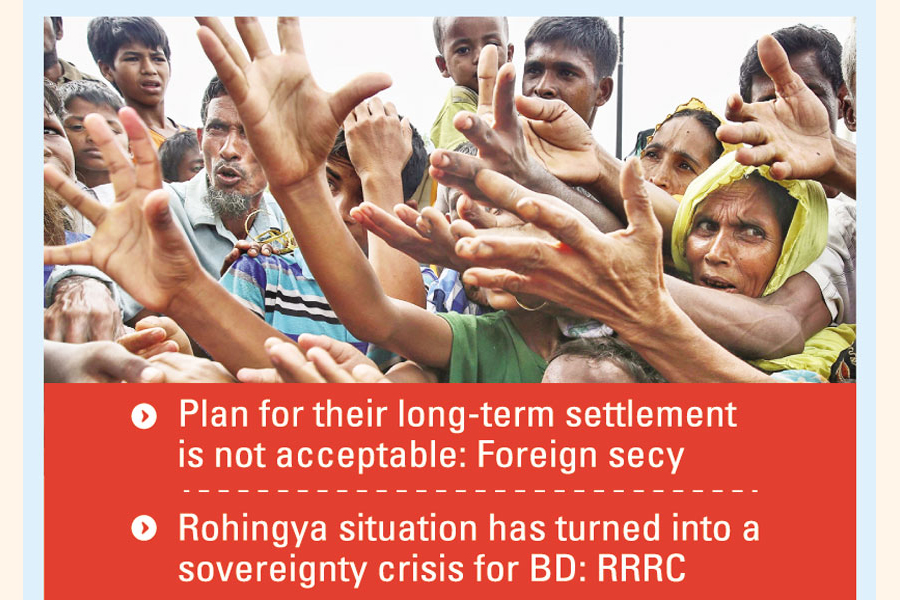
"Any plan for their long-term settlement is not acceptable, as it will encourage the genocide criminals (in Myanmar) to expel the very last few of them (Rohingya) from their homes in Rakhaine," he noted.
Referring to a huge number of unemployed people in Bangladesh and over 18 per cent of its population living below the poverty line, he opined that integrating the refugees into the local job market is not viable.
RRRC Mizanur Rahman said the Rohingya situation has evolved beyond a humanitarian issue, and it has now turned into a security and sovereignty crisis for Bangladesh.
He noted that the host community in Cox's Bazar, a pocket of poverty and malnutrition, is already struggling to maintain peaceful coexistence under the pressure of demographic imbalance and ecological collapse.
Tomohide Ichiguchi highlighted the JICA's initiatives in the region, and said its efforts have primarily focused on strengthening local governance, health system, and disaster risk reduction to ease the pressure on local institutions and maintain social stability.
The seminar concluded with a call for the international community to create a conducive political environment in Rakhine. The participants agreed that though repatriation of the Rohingya refugees seems difficult, efforts must be on to ensure a meaningful future for them.
saif.febd@gmail.com
© 2026 - All Rights with The Financial Express

