CHITTAGONG, Feb 23: Even though 20 years have already elapsed, the Chittagong Development Authority (CDA) and Chittagong City Corporation (CCC) are yet to implement any recommendations put forward to resolve the long-standing water-logging crisis in the port city.
The CDA devised a master plan in 1995 and made 12 recommendations aiming to deal with the water-logging crisis.
CDA Chairman M Abdus Salam Saturday acknowledged that the CDA and CCC have failed to implement the recommendations made to mitigate sufferings of city dwellers caused by water-logging during the monsoon every year.
The master plan had different components like structural plan, urban area plan and drainage master plan.
Work of mega project phase-1 was scheduled to be completed in between 1994 and 1997 while phase-2 in between 1998 and 2002, phase-3 in between 2003 and 2007, phase-4 in between 2008 and 2012 and phase-5 in between 2013 and 2015.
Experts have opined that the government may consider extending the duration of the master plan by five more years and CDA can start working on fine-tuning to the existing plan.
Although city dwellers have long been facing water-logging crisis during the rainy season, former mayors or incumbent mayor have not drawn up any massive plan to ease sufferings of city dwellers caused by stagnant waist-deep.
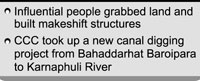
As many as 65 canals and tributaries in the city and a good number of smaller canals have disappeared over decades as influential people grabbed them and built makeshift or permanent structures.
The Chittagong City Corporation in 2011 took up a new canal digging project from Bahaddarhat Baroipara to Karnaphuli River near Bolirhat at an estimated cost of Tk 2.97 billion (Tk 297 crore).
The Executive Committee of the National Economic Council (ECNEC) has approved the development project profile of the new canal digging project and the government has recently allocated funds for this project, but work is yet to begin.
Water-logging is caused due to inflow of muddy waters from hills, tidal water, illegal occupation of water bodies, filling up of drains, non-implementation of drainage master plan-1995 and gradual disappearance of water bodies due to rapid industrialisation and building construction in recent years.
There were 418 kilometres of drains in the city, but many of them have been filled up by sand and devoured by adjoining roads and walkways.
A committee comprising engineers, consultants and experts conducted a study on the existing canals and drains and observed that these canals and drains have lost the capacity of carrying water following heavy rain, resulting in water-logging.
They also suggested digging three new canals. As per the drainage master plan, the CCC took up schemes to dig three new canals following a record 463mm rainfall in the city and adjoining areas in 2011-12.
Head of Civil Engineering Department of Southern University Bangladesh Prof M Ali Ashraf said 20 years have elapsed, but most of the proposals have remained unimplemented.
Government agencies and autonomous bodies like CDA and CCC were responsible for implementing these proposals. But in most cases, the organisations did not come forward with specific design proposals to be approved by the government, he added.
The drainage master plan had several proposals which, if implemented, could have saved the city from flash flood and water-logging, he said, adding that but none of these proposals had been implemented yet.
The CCC submitted a project proposal to the government for excavating a new canal from Bahaddarhat to Karnaphuli River few years back. The government has recently allocated funds for this project, but work is yet to begin.
© 2026 - All Rights with The Financial Express

