Women are more vulnerable than men in climate disaster-prone areas due to their income inequality and lack of rights to play a role in decision-making, a study has revealed.
It recommended priority to gender equality issues in all related national policies.
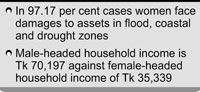
The baseline study on socio-economic conditions of women in three eco-zones of Bangladesh revealed that damages to assets or sources of income due to climate disasters were found in 97.17 per cent cases of women in flood, coastal and drought zones.
The study, conducted by the United Nations Women, the Bangladesh Centre for Advanced Studies (BCAS) and the Norwegian Embassy, was unveiled during a symposium in the city on Tuesday.
UN Women Country representative Chrisine Hunter chaired the programme where Secretary to women and children affairs ministry Tariq-ul-Islam and Norwegian Embassy Deputy Head of Mission Arne Haug addressed as chief guest and special guest respectively.
Professor Ainun Nishat, Dr Ahsan Uddin Ahmed of the Centre for Global Change and Mahbub Hossain of the Bangladesh Climate Change Trust spoke as panel discussants.
The study found that women's decision-making role was only 11 per cent in cases of communication, which means going outside their homes, work and education for children and engaging in alternative livelihood activities.
It is found that average income in climate vulnerable areas is Tk 71,833 and 39 per cent household annual income came from agricultural sector, 25 per cent from agricultural labour sources, 16 per cent from non-farm labour sources and eight per cent from businesses.
But the study said that female-headed household income was lower than the male household incomes in every climate vulnerable zone. In the drought-prone areas, male-headed household income was Tk 70,197 whereas female-headed annual household income was Tk 35,339. The highest income household (Tk 74,189) was found in coastal areas and lowest Tk 66,409 in drought-prone areas.
Due to increased water-borne diseases, 5.5 per cent of the monthly income was spent on health. As hand-tubewells are the largest sources of drinking water in three eco-zones, the study found women did not use tubewell water for cooking. They take the responsibility to bring water from distant areas.
Water supply and sanitation facilities are always vulnerable to natural hazards, the study said adding that women including pregnant and elderly ones were in more critical situation than men.
The study, conducted with the objective to address widespread and comprehensive approach to dealing with vulnerability and bringing women through a process of leadership, also said feminisation of poverty, maternal health and girls' education must also be critical aspects of pre-disaster planning, climate change adaptation, disaster management and disaster recovery.
The discussants also recommended addressing the gender dimension in more effective ways in all policy planning including five-year plans and national adaptation plan.
They observed that disaster responses of men and women are different and women bear the additional burden of loss and damage for their attachment to housing and livestock loss and damage.
The study also recommended more income- generating training programmes for women and their inclusion in all levels of decision- making as effective strategy to build women's economic resilience.
smunima@yahoo.com
© 2026 - All Rights with The Financial Express

