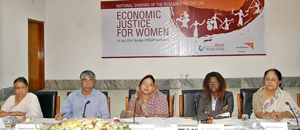
 State Minister for Women and Children Affairs Meher Afroz Chumki seen, among others, distinguished guests at the publication of a research report styled \"Economic Justice for Women\" conducted by Steps Towards Development, an NGO, in cooperation with Wor
 FE Report
Speakers at a discussion urged the government Sunday to abolish or revise all the discriminatory laws and provisions and social culture that deter women from property rights.
Around 82 per cent women do not have any ownership on inherited or purchased property though women entrepreneurs or workers are playing a significant role on asset creation, according to a research finding.
They said declaration of national minimum wage for different informal sectors will help control gender- based wage discrimination.
They said social justice is a very important factor in economic justice system, it cannot be ensured without addressing social and legal discrimination in the society.
These were uttered at a national sharing of research report on Economic justice for women: fair wage, rights on resources and property, and market access perspectives at CIRDAP auditorium. Steps Towards Development and World Vision Bangladesh jointly organised the programme.
State Minister of Women Affairs Meher Afroz Chumky said: "Women have to be aware of their rights and firstly they have to be educated. Only coordinated efforts can ensure the economic justice for women."
"The people of the country are going to have good news on national property act," She said as chief guest of the programme.
The research was conducted in eight villages under eight districts - Bogra, Netrakona, Khulna, Barisal, Pirojpur, Chittagong and Cox's Bazar to reveal women's justice facts from the perspectives of women's access to market, fair wage and property rights.
As per the research finding, women are getting involved into different formal and informal jobs in government and non governmental organizations due to socio-economic condition. Some of the women joined business due to economic hardship and high living cost.
The women are facing discrimination to be an entrepreneur due to raw material collection, product marketing and transportations, insecurity, family obstacles and lack of information on marketing, the research noted.
Mobile phone technology for communication and financial transaction made a significant positive impact on women's economic participation. Savings are mostly used by women entrepreneurs for better living, not for increasing production or products diversification. Most of the women are less paid than their male colleague.
Women are giving their best efforts in running their business by running their traditional role in family. Most of the respondents are more interested in spending in family property and better living, not for business expansion.
Key Informant Interview (KII) technique was followed in the research. In depth interviews 202 respondents and 16 Focus Group Discussion were documented (from November 2013 to March 2014) and analysed.
World Vision Bangladesh acting national director Dr Jeanpo Olowo, Ain O Shalish Kendro executive director Sultana Kamal, Bangladesh Mohila Parishad president Ayesha Khanam, Dhaka University Economics Department Professor MM Akash, Labour and Employment joint secretary Khondaker Mostan Hossain, economist M Mamunur Rashid and Steps Towards Development executive director Ranjan Karmaker and Steps Towards Development Saif Iqbal were present at the programme.
© 2026 - All Rights with The Financial Express

