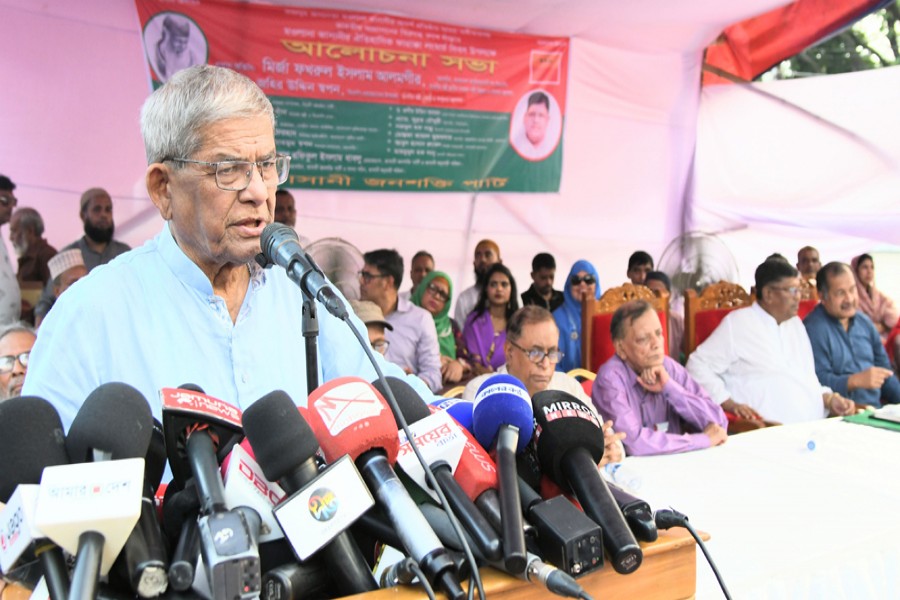
 BNP Secretary General and Local Government, Rural Development and Cooperatives Minister Mirza Fakhrul Islam Alamgir speaking at a discussion organised by Bhashani Janashakti Party marking Maulana Bhashani's historic Farakka Long March Day at the Central Shaheed Minar in the capital on Saturday. — PID
 BNP Secretary General and Local Government, Rural Development and Cooperatives Minister Mirza Fakhrul Islam Alamgir on Saturday called for national unity crossing all political lines to ensure Bangladesh's fair share of water from the Ganges and other common rivers with India, reports UNB.
"Now the question has arisen whether the Ganges Water Sharing Agreement will be renewed or not. This is not for any party, any individual or any government," he said.
"In the interest of the nation, the country and the people, all political parties must unite to secure our rightful share of Ganges water and the water of other rivers," he added.
He made the remarks while speaking as the chief guest at a discussion organised by Bhashani Janashakti Party marking Maulana Bhashani's historic Farakka Long March Day at the Central Shaheed Minar in the capital.
Fakhrul said the Ganges Treaty, also known as the Farakka Treaty, must be renewed immediately.
BNP Chairperson's Adviser and Information and Broadcasting Minister Zahid Uddin Swapan attended the programme as the keynote speaker, while Bhashani Janashakti Party and Bhashani Followers' Council Chairman freedom fighter Sheikh Rafiqul Islam Bablu presided over the event.
Describing the Farakka movement as a symbol of resistance, Fakhrul said Maulana Abdul Hamid Khan Bhashani had shown how a united nation could stand against international dominance and injustice.
He said many in the younger generation are unfamiliar with Bhashani and his ideals, calling him a "legendary leader" who fought against British colonial rule, the Pakistani ruling class and later against post-independence authoritarianism.
"Farakka is a symbol of our resistance," Fakhrul said, adding that Bhashani had mobilised people against India's unilateral decisions regarding river water distribution and was supported by BNP founder and Independence Proclaimer Shaheed President Ziaur Rahman.
He said Ziaur Rahman raised the Farakka issue at the United Nations and succeeded in signing an agreement with India. BNP Chairperson Khaleda Zia also took initiatives on the issue later, he added.
Referring to the current treaty signed during Sheikh Hasina's tenure, Fakhrul said it is set to expire in December 2026.
The BNP secretary general thanked Prime Minister Tarique Rahman for taking a "timely and appropriate" decision to construct the Padma Barrage.
According to him, the barrage would help Bangladesh put diplomatic pressure on India while also addressing drought and salinity problems in the country's southern and southwestern regions.
"Our government has completed three months in office. During this time, we have tried to identify the core problems and work on them," he said.
He said the government has already initiated programmes such as river dredging, farmer cards and canal excavation projects.
Meanwhile, BNP Chairperson's Adviser and Information and Broadcasting Minister Zahir Uddin Swapon on Saturday expressed optimism that the ruling BNP government would be able to resolve the long-standing Farakka issue with support from both domestic and international stakeholders.
"As the Sheaf of Paddy symbol received the people's spontaneous mandate in the national election and gained support from all domestic and foreign forces, in the same continuity the Sheaf of Paddy will, InshaAllah, resolve the Farakka problem," he said.
He made the remarks while speaking as the chief discussant at a discussion organised by Bhashani Janashakti Party marking Maulana Bhashani's historic Farakka Long March Day at the Central Shaheed Minar in the afternoon.
© 2026 - All Rights with The Financial Express

