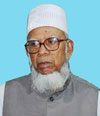
 Maulana AKM Yusuf
 Senior nayeb-e-ameer of Jamaat-e-Islami Maulana AKM Yusuf, who had been facing the trial of crimes against humanity during country's war of independence, died on Sunday of a cardiac arrest, half way through the trial at the argument phase, reports UNB.
Founder of notorious Razakar outfit in 1971, detained Yusuf, 88, was brought to Bangabandhu Sheikh Mujib Medical University Hospital after he fell ill in the morning at Kashimpur jail, Gazipur.
Yusuf, also a member of infamous Malik cabinet in occupied Bangladesh backed by Pakistan junta, died soon after he was admitted to the hospital, said Tarikul Islam, a counsel for the deceased.
Yusuf is the lone war crimes accused who died during the trial by International Crimes Tribunal (ICT) since its inception on March 25, 2010.
Deceased war crimes accused Jamaat leader AKM Yusuf's body has been autopsied at the Dhaka Medical College morgue.
"He suffered brain haemorrhage, which is common in case of strokes," Assistant Professor of Forensic Department AKM Shafiuzzaman said on Sunday evening after the autopsy.
There was no evidence of external or internal injuries in the body, he added. Samples had been collected for viscera examination.
After the autopsy, Assistant Jailer Abid Ali of Kashimpur Central Jail, where Yusuf was imprisoned, handed over the body to his relatives.
Yusuf's son Mahbub Rahman told reporters the body would be taken to their Dhanmondi home and further decisions would be made there.
On February 12, the ICT-2 was supposed to hear from the prosecution the summing up arguments of the case with the accused Yusuf in the dock.
Yusuf was arrested from his Dhanmondi residence on May 12 last year hours after the tribunal, responding to a prosecution plea, issued a warrant for his arrest on charges of war crimes.
On August 1 last year, the tribunal indicted Yusuf for his involvement in crimes against humanity during the 1971 war.
The tribunal considered 13 out of 15 charges of crimes against humanity during the liberation war as proposed by the prosecution on May 8 last year which fall under sections 3(2), 4 (1) and 4 (2) of the International Crimes (Tribunals) Act 1973.
Yusuf, also the second man in the hierarchy of Jamaat leadership, had been facing trial on charges of genocide, killing, loot, arson, deportation of people and religious conversion.
According to the prosecution, Yusuf had formed for the first time in Khulna in 1971 the vigilante group Razakar with the members of Jamaat-e-Islami that acted as an auxiliary force of the Pakistan occupation army to actively thwart the Bangladesh liberation forces.
Yusuf had also acted as the chairman of the Peace Committee (Collaborator) in Bagerhat, Satkhira and Khulna districts during the liberation war.
© 2026 - All Rights with The Financial Express

