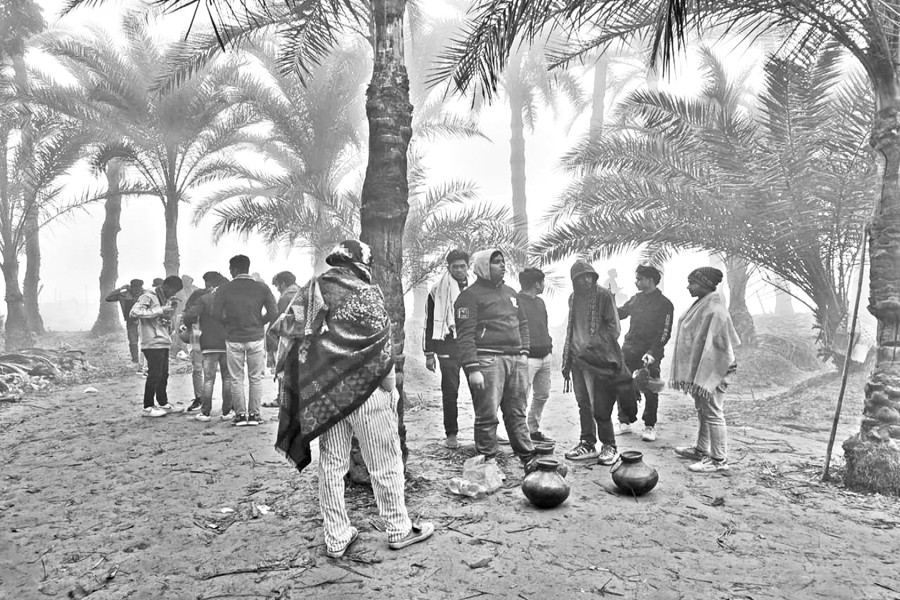
 The photo shows raw sap being sold inside a date palm orchard at Bhadiakhola in Balla union of Harirampur upazila of Manikganj district —FE Photo
 OUR CORRESPONDENT
MANIKGANJ, Jan 12: The Nipah virus risk in Manikganj, a district located near Dhaka,
is no longer just a concern but has now turned into a 'real threat', following outbreak of the disease in 35 out of Bangladesh's total 64 districts.
The surge in spread of the deadly virus has been recorded with comparatively higher infection and death rates in Faridpur, Rajbari, Naogaon, and Lalmonirhat, according to the Institute of Epidemiology, Disease Control, and Research (IEDCR).
The growing trend in outbreak of the disease has mainly been attributed to widespread consumption of raw date palm sap.
In 2024, the country's first Nipah virus-related death was reported from Manikganj. Babul Hossain, a resident of Ghosta village under Putail union in Sadar Upazila, died reportedly after consuming raw date palm sap.
According to his family, in early January 2024, Babul and three others, including his shop employee Tamim, drank one litre of raw date palm sap together. About two weeks later, Babul developed symptoms such as a cold, cough, and fever. He was admitted to Manikganj Sadar Hospital on January 16. As his condition worsened, he was shifted to the ICU of a private hospital in Dhaka early on January 18. His samples were later sent to IEDCR, and on January 24, the report confirmed Nipah virus infection. Babul Hossain died on the night of January 28.
After this incident, consumption of raw date palm sap was expected to decline in Manikganj. However, the reality tells a different story. In some areas, drinking raw sap has almost turned into a seasonal festival.
According to the Harirampur Upazila Agriculture Office, there are around 12,000 date palm trees across different villages in the upazila. This season, sap is being collected from nearly 7,500 trees, which is then sold both as raw sap and molasses.
During a visit to the Bhadiakhola area under Balla union in Harirampur upazila, this correspondent found raw sap being sold inside a date palm orchard. Although earthen pots were hung from the trees, no
nets, covers, or bamboo guards were used anywhere. As a result, bats were seen freely licking sap from the pots during the night and early morning. Despite repeated warnings about Nipah virus risks, there is little sign of caution in practice.
Meanwhile, after videos and posts spread on social media, hundreds of people gather there every day. Visitors are coming from Dhaka, Narayanganj, Savar, Dohar, and Nawabganj to drink raw sap. Taking advantage of the crowd, sellers are charging between Tk 250 and Tk 300 per litre.
No one seems concerned about where the sap comes from, how it is collected, or whether it has been contaminated by bats.
Several sap sellers admitted that most trees are not protected with nets or covers. One seller said, "Using nets is troublesome and time-consuming. So many people come every day that we struggle just to supply enough sap."
Public health experts, however, have repeatedly warned that bats are the primary carriers of the Nipah virus. The virus spreads through bat saliva or bodily secretions, which can easily contaminate raw date palm sap.
Manikganj Civil Surgeon AKM Mofakkharul Islam said, "If nets or bamboo coverings are not used while collecting date palm sap, the risk of Nipah virus infection increases many times. We have strictly advised people not to drink raw date palm sap. So far, no Nipah patient has been identified in the district this year. Completely avoiding raw sap is the safest option."
asadlimon@gmail.com
© 2026 - All Rights with The Financial Express