Forecasting or projecting the world economic conditions for the near future is a regular exercise of a number of international bodies or organisations. The projections are primarily linked to a number of 'ifs' and 'buts', which minimises the scope for blaming organisations for wrong forecasts. The World Bank, International Monetary Fund (IMF), Organisation for Economic Co-operation and Development (OECD), and United Nations (UN) are four leading organisations that regularly forecast near- and long-term economic trends worldwide. Other organisations, such as the World Trade Organisation (WTO), forecast trends in global trade and use macroeconomic projections from the World Bank or the IMF. Organisations like the Asian Development Bank (ADB) focus on regional economic trends.
To predict the future of economic growth and inflation, the two most significant macroeconomic indicators, the organisations use various techniques and tools. Empirical data on economic indicators such as exports, imports, consumption, investments, interest rates, industrial output, consumer confidence, workers' productivity, retail sales, and unemployment rates are used to understand past trends. Geopolitical trends, such as wars and conflicts, and natural disasters, such as floods and droughts, are also taken into account by converting them into quantifiable variables. Models are applied to infer possible future scenarios using empirical data and other variables. Though economic forecasting is more than a century old, it gained momentum after the Great Depression in the 1930s.
The task of prediction, however, is tricky and complex, as economic environments are always changing. The conditions that shaped past events, such as technology, government policies, or global markets, may not be similar today or tomorrow. So, patterns of the previous years are unlikely to repeat exactly. In many economies, data quality is poor, leading to wide-ranging incorrect projections. The models used to predict the future also have limitations, as they are based on assumptions that may not be true. For instance, it is generally assumed that an economy goes through a business cycle, meaning that economic expansion is followed by a contraction, which then enters an expansionary phase later. Economic models, based on the alternating phases of expansions and contractions of the business cycles, predict that a recession will be followed by a recovery. Usually, forecasting models have tended to smooth out predictions. Forecasts may also be influenced by personal theories or biases. Human behaviour is another factor that may nullify the forecast. In many cases, people and markets often react to forecasts themselves, causing shifts that models cannot predict. Economists who generally forecast using various high-tech models mostly failed to predict most recessions over the last five decades. The most vivid example is the subprime mortgage crisis in the United States (US) that led to the global financial crisis in 2007 and the Great Recession in 2009.
Nevertheless, international organisations are making predictions and projections with the above-mentioned limitations, as these projections are critical for policymakers, investors, and consumers. Having an idea of where the economy might be headed helps them make better decisions about what to do today.
Last week, the United Nations Department of Economic and Social Affairs (UNDESA) released the World Economic Situation and Prospects 2026. It says the world economy is expected to grow by 2.7 per cent in 2026, slightly below the 2.8 per cent estimated for 2025 and well below the pre-pandemic average of 3.2 per cent. The report finds that last year, unexpected resilience to sharp increases in US tariffs, supported by solid consumer spending and easing inflation, helped sustain growth. According to the report, headline inflation declined from 4.0 per cent in 2024 to an estimated 3.4 per cent in 2025, and is projected to slow further to 3.1 per cent in 2026.
UNDESA identifies five key factors clouding the global economic outlook: increased macroeconomic uncertainties, shifting trade policies mainly due to the sharp rise in US tariffs by President Donald Trump, persistent fiscal challenges, geopolitical tensions, and financial risks. The abduction of Venezuelan President Nicolas Maduro and his wife Cilia Flores by the US army in the first week of the New Year has sharply increased global geopolitical tension. Trump is now threatening Iran with a hard strike, and he may order US troops to attack Iran at any time. These unseen and unpredictable factors are not directly included in projections for the global economy in 2026. It was also not possible to do so.
UN expects 'broadly stable growth prospects for major economies' but 'uneven growth momentum across developing regions'. For South Asia, the economic outlook remains robust, driven by strong private consumption and public investment. The regional gross domestic product (GDP) is expected to expand by 5.6 per cent in 2026 and 5.9 per cent in 2027, following an estimated 5.9 per cent growth in 2025.
In India, growth is estimated at 7.4 per cent for 2025 and forecast at 6.6 per cent for 2026 and 6.7 per cent for 2027, backed by resilient consumption and robust public investment. The UN expects these two factors to largely offset the adverse impact of higher US tariffs. The latest US move to impose 500 per cent punitive tariffs on India for purchasing Russian oil is not included in the projection. If imposed, a 500 per cent tariff would amount to a trade embargo, making Indian goods commercially unviable in the US market. An estimate shows that exports of $120 billion may take a severe hit, with labour-intensive sectors like textiles and gems and jewellery facing closures and job losses. These sectors have already been under 50 per cent tariffs since August last year.
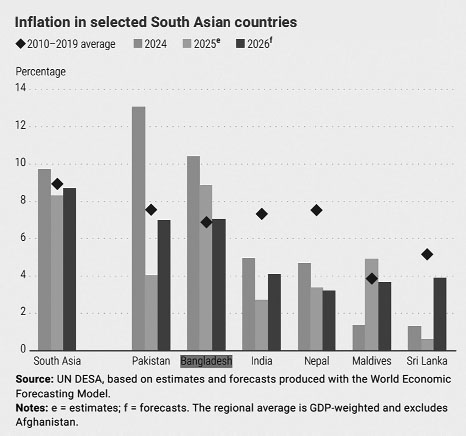
Average consumer price inflation is predicted to rise from an estimated 8.3 per cent in 2025 to 8.7 per cent in 2026. Last year, inflation across the region declined in 2025, with rates in most economies at or below central bank targets and long-term averages. Bangladesh, however, faced an inflation rate above the central bank's target, averaging 8.90 per cent. The report also projects that the rate may come down to 7.10 per cent in the current year. According to UNDESA, Bangladesh is likely to continue recovering, with economic growth projected at 5.1 per cent in FY26. How much these projections will be realised remains to be seen.
asjadulk@gmail.com
© 2026 - All Rights with The Financial Express