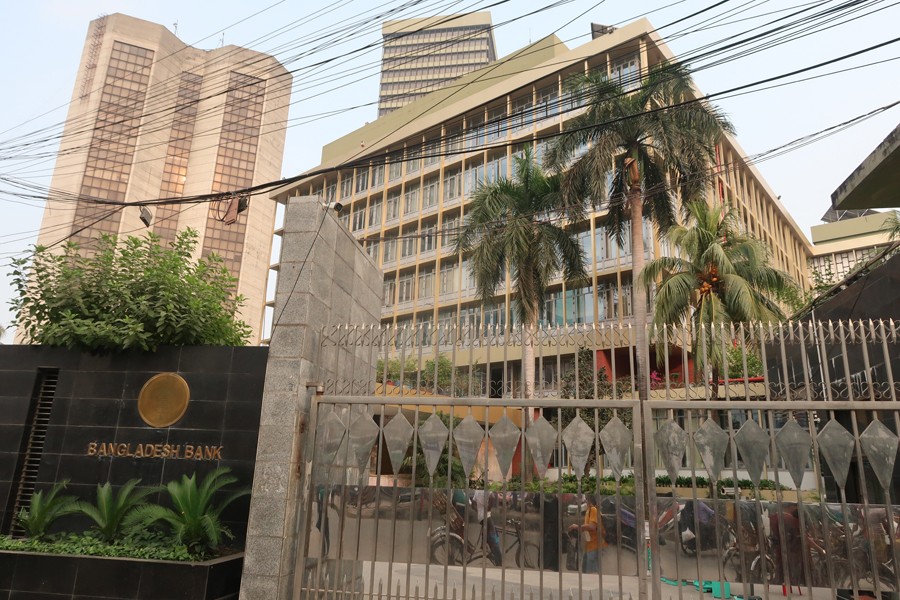
The appointment of a businessman as the governor of the country's central bank has come as a complete surprise to many. Surprise, because never before a businessman was chosen as head of the Bangladesh Bank. The departure, which many consider under humiliating circumstances, of Dr Ahsan H Mansur, the immediate past governor, on Wednesday last has also shocked most sensible people.
Coming from the business world with an advanced degree in accounting, Md Mostaqur Rahman is set to lead the country's monetary policy and supervise the banking sector for the next four years. By appointing him, the newly elected government has broken the tradition of choosing an economist, bureaucrat, or banker as central bank governor. There is, however, no rule that prevents a businessman from being appointed as the head of Bangladesh Bank. Still, in the world of central banking, such examples are rare.
In the neighbouring country, the Reserve Bank of India (RBI) has had 26 governors in its 91 years. Except for K R Puri, the 12th governor, none had direct experience in the corporate or business world. Puri served as chairman and managing director of the Life Insurance Corporation of India before his appointment. The company is India's leading public sector life insurance entity. In its 78-year history, the State Bank of Pakistan (SBP) has never been headed by a businessman. The Central Bank of Sri Lanka, which began in 1950, has had 17 governors, none of whom was a businessman.
The appointment of Rahman as the new governor of the Bangladesh Bank has already drawn criticism from various quarters. Some fear conflict of interest in the case of new governor, who until his appointment ran a number of business entities.
The hasty cancellation of the sitting governor's appointment forced him to leave the office quickly. This looked odd and set a bad example. The people in the know of things had an apprehension that the new government might replace him with a new governor. But they never expected such unceremonious departure of Dr Mansur who was able to stabilise the country's forex market and a collapsing banking industry.
It is to be noted that Dr Salehuddin Ahmed, the 9th governor, was appointed by the BNP government in 2005. When the Awami League assumed power on January 6, 2009, he had about three months left in his term. The then government did not remove him before the end of his tenure on April 30, 2009. He also spent half of his tenure under the Army-backed caretaker government earlier.
But removing Ahsan Mansur amid protests by a section of central bank officials clearly sends a wrong signal. Those who accused Mansur of his tough administrative stance and labelled him as an 'autocrat' should now feel empowered. Some unruly officers also physically harassed the advisor to the immediate past governor and forced him to leave the central bank premises. Though some demands of the central bank officers are reasonable, it does not mean that they should be allowed to become violent. It is unfortunate that people witnessed a mob in the central bank within a week after the new home minister announced that 'mob culture is over' in the country. People will also wait to see whether the government takes any action against these trouble-makers.
One may also remember that it was on October 2003, some officers and employees of the Bangladesh Bank, led by CBA leaders, besieged the then governor, Dr Fakhruddin Ahmed, in his office for an hour to protest reform initiatives. He later left the office under police protection. The story did not end there. At least 10 CBA leaders faced termination for violating service rules and the official code of conduct by creating chaos. The governor's tough move was backed by the then-finance minister M Saifur Rahman, sending a strong message to all relevant quarters.
Ahsan Mansur was appointed central bank governor at a critical time for the country. After the ouster of the Hasina regime on August 5, 2024, following a student-led uprising, the Yunus-led interim government appointed him as central bank chief on August 14 for a four-year term. The IMF-trained macroeconomist faced many difficulties and barriers due to the fragile state of the banking sector. During his 18 months at the central bank, Mansur took corrective measures and reform initiatives to restore confidence in the financial sector. As cronies of the Hasina regime plundered money from the banking sector, several banks became sick. Mansur took the bold step of merging five commercial banks, the first such merger in Bangladesh's history, and extended liquidity support to gradually repay depositors. He also made the exchange rate more market-oriented and took steps to check the depletion of foreign exchange reserves. His move to fight capital flight was also bold. He facilitated reduction of the burden of unpaid US$3.2 billion in the power and energy sector.
Mansur removed the shady reporting on the banking sector's financial health, which the previous regime used to hide the true picture of bad loans. As a hard monetarist, he adopted a tight monetary stance to contain inflationary pressure despite criticism. He also dealt efficiently with the International Monetary Fund.
Mansur was not fully successful in his measures, as it is not possible to fix all deep-rooted problems in a short time. Some of his steps also drew valid criticism. As his chapter in the Bangladesh Bank closed unceremoniously, his failures and limitations will be highlighted, especially by those who did not receive undue benefits from him. However, it is necessary to examine his tenure objectively for the greater interest of the country. His allegation that the troubles that erupted on the eve of his departure were the handiwork of the owners who had brought the five Islamic banks to their knees by their desperate looting and other large bank loan defaulters might not be without substance. The headline and content of the story on the departure of Dr Mansur of a vernacular daily, owned by a business conglomerate, could be a pointer to that fact.
Mansur's hasty departure is also a message to the new governor, no matter how close he is to the finance minister or the government. He must work with those who created anarchy in the central bank. It remains to be seen how he will manage them and re-establish a smooth, professional working environment in the Bangladesh Bank. Rahman assumed office on Thursday. In his initial comments to the media delivered through the BB spokesman, the new governor said he would restore confidence in the banking sector and cut interest rates to enhance credit flow to the private sector. The rate cut, loan rescheduling and working capital loan are desired most by businessmen, and they will be happy to get it. The measures taken by the new governor will also be closely watched from the very beginning, as the government has gambled by appointing a businessman as the central bank's chief.
asjadulk@gmail.com
© 2026 - All Rights with The Financial Express