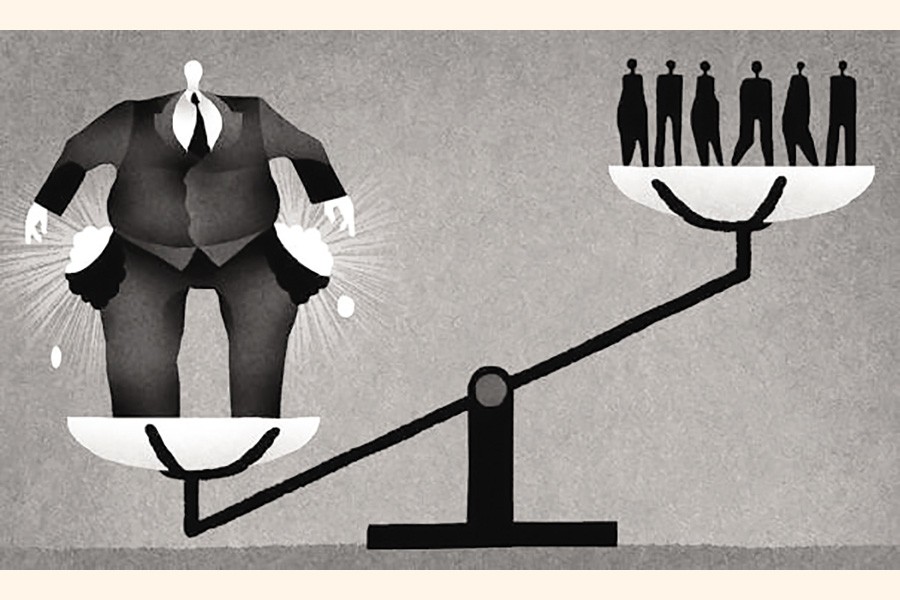
A recent report titledm 'World inequality report 2026', published by the Paris-based World Inequality Lab, has once again laid bare the ever-widening chasm between the rich and the poor. According to the report, the richest 10 per cent of people in Bangladesh hold 58 per cent of the country's total wealth, while the bottoms 50 per cent own a mere 4.7 per cent. Wealth is even more heavily concentrated at the very top, with the richest one per cent alone controlling around 24 per cent of all assets, a clear evidence of an extremely unequal distribution of wealth.
This disparity is not, however, a problem peculiar to Bangladesh. Globally, the report found that the wealthiest 10 per cent of the world population own nearly three-quarters of all wealth, while the poorest half hold barely 2 per cent. Perhaps most striking is that fewer than 60,000 multi-millionaires now control three times more wealth than half of humanity combined. In most countries, the bottom 50 per cent possess no more than 5 per cent of national wealth, which underscores the global scale of the inequality crisis.
Uneven distribution of resources has impelled America's impoverished masses who call themselves '99 per cent' to launch the historic 'Occupy Wall Street' movement. As for Bangladesh, the Liberation War of 1971 was fought against discrimination, exploitation and systematic injustice. More recently, the historic student-mass uprising of 2024 that toppled the Sheikh Hasina government was also rooted in inequality. Although the movement was initially launched to demand the abolition of a discriminatory quota system in government jobs, it ultimately culminated into a massive public outburst against wider grievances stemming from destructive and corrupt politics and governance that had entrenched deep economic inequalities. And yet, the chasm between the rich and the poor continues to widen, and the sense of deprivation among the jobless and the poor persists.
One effective way to address the concentration of wealth in the hands of the rich is to reform the taxation system based on the simple and widely accepted principle that those who earn more should pay more in taxes. In Bangladesh, however, taxation is neither properly nor fairly enforced. As revenue collection from direct taxes, such as income tax, continues to fall short of targets, the government increasingly relies on indirect taxes like VAT and supplementary duties. In Bangladesh, indirect taxes accounted for about 66 per cent of total tax revenue.
Revenue collection through indirect taxes is regarded as regressive because it is applied uniformly to goods and services, regardless of consumers' income levels. Since lower-income individuals spend a larger share of their income on essential items such as food and utilities, VAT increments disproportionately affect them. As a result, poorer households end up paying a higher percentage of their income in taxes than wealthier groups, reinforcing the regressive nature of VAT-led taxation.
Moreover, wealthy individuals and corporations often employ shrewd mechanism to avoid paying their full share of taxes, or to escape taxation altogether. To make up for these losses, governments frequently increase indirect taxes or place a heavier burden on working people and those with modest incomes, who already struggle to make ends meet. As a result, the financial responsibility of the rich is effectively transferred to the shoulders of the lower and middle classes. This imbalance is unjust and must be corrected.
A fair tax system should be guided by the principle that higher income and greater wealth entail higher responsibility. The idea that "the more you earn, the more tax you pay" must be firmly embedded in policy and practice. Taxes should apply not only to personal income but also to capital gains, inherited wealth, and large accumulations of assets. While this approach may appear straightforward, its proper implementation can have a transformative impact on reducing inequality. Evidence supports this claim. A study by Oxfam has shown that an annual tax of up to five per cent on the world's multimillionaires could raise around $1.7 trillion - an amount sufficient to lift nearly two billion people out of poverty and to end global hunger and malnutrition. Such figures underscore the potential of progressive taxation when applied seriously and consistently.
The idea of equitable taxation is not new. As far back as ancient times, Kautilya's Arthashastra advocated a balanced and just tax system in which the wealthy paid more than those with smaller means. He also argued for special considerations and tax relief for the sick, students and working people, recognising that taxation should not increase hardship but support social stability and welfare. These principles remain remarkably relevant in today's world.
To address rising inequality, a 'Taskforce on Economic Strategy Redesign' formed by the interim government has also recommended prioritising the introduction of a progressive tax system to ensure that the rich contribute a higher share of taxes. It has also proposed levying a wealth tax on both personal and inherited assets to prevent the excessive concentration of wealth in the hands of a few. In addition, the taskforce emphasised the need to strengthen the NBR's capacity to collect taxes from high-income individuals and to curb widespread tax evasion.
It is high time to revisit and revamp the taxation system. Redistributing wealth through progressive taxation is a proven and effective tool for reducing inequality and promoting inclusive growth. To achieve this, governments must undertake serious reforms, plug long-standing loopholes in the taxation system and abolish tax privileges that benefit only the wealthiest. Doing so can curb excessive concentration of wealth, restore a sense of fairness and lay the foundation for a more equal society where poverty and hunger are no longer accepted as inevitable realities.
aktuhin.fexpress@gmail.com
© 2026 - All Rights with The Financial Express