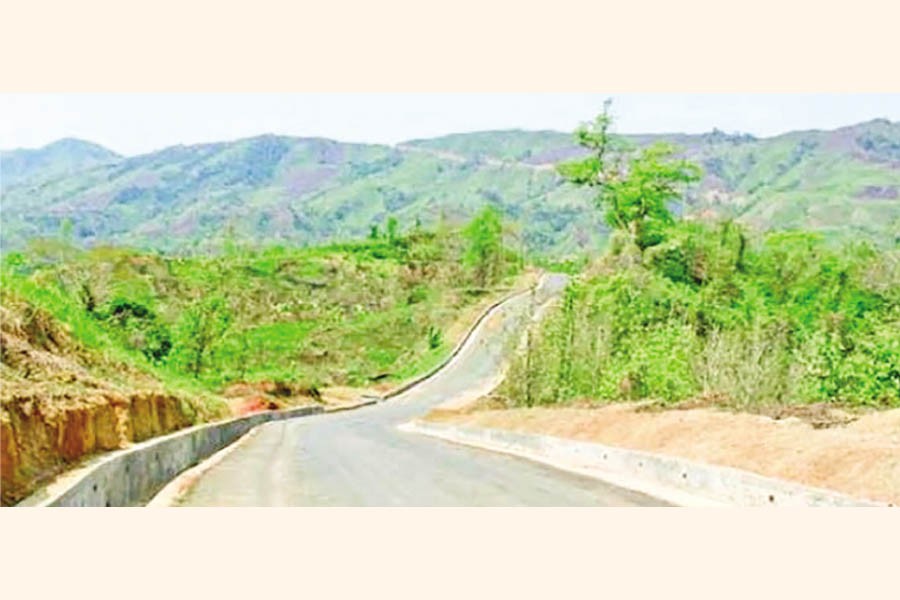
A New Road to the Future
A quiet revolution is taking place in the wavy green hills of Bangladesh in one of the most distant frontiers of Bangladesh. The Border Road Project in Chittagong Hill Tracts (CHT) which is spearheaded and implemented by Bangladesh Army is not just a road passing through the wild territory. It is a strategic, social and developmental life line which is supposed to connect the geographically and historically closed Pahari communities.
The CHT occupies over 13,000 square kilometre area of Rangamati, Khagrachari and Bandarban. Though breathtakingly beautiful, it is very difficult to navigate due to its steep hills, dense forests and scattered valleys. The lack of good connectivity results in poor development and insecurity in the region.
Landslides caused by monsoons are frequent in this hilly region. The villages are frequently isolated by the landslides taking weeks to clear. The farmers struggle to sell their commodities. The children are forced to walk miles over the slip roads to school and those who are patients during an emergency are ferried on makeshift bamboo carts to the nearest clinic. Therefore, absence of the road has emerged to be one of the root causes of underdevelopment of CHT.
Now, that is changing.
The Vision of the Border Road
An insightful strategy was adopted in the year 2018 in order to develop the communication network of the CHT. This was to be done by constructing a 1,036-kilometre road which would have the advantage of traversing through elusive ridges and valley borders. The first phase of the project (317 kilometres), was scheduled to be constructed by the 34 Engineer Construction Brigade of Bangladesh Army in June, 2025.
Enhancing border security, lowering opportunities for illegal cross-border activities alongside integrating the local communities into the road network were the main goals. Achieving such would eventually upgrade the local economy as well. Therefore, what started as an infrastructural project later became a strong bridge of internal security as a peace-building project alongside development in CHT.
A Land of Opportunities and Difficulties
Pahari communities found in the CHT include the Marma, Chakma, Bawm, Kumi, Khiyang, Tripura, Chak, Lusai, Tanchangya, Mro and Pangkho. The region can be said to be extremely diverse as every ethnic group possesses their own set of culture, language and traditions.
The population density of this region comprises 87-185 people living per square kilometre, which makes it very remote compared to the rest of the country. Although the inhabitants rely on small-scale agriculture and forestry for their livelihoods, the inaccessibility of a good road provided significant inhibition to trade as well as education and healthcare facilities.
Furthermore, the region's uneven, inaccessible topography rather acts as a sanctuary of sorts for various criminal networks and treasonous groups spread out across the borders of India and Myanmar. Such issues provided an obvious blockage to ensuring law and order, which further led to security issues. Alongside this, isolation and poverty issues made it clear that the border road was of dire necessity.
Challenges on security front in the hills
The thick forests with porous boundaries of the area made it a natural haven to armed groups and cross-border traffickers. Organizations like Kuki-Chin National Front (KNF), United People Democratic Front (UPDF), Jana Sanghati Samiti (JSS), Arakan Army (AA) and Tripura Mukti Bahini (TMF) are infamous for having been involved in criminal activities like violence, smuggling and extortion. The recent incident, in May 2023, where two army soldiers were killed in a brutal KNF ambush in Bandarban speaks volumes about the dire situation in these areas. Internal disputes between opposing groups further highlight the fragility of peace in the hills.
Lack of roads has always been frustrating in view of security operations. The time that the patrolling units take in walking long distances to the remote inaccessible villages acts as a great disadvantage in timely reinforcements. In most cases, it is very vital for preventing the loss of life. Therefore, the necessity to construct year-round and durable roads on the border was a strategic requirement and development necessity.
The inaccessibility of roads moreover hinder security operations to a great extent. It takes patrolling units an additional amount of time to travel long distances by walking in order to reach the remote villages. This is a clear disadvantage in not only timely reinforcements but also in preventing possible loss of lives. Therefore, it was highly mandatory to construct durable roads on the border through proper strategic requirements.
The Bangladesh Army: Reflection of Security and Development
Bangladesh Army is the manifestation of devotion towards its motherland which drives it to succeed in any challenging mission that is required. The Army has proven its ability to work in situations of hostility and extreme complicacies during important missions of peacekeeping, disaster response as well as establishment of infrastructure since independence.
The 34 Engineer Construction Brigade of the Army has led the Border Road Project in the CHT. The brigade has expertise and so is able to work in areas where civilian contractors are unwilling to work due to factors like adverse weather conditions, isolation and insecurity of work place and more. The 317 km road is the outcome of their hard work, efficiency in engineering and moreover complete dedication to the motherland.
Nevertheless, the Army plays a lot of other important roles in CHT besides road construction. The posted troops in the hills provide security escort to the engineers and medical assistance to the inhabitants. The Army also plays a role in providing job opportunities to the local community. Today, the people of the hill are employed and working alongside the Army's engineers. Fair salaries are paid and technical training skills are provided also. Such inclusion has slowly reinforced collaboration as well as a sense of trust between the inhabitants and the Army. Given that the people of the hill were initially distrustful of state authority, the projects carried out in the CHT areas have made a positive and lasting impact on their attitudes and mindsets.
Beyond Roads: A Pathway to Inclusion
The impact of the Border Road Project is already visible across the hills.
Enhanced Security
The new roads have ensured that army patrols and border guards can now move faster. This has further enhanced surveillance along remote stretches of the Bangladesh-India and Bangladesh-Myanmar borders. The upgraded mobility heavily influences the subsequent reduction of narcotics trafficking networks as well as illegal arms routes, thus bringing down the impact of subversive groups in general. These roads have allowed the physical presence of security forces in places that were once deemed as unreachable.
Economic Transformation
Farmers are now able to transport their produce to district markets via the new roads easily instead of relying on perilous trails. Local trade centres are now being established along the road, giving rise to micro-enterprise and tourism. Income levels of Pahari families have also substantially increased, given the improved access to job centres.
Healthcare Access and Education
Children are now able to access schools all throughout the year. Emergency patients are no longer being hindered in the roads during monsoon months. Small bridges, culverts and retaining walls are also being constructed by the Army so that important routes stay accessible even during bad weather conditions. These improvements, though simple, are proving to be life changing to communities who have been denied their rights to basic transportation.
Social Cohesion
Connections create contact. The enmity between ethnic groups are starting to die down as the villages start to interact more inclusively. Community engagement programmes are being made by the Bangladesh Army which include construction of schools, organising health camps, relief efforts, cultural interchange, etc. These efforts are reinforcing unity and a feeling of belonging to one national identity.
The Environmental and Cultural Dimension
Constructing roads in the CHT requires a strategic balance between development and sustainability. The Bangladesh Army has designed roads to follow natural curves, minimizing deforestation and soil erosion. Drainage systems manage heavy rainfall, while the extensive tree plantation programmes restore verdure along cleared areas.
Cultural sensitivity is also a big focus. The Army liaises with the local leaders and traditional institutions before construction to make sure that the road alignments avoid sacred sites and burial grounds, etc. This involvement strategy does not only heap avoid social friction but also provides local ownership and participation in sustaining the infrastructure even after completion.
The Big Picture: From Frontier to Opportunity
The Border Road Project reflects the dedication of Bangladesh to developing its citizens even in most remote areas. Furthermore, the project makes CHT a likely candidate of regional connections for prospective trade exchange with the neighbouring countries in the long-term.
With the completion of the first phase, the second phase is gaining momentum. Soon the border road will help open up eco-tourism, cross-border trade, and sustainability projects like renewable energy production.
It shows how peace and development can coexist as well as be supportive of one another in post-conflict or marginalised areas. The success of this initiative by the teamwork between the civil administration and the military has provided a reassurance in future nation-building initiatives.
A Symbol of Hope and Unity
The best thing about the Border Road Project is perhaps not the kilometres of asphalt that are being laid, but also the bridges of trust that the project is establishing between the state and the people. The scene of army engineers standing beside and joining hands with the Pahari has become a new symbol of partnership in the CHT region.
To the Bangladesh Army, this project is a representation of its mission that prioritises not only the protection of territory but also human security and overall national harmony. To the people of the CHT it is a sign of hope that the days of being isolated and neglected are coming to an end.
On the journey toward becoming a middle-income country, the lessons from the Border Road Project resonate far beyond the hills. These lessons remind the country that real development is not only about infrastructural development but it is also about inclusion, security and dignity to all citizens.
The Road That Unites
The Border Road Project in the Chattogram Hill Tracts is all at once an exemplary example of Bangladesh Army's engineering skills, security as well as compassion. Under its committed leadership, an ambitious blueprint has been brought into a living reality which has spread out, interconnecting every aspect of life in the hills.
The Border Road has brought forth new avenues of trade, security as well as education, further integrating the CHT deeper into the national landscape. Sovereignty is getting enhanced, threats are getting suppressed and communities are being empowered. Moreover, it is reinvigorating the time-honoured ideology of Bangladesh that believes in development and security going hand in hand.
Ultimately, the Border Road Project is a direct reflection of Bangladesh Army's steadfast devotion to prosper as a unified country- promoting peace, security and development all across the country. Such is anchored in its enduring motto- In War, In Peace, We Are Everywhere For Our Country.
Colonel Mohammad Emran Islam Bhuiyan is Colonel Staff, Welfare and Rehabilitation Directorate,
Army Headquarters.
emran480@gmail.com
© 2026 - All Rights with The Financial Express