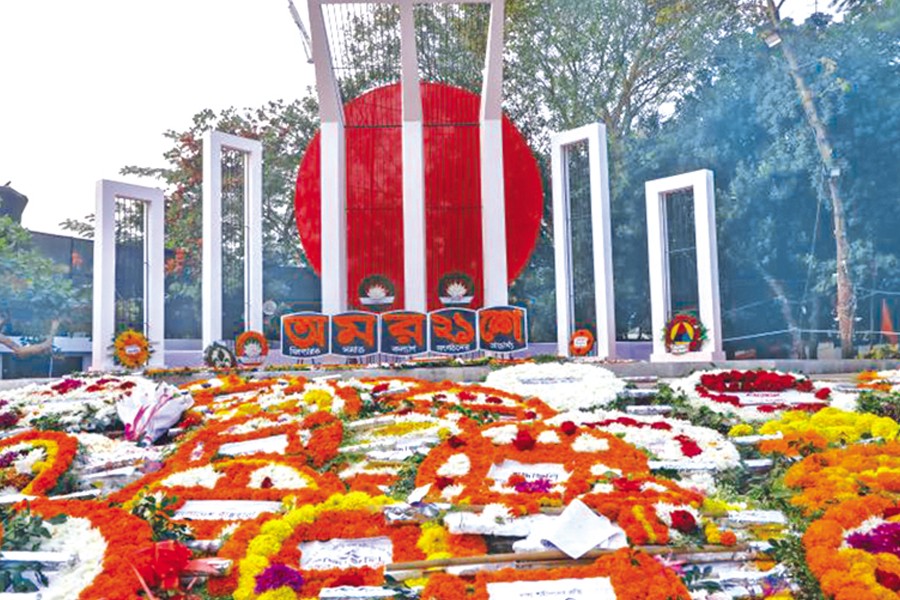
February 21 is the self-awakening day to the Bengali nation. Through the Language Movement, Bengalis realized that state identity is not built on religion. It is built by language and culture. This realization led to the rise of Bengali nationalism which later played a decisive role in the birth of independent Bangladesh.
Anthropologically, Bengalis are an ancient people. But the 'Bengali' identity as a modern nation emerged through the cultural renaissance of the 19th and 20th centuries. During this period, the Bangla language and literature gained new strength.
Writers such as Michael Madhusudan Dutt, Bankim Chandra Chattopadhyay, Rabindranath Tagore and Kazi Nazrul Islam shaped modern Bangla literature and laid the foundation of Bengali self-identity. In the visual arts, Abanindranath Tagore, Nandalal Bose, Jamini Roy, Zainul Abedin and Kamrul Hasan created a distinct Bengali aesthetic sense.
Thus, the cultural foundation of Bengali nationalism was built long before it took a political form.
It is important to note that transforming Bangla from a cultural force into a political philosophy took place in three key stages.
In the first stage, Rabindranath Tagore and Kazi Nazrul Islam shaped the cultural strength of the language. Through their literature and music, Bangla became a language of humanity, dignity, and inclusiveness.
In the second stage, thinkers brought language into the political arena. Muhammad Shahidullah argued that the language of the people must be the language of the state. Abul Mansur Ahmad helped build public support for a language-based national identity.
In the third stage, language took on a clear political role. Huseyn Shaheed Suhrawardy framed Bangla as a democratic right. Sheikh Mujibur Rahman transformed the spirit of the Language Movement into a political philosophy, where language became the foundation of nationhood. Bangla was no longer just a cultural medium; it became a tool for state formation.
The foundation of Bangladesh's state identity rests on three pillars: language, culture, and secularism. Ekushey represents their convergence. Before the Language Movement, Bengalis had a cultural identity but lacked political clarity. Ekushey changed that. Language emerged as a symbol of dignity, a means of unity, and a basis for political consciousness.
After the movement, Bengalis re-embraced their New Year, literature, music, and cultural practices. Attempts to ban Tagore's works only pushed Bengalis closer to their roots. Language thus became the seed of the Liberation War.
Today's Bangladesh faces social and political divisions. Ideological conflict, partisan polarization, and social mistrust have widened the distance between people. Here, the spirit of Ekushey remains deeply relevant. Language and culture rise above religion, party, and class. Where politics divides, culture connects.
Baul songs teach humanism, Tagore's music inspires empathy and Nazrul's songs speak of justice and equality. This cultural heritage reminds us: we are human first, before we are followers of any ideology. Ekushey teaches us a simple truth which is 'language is not a tool of division, but a bridge of connection'.
A section of Bangladesh's youths today are losing civility in the language of protest. In the streets, insults are growing louder than arguments. Humiliation is becoming more visible than resistance. The goal seems less about defeating opponents and more about degrading them. This is not just a failure of the young; it reflects our wider political culture.
Harsh words may grab attention quickly, but they weaken the moral foundation of any movement. Poor language weakens expression and is unworthy of an educated society. Yet political platforms have normalized such speech in public discourse. A segment of society has further amplified it through viral sharing. The culture of 'Virality' is turning protest into spectacle, encouraging abusive language for drama and excitement. At the end, it has backfired. Our sensitive, emotional and affectionate Bangla language has not embraced this trend. It has rejected it with deep discomfort. We see this reflection in public responses to contemporary youth leaders and even local and foreign YouTubers.
A portion of Gen Z now view verbal aggression as a powerful weapon. Social media is accelerating this trend. The race to go viral is fuelling provocation. Here lies the danger. When language loses humanity, movements lose morality. Opponents become enemies. Dialogue collapses. The public is now asking a very common question: do we want uncivil protest led by Gen Z?
The true spirit of Ekushey stands for civility, humanity, tolerance and cultural consciousness. A nation that does not respect its language cannot respect its people. Ekushey taught us that language is not merely a tool of communication. It is the soul of a nation. At a time of growing division, we must return to the beauty of language, the generosity of culture and the humanity of Ekushey. History reminds us: language gave us freedom and language can restore our unity.
Professor Dr. Md. Nasiruddin Mitul is Former Dean of National University, Bangladesh.
mitulnasiruddin@gmail.com
© 2026 - All Rights with The Financial Express