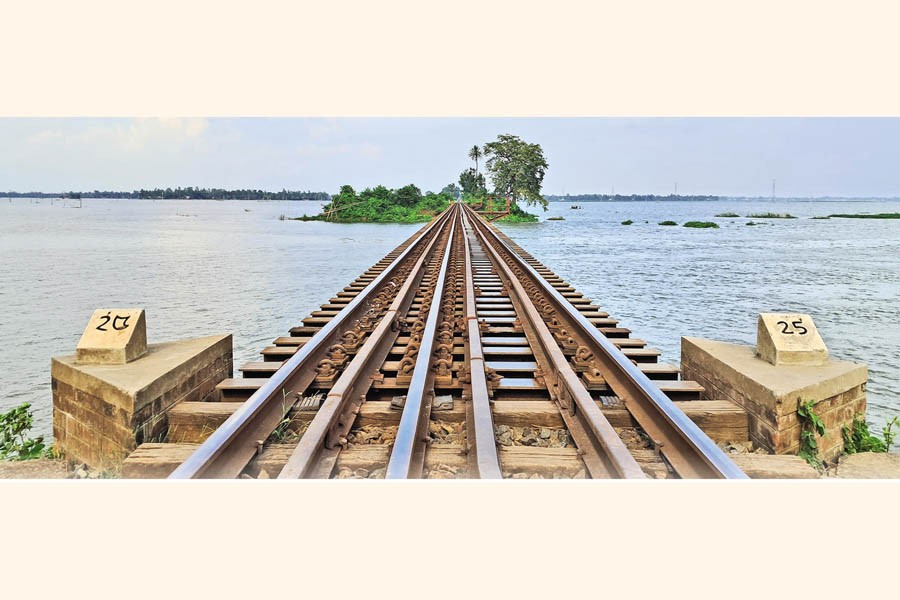
 Rail tracks cut through the Chalan Beel, the country’s largest beel stretching across Pabna, Sirajganj, and Natore districts – FE Photo
 I phone Pobitro Adhikary when the Dhumketu Express lurches forward at 6am, telling him we have departed from the Kamalapur railway station on time. He is my childhood friend, and we have planned a train-themed exploration of the Chalan Beel. Our destination is the Dilpasar station in Pabna, but as no intercity train stops there, we will disembark at Baral Bridge in the same district and take a boat from there.
Pobitro boards from the Dhaka Airport station. Meeting him on a train feels like a reunion on the move. It has been more than a decade since our last train journey to Chattogram to attend the wedding of one of his friends.
Our train curves westwards towards the Joydebpur-Ibrahimabad section after the Joydebpur Junction halt. We chat at the door, catching glimpses of rural life, waterlogged fields, and deep green aquatic plants. For the first time, Pobitro experiences the rumble of the train on the Jamuna Railway Bridge.
We get off at Baral Bridge, an elevated station in Pabna's Bhangura upazila. The weathered red bridge, with its quintessentially colonial architecture, stands on the Baral River, where large merchant boats once plied. After having chapatis and eggs in a small eatery, we hop on a motorised rickshaw van, heading to the Char Bhangura ghat.
The van runs down the Sharat Nagar Bazar Road lined with shops, occasional houses, and a few banks. Char Bhangura is an unremarkable ghat on the Gumani River, with several brightly-painted, engine-powered boats lying anchored. We get on a boat, and soon the boatman sets sail.
Past a road bridge, the scale of the Chalan Beel becomes obvious. According to textbook knowledge, it is a massive wetland stretching across Pabna, Natore, and Sirajganj districts. Interconnected by a network of rivers and beels of varying sizes, it turns into a continuous body of water in the monsoon.
And that is what I see - a watery world where the rivers and beels that make it up have lost their boundaries. Under a bright blue sky dotted with white, fluffy clouds, shimmering water flows with gentle ripples. The further away we go from the ghat, the more I wonder what truly distinguishes a beel from a river.
Except for the distant electric transmission towers and hazy tree lines on the horizon, it looks like a wide river or a flood-hit zone with murky water. A long, tree-covered shoreline appears far away after a while, with tall coconut trees standing out. A lift net near it almost touches the water.
With his left hand on the tiller and eyes on the horizon, boatman Saidul navigates the waterway as if he were travelling to his village home. He has a calm posture, checking his phone every so often. Pobitro sits cross-legged on the bamboo canopy, gazing at the country's largest beel through his sunglasses.
In addition to big boats, a few small ones rowed with oars glide by, one of them carrying two women and some goods. Small and big clumps of water hyacinths drift around. A small patch of land comes into view, with several buildings clustered on the edge.
The first building with a tin roof and a row of windows resembles a school. As our boat gets closer for anchoring, a raft of ducks swimming in the water scramble up the bank. Apart from the three of us, the ducks and a flock of sheep appear to be the only living things on this land.
Small and big haystacks are scattered around us. There are four buildings here - two of them belong to Dilpasar Union High School, one houses the Dilpasar Union Health and Family Welfare Centre, and the other is the Dilpasar union parishad. The unpainted health centre, with its weathered red bricks, wears a dilapidated look.
But the adjacent union parishad looks lively, its front painted in bright blue. Next to it is the main school building, a single-storey structure with blue arches separated by red columns. In the front yard stand a red-green shaheed minar (monument commemorating the 1952 language movement martyrs) and several slender trees.
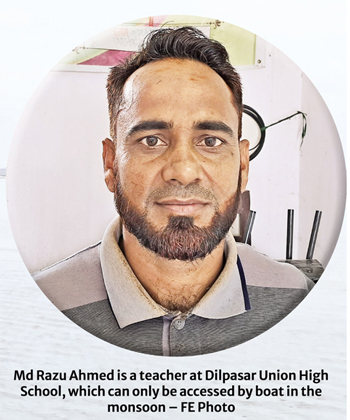 "The school has 16 members of staff, including teachers. Around 250 students, most of them from agriculture-dependent families, study here. It became a high school in 2000," says Md Razu Ahmed, an assistant teacher of agriculture and an alumnus of the institution.
Boats are the only way to come to the school when the beel is filled with water, he explains. At other times, students can take a rickshaw van, but have to get off at least half a kilometre away and then walk. On the other hand, most of the teachers commute from Bhangura.
We leave the school, tell the boatman we want to take a dip, and he stops the engine in the middle of the beel. Pobitro and I ease down into the water, managing to keep only our heads dry. The water is cool and refreshing, giving a nice relief from the 31-degree Celsius heat and 77 per cent humidity.
The Dilpasar station is close by, and when our boat moors there, I feel that Bangladesh Railway should start rail tourism campaigns from here. For eight months of the year, it is a small, mundane station with a basic platform and a one-storey building, while there is cropland all around. But come between July and October, and you will see how it turns into a scenic viewpoint.
Today, it offers a stunning panorama of the Chalan Beel in the sunny autumn weather. The tracks stretch out in both directions like a long metal corridor, which promises the thrill of walking to the very edge where the sky meets the water. Of all the stations I have visited around Bangladesh so far, the watery beauty of Dilpasar feels unique.
This seasonal transformation of the station has already drawn many visitors, including families with little children, for a day out. They stroll on the platform and the tracks, eat snacks, and savour the picturesque surroundings. The children relish it the most, running around as far as possible before their parents grab them.
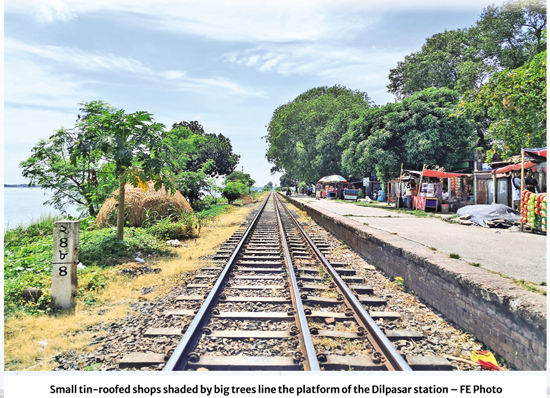 Small tin-roofed shops shaded by big trees line the platform, selling packaged snacks, beverages, and other refreshments. I spot mahogany, mango, jackfruit, papaya, and moringa trees. A few makeshift stalls set up under colourful patio umbrellas and tarpaulins offer made-to-order items, including sugarcane juice, spicy puffed rice, and guava cubes mixed with spices.
"I have spent a lot of time at the station since I was eight. My father ran a thriving eatery here," reminisces Md Biplob Ali, who has a homeopathy shop at the station.
Back then, everyone would travel by train as there was no bus road in Dilpasar. It was not just a busy station but also a vibrant fish market in the morning, with the odour permeating the platform. Merchants from Bogura, Sirajganj, and even Dhaka would come to buy fish, and Biplob's father hired two assistants to handle peak-hour operations.
But now Biplob sees a "dead station" that only attracts some visitors in the monsoon. Dilpasar still has no bus road, forcing residents to hire motorcycles to get around when the water recedes. But as bike fares are high, they often walk to Mohonpur and even as far as Ullapara in Sirajganj.
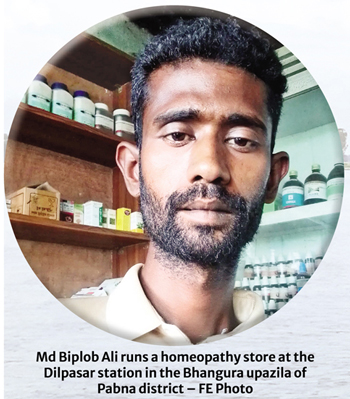 Biplob believes a road connection could make Dilpasar a year-round tourist destination, drawing visitors to walk through the vibrant yellow mustard fields that stretch for miles in the dry season. The shop owners at the station do farming on the side as business earnings are scanty. Biplob also does that, which is why he does not have to buy rice, edible oil, and fish from the market.
Built in the colonial period, the station is on the Ishurdi-Sirajganj line. Lowlands stretch through Pabna and Sirajganj, which necessitated the installation of tracks on embankments. But the embankments greatly hindered the flow of the beel water, disrupting agricultural activities.
As the station has no activities now, the weathered beige building remains padlocked. There is no station master, and tickets are not sold either. Only a local train stops here, and passengers buy tickets on board.
"Dilpasar is a beautiful place. If a bus road is built, I will open a restaurant at the station, like my father," Biplob says.
The road he wants to see will obviously connect Dilpasar to the region's main communication network. It may bring a steady stream of visitors throughout the year. But I think the real beauty of the Dilpasar station will always be defined by how the waters of the Chalan Beel isolate it in the rainy season.
r2000.gp@gmail.com
© 2026 - All Rights with The Financial Express