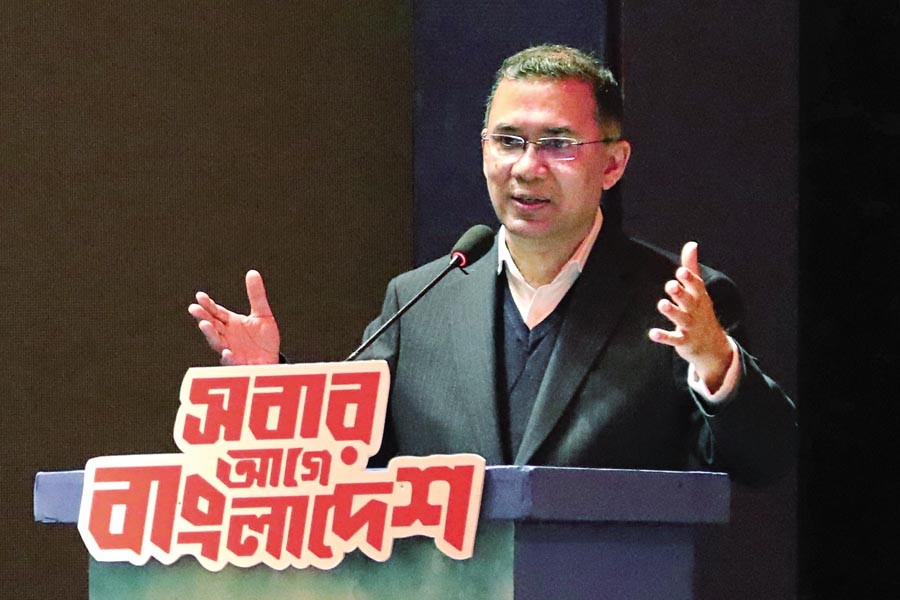
 BNP Chairman Tarique Rahman delivers a speech at a view-exchange meeting with editors and journalists at a city hotel on Saturday. — FE Photo
 BNP Chairman Tarique Rahman on Saturday said Bangladesh must safeguard democracy through accountability at every level of society alongside economic uplifts with time-suiting recipes.
He stressed that accountability must extend beyond politics to trade unions and professional bodies, noting that unchecked practices in these sectors often undermine workers' rights and weaken democratic institutions.
And "unions must operate transparently and responsibly, ensuring that their leadership is answerable to members and that their activities contribute to national progress rather than partisan conflict".
Speaking at an interaction with editors, journalists, and owners of newspapers, television channels, and online in a city hotel on the day, he pledged to reshape the country's political and economic future with a focus on unity, social security, healthcare reform, and women's empowerment if voted to power.
He said the BNP intends to move beyond the politics of vengeance and division, urging dialogue among parties and constructive criticism from the press to address national challenges.
He stressed that difference of opinion must not fragment the nation, citing the consequences of past conflicts, particularly the events of August 5, 2024, as a warning against returning to old patterns of repression and violence.
Tarique Rahman opened the event by greeting attendees, moving from table to table to shake hands and engage in brief conversations.
He announced that the BNP will start presenting its plan to the public on 22 January, ahead of the 13th national polls scheduled for 12 February.
Speaking on the occasion, the BNP's new Chairman announced plans to introduce universal social-security programmes, including a Family Card system to be issued under the name of women in each household.
He expects the initiative would empower rural women, ensure resources are directed toward healthcare, education, and small investments, and strengthen local economies.
The card would be valid for five to seven years and provide either financial support or essential food items depending on household needs.
He explained that women, when entrusted with direct assistance, prioritize family health, children's education, and savings, creating ripple effects that drive community progress.
Alongside this, Rahman told the media meet, the BNP would launch an Agri Card for farmers, arguing that those who feed 200 million citizens deserve a dedicated platform to address their problems.
Healthcare reform features prominently in Rahman's vision.
Drawing on his experience abroad, on a prolonged exile, he said Bangladesh must adopt a prevention-focused model to reduce costs and improve outcomes.
He argued that awareness campaigns and community health workers could help citizens avoid diseases such as kidney ailments, heart conditions, and diabetes, thereby reducing state expenditure.
He pledged to improve ambulance services and emergency-response times, warning that without reform Dhaka could face a severe healthcare crisis within 10 to 15 years.
His goal, he went on, is to ensure healthcare for all 200 million citizens, emphasizing nutritious food, hygiene, and preventive care alongside hospital services.
Turning to the economy, Rahman identified garments and remittances as the two pillars of Bangladesh's growth but stressed the need to diversify.
He noted that 1.0 million Bangladeshis migrate abroad annually, with most heading to the Middle East. Language training and vocational skills could help them earn more and boost foreign-currency reserves.
He proposed bonded facility benefits for entrepreneurs who export 100 per cent of their products, in order to expand employment opportunities.
He also suggested a rethink on IT parks by offering young professionals free Wi-Fi and small office spaces to foster innovation.
Rahman also highlighted the growing influence of content creators on platforms such as Facebook and TikTok, calling for streamlined policies to help them access international markets and simplify payment systems.
Rahman acknowledged the frustration of Bangladesh's young workforce, noting that many are searching for guidance and hope.
He pledged to expand overseas-employment opportunities through vocational training and language education, while also developing new export sectors beyond garments.
Empowering youth is essential for national progress, as their energy and innovation can drive economic transformation.
Environmental concerns were also raised, with Rahman warning of a looming water crisis. He notes that the Buriganga River is fully polluted, the Shitalakshya is nearly half-polluted, and pressure on the Meghna River is increasing. If these trends continue, he cautions, Bangladesh could face a catastrophic shortage of safe drinking water.
Women's safety emerged as another priority. Rahman acknowledges growing concerns about harassment on social media and pledges to combat it, stressing that both men and women have the right to security. "Protecting women from harassment is essential for a just society."
Media independence was highlighted during the exchange of views, with editors such as Nurul Kabir of New Age stressing that democracy cannot thrive without a free press.
Kabir noted that past injustices against journalists, including cases and attacks that left them legally deprived of defence, and urged immediate action to prevent repetition.
Rahman echoed these concerns, affirming that accountability must remain central to Bangladesh's democratic process.
He insisted that the country could not return to the pre-August 2024 situation, when political repression stifled dissent.
Rahman invoked the spirit of the 1971 Liberation War, the 1990 mass uprising, and the July Uprising of 2024, arguing that these movements demonstrated the power of collective action.
He urged citizens to keep democracy alive and ensure accountability in governance.
He acknowledged the immense expectations people have of politicians, noting that while not all expectations can be met, leaders have a responsibility to guide the nation forward.
The event was also addressed, among others, by editor of Jaijaidin Shafik Rehman, editor of the Daily Star Mahfuz Anam, chief editor of Manabzamin Matiur Rahman Chowdhury, editor of Kaler Kantho Hasan Hafiz, editor of Jugantor Abdul Hai Shikdar, editor of Amar Desh Mahmudur Rahman and executive editor of Prothom Alo Sajjad Sharif.
BNP's press secretary, Dr Saleh Shibly, conducted the event where BNP Secretary -General Mirza Fakhrul Islam Alamgir and Standing Committee members Amir Khosru Mahmud Chowdhury and Salahuddin Ahmed among others were present.
Azizjst@yahoo.com
© 2026 - All Rights with The Financial Express