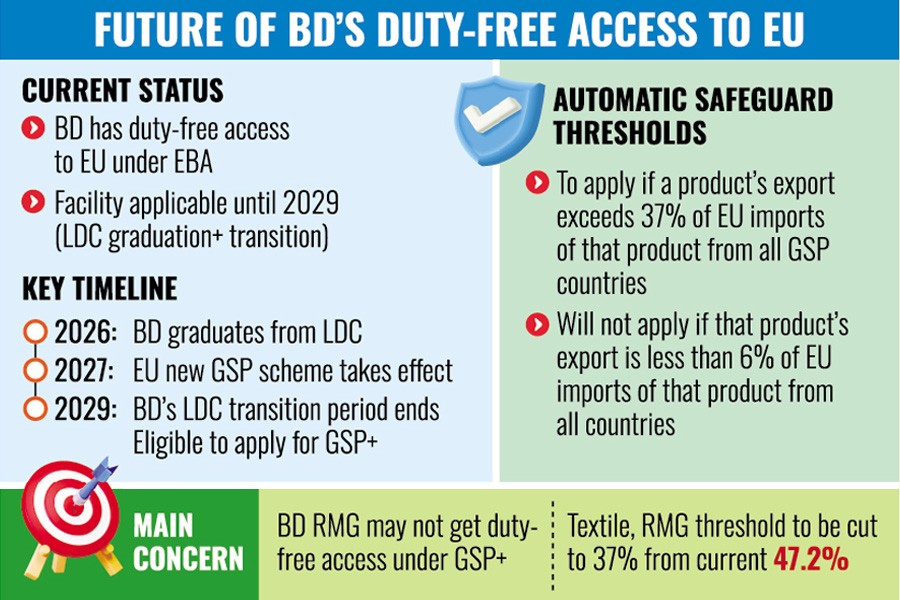
Bangladeshi-made readymade garments might not get duty-free market access to the European Union (EU) under GSP-plus facility after its graduation and related transition period up to 2029, sources say.
After the year 2029, Bangladesh will lose its duty-free market access to the EU under the current EBA or everything-but-arms facility and will eligible to apply for GSP-plus package deal, they say,
But locally made garment exports might not get the duty-free benefit under the EU's new GSP scheme.
The European Commission, its Council and Parliament on December 01 struck an agreement to revise the GSP scheme with effect from January 01, 2027 for ten years. The concessional-trade scheme, among others, confirms lower product-graduation thresholds, according to an EC statement available on its official website.
According to the proposed provision, the relevant threshold for Bangladeshi textile and garment exports to the EU - the main interest of Bangladesh - will be pared down to 37 per cent from the current 47.2 per cent after 2029 when Bangladesh's transition period would come to an end.
Asked about the latest trade paradigm, EU Ambassador and head of delegation to Dhaka Michael Miller through email communications responded that EBA beneficiaries such as Bangladesh are not subject to this threshold.
"The threshold applies only to standard GSP and GSP+ beneficiary countries."
Bangladesh will continue to benefit from the EBA scheme as long as it has LDC status, and, in addition, the benefits will also continue to be provided unilaterally by the EU during a 3-year transition period following the graduation, allowing them to prepare for the GSP or GSP+ requirements.
The EU will help Bangladesh meet GSP+ requirements throughout this period, through financing and the exchange of expertise, he says about the capacity-building assistance.
Explaining the threshold, the EU envoy says the automatic safeguards mechanism is not a novelty introduced by the new GSP Regulation, but an already existing tool and the European Commission has never activated the automatic safeguard mechanism because the relevant thresholds in the GSP Regulation have not been met so far.
More specifically, automatic safeguards would only kick in if a beneficiary country's export of a product meets the specified criteria such as exceeding 37 per cent of EU imports of the same products from all GSP-beneficiary countries.
The automatic safeguards will not apply if the beneficiary's exports of the relevant product do not exceed 6.0 per cent of EU imports of the same products from all countries -- whether or not they are GSP beneficiaries.
"At this point in time, it is not possible to foresee what the share of Bangladesh's exports will be when Bangladesh eventually graduates from the EBA arrangement," Mr Miller adds.
Responding to a query from The Financial Express, Dr MA Razzaque, chairman of Research and Policy Integration for Development (RAPID), has said if a country's share goes over 6.0per cent of total EU imports or 37 per cent of total GSP textile imports for three years in a row, safeguards can be applied, potentially removing duty-free access.
And Bangladesh's share is 24 per cent and around 47 per cent respectively, he mentions, apprehending the loss of the duty benefit which helped the country increase garment exports to the EU for last several years.
The EU as a bloc is Bangladesh's largest export destination, where RMG exports grew significantly over the past decade mainly because of the duty benefits, insiders say.
According to Eurostat data, Bangladesh's RMG exports to the EU were worth €11.54 billion in 2015, which climbed to €18.28 billion in 2024 in a remarkable 58.45-percent growth.
Due to the ramped-up US tariffs, Bangladesh's major competitors like China, Vietnam, India, and Cambodia are focusing on enhancing their EU market shares, insiders say.
Bangladeshi RMG will face 12-percent duty on the EU market after 2029, while it will gradually come down to zero for Vietnam by then because of the latter's free-trade agreement (FTA) with the 27-nation bloc, exposing products from Bangladesh to tough competition, they point out.
Talking to the FE, Fazlee Shamim Ehsan, executive president of Bangladesh Knitwear Manufacturers and Exporters Association (BKMEA), also echoes the view about same uneven competition as there would not be duty-free market access while Vietnam would achieve zero-rated duty.
He stresses diplomatic efforts from the government to withdraw the safeguard clauses and extension for the transition period for six years.
Mr Ehsan also notes that the industry also "must get ready by this time by enhancing its efficiency, productivity and diversification of both products and markets and reducing wastage rate".
Munni_fe@yahoo.com
© 2026 - All Rights with The Financial Express