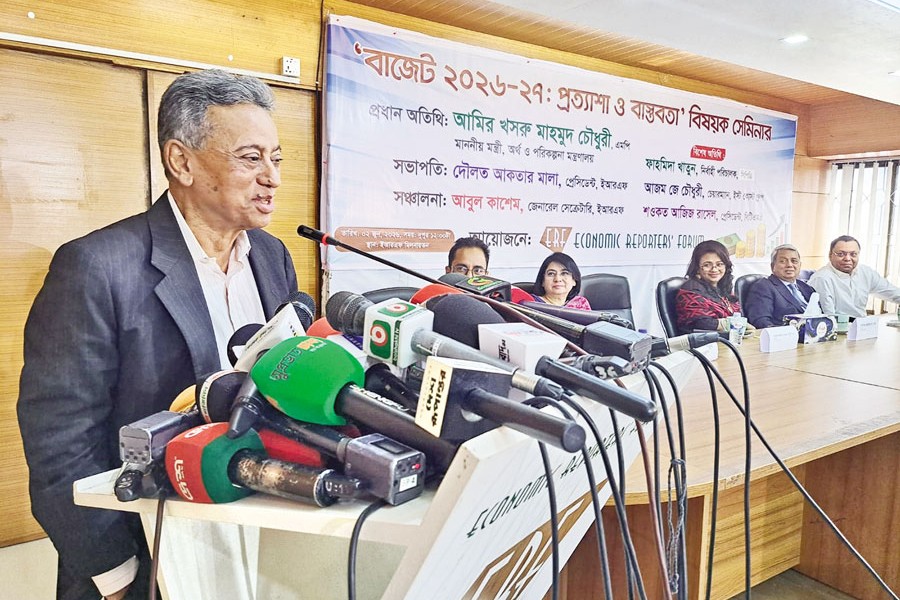
 Finance Minister Amir Khosru Mahmud Chowdhury speaking at a pre-budget discussion meeting organised by Economic Reporters' Forum (ERF) at its auditorium in the city on Tuesday — FE Photo
 Finance Minister Amir Khosru Mahmud Chowdhury has said the government will introduce Universal Health Care (UHC) in the next budget to strengthen healthcare access, as well as protect low-income and marginalised people.
Speaking as the chief guest at a seminar titled "Budget 2026-27: Expectations and Reality" and organised by the Economic Reporters Forum (ERF) at its office in the capital on Tuesday, he said Bangladesh's healthcare system remained heavily dependent on out-of-pocket spending by patients.
"People in our country bear one of the highest levels of out-of-pocket healthcare expenditure. This spending is even higher than in Afghanistan, reflecting the poor state of our healthcare sector," the minister said.
 "If we fail to improve the health conditions of low-income people who cannot afford treatment, sustainable development will not be possible."
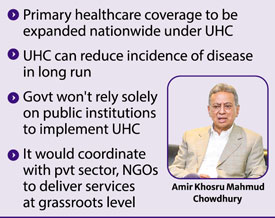
He said the government had undertaken a major initiative to expand primary healthcare coverage nationwide under the UHC programme.
"Through a universal healthcare system, we can provide basic healthcare support and reduce the incidence of disease in the long run," said Khosru.
He said the government would not rely solely on public institutions to implement the programme. Instead, it would work with the private sector and non-governmental organisations (NGOs) to deliver healthcare services at the grassroots level through a coordinated approach.
On the Family Card programme, he said transparency would be ensured in selecting beneficiaries.
"There is no political interference in the beneficiary selection process, and there will be none," he said.
According to him, a pilot project found the error rate in beneficiary selection to be between 1.0 per cent and 1.5 per cent, which he described as a significant achievement for a programme of such scale.
The remaining discrepancies were being addressed to ensure assistance reached genuine beneficiaries with near-perfect accuracy, he said.
Special guests at the event included Azam J Chowdhury, chairman of East Coast Group; Dr Fahmida Khatun, executive director of the Centre for Policy Dialogue (CPD); and Showkat Aziz Russell, president of the Bangladesh Textile Mills Association (BTMA).
CPD's Dr Fahmida said revenue collection was not increasing at the desired pace despite the expansion of the economy and the growing size of the national budget.
Although the National Board of Revenue (NBR) sets ambitious revenue targets every year, those targets remain largely unmet, she said, attributing the persistent shortfall primarily to the lack of institutional reforms in the revenue system.
She said some reforms had been implemented on a piecemeal basis, while several initiatives were introduced following recommendations from development partners.
However, a comprehensive and coordinated reform programme had yet to be undertaken, she said.
Describing the move to separate tax policy from tax administration as a positive first step, she stressed the need for deeper structural reforms.
Dr Fahmida also noted that efforts to increase revenue collection continued to place a disproportionate burden on the existing taxpayers, while progress in expanding the tax net and curbing tax evasion remained limited.
Referring to investment bottlenecks, East Coast Group's Azam said land mutation procedures take at least seven months to complete, delaying investment projects and related approvals.
As mutation documents are required for obtaining various licences, the lengthy process further complicates investment activities, he said, urging the finance minister to simplify the procedures and reduce bureaucratic hurdles.
Referring to the petroleum act, he said the law should be amended to meet present-day business requirements.
He also noted that the country's fuel inventory capacity was sufficient for only about 40 days, highlighting the need to expand storage facilities to support new investments.
BTMA's Showkat said the government had earmarked Tk 60 billion for reviving closed industrial units, but there was still no clarity regarding the disbursement mechanism or the criteria for selecting eligible factories.
He said these issues should be clarified before the budget was finalised.
Besides, he said extortion and violence continued to affect the business environment and warned that such problems would persist unless more employment opportunities were created.
To promote job-creating investments, he urged the government to introduce low-cost financing for the textile sector, similar to India's Technology Upgradation Fund (TUF), under which loans are provided at a 1.0 per cent interest rate.
The programme was moderated by ERF General Secretary Abul Kashem and chaired by ERF President Doulot Akter Mala.
newsmanjasi@gmail.com
© 2026 - All Rights with The Financial Express