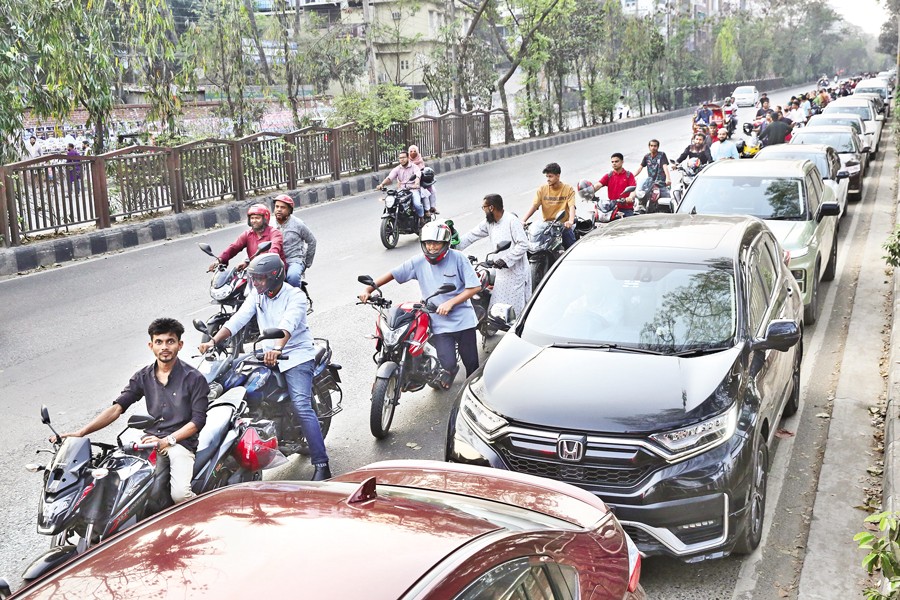
 Panicked motorbike and car drivers form long queues at fuel stations amid shortage fears, as global supply drops due to Middle East tensions. The photo was taken at a fuel station in the Asad Gate area of the capital on Friday. — FE Photo by Asad-Uz-Zaman
 Bangladesh has sufficient fuel stocks to meet its demand this month, according to the relevant quarters.
Yet, filling stations across the capital and nearby areas have seen long queues of vehicles as motorists rushed to buy fuel amid fears of global supply disruptions and possible price hikes triggered by the ongoing conflict in the Middle East.
During visits to several petrol pumps at Asad Gate, Ramna, and the Tejgaon industrial area on Friday, large crowds of customers, particularly motorcyclists and car owners, were seen waiting in long lines to purchase petrol and octane.
Customers were also seen moving from one pump to another as they were unable to obtain fuel according to their demand following the government's decision to set a maximum limit for fuel supply based on the type of vehicle.
According to eye witnesses, filling stations on Dhaka's outskirts including Savar also experienced similar rush of motor vehicles .
The Bangladesh Petroleum Corporation (BPC) issued a notice on Friday, assuring the public that fuel imports were continuing as scheduled and shipments were arriving regularly, aiming to ease concerns over potential supply shortages.
It said fuel was also being transported from the main installations to depots across the country through rail wagons and tankers to maintain uninterrupted distribution.
"Hopefully, within a short time, an adequate buffer stock of fuel will be built up in the country," the notice added.
Pump operators said the demand for fuel among customers had increased several times over the last three days compared to normal levels.
They claimed that since Thursday the rush has been unusual.
Besides, they noted that customers who previously purchased Tk 500 worth of fuel were now demanding two to three times that amount, with many seeking to fill their tanks completely.
Because some pumps fixed a maximum limit for fuel supply per vehicle, customers were unable to purchase their required amount and were travelling from one pump to another in search of additional fuel.
Pump authorities also said fuel was being supplied to long-distance vehicles by taking their specific requirements into consideration.
Several pump officials further reported that over the last three days, depots also failed to supply fuel according to their requirements.
The fear of supply chain disruptions - compounded by the ongoing Middle East conflict - drove many consumers to stock up as a precaution.
Sumon, a motorcyclist, told The Financial Express he filled his fuel tank to the capacity as a precaution from a petrol pump on Friday.
Under normal circumstances, he typically purchases only Tk 500 worth of octane at a time, but the uncertainty regarding the coming days prompted him to change his routine.
Mohammad NazmulHaque, secretary of the Bangladesh Petroleum Dealers, Distributors, Agents and Petrol Pump Owners Association, said many people rushed to filling stations out of panic and were purchasing petrol and octane for their vehicles, including cars and motorcycles.
"There is no reason for people to panic," Haque said, adding that the government currently had sufficient fuel stocks to meet the demand for this month.
Haque, who is the owner of Ramna Filling Station, said the shift in consumer habits had put immediate pressure on local stations.
He also noted that many motorcyclists who usually buy fuel worth Tk 100-200 at a time were now filling up their tanks full amid concerns about possible shortages.
According to him, supplies of petrol and octane are adequate for the entire month of March, although diesel supply could face some pressure if the situation worsens.
"The government has decided to introduce rationing for motorcycles, local buses, cars, long-route buses, and other vehicles considering the prevailing situation," he said.
Energy analysts also warned that prolonged disruptions in global fuel supplies could pose risks to Bangladesh's energy and power sector.
ShafiqulAlam, lead energy analyst for Bangladesh at the Institute for Energy Economics and Financial Analysis (IEEFA), cautioned that prolonged disruption in global fuel supplies would significantly affect the country's energy and power supply.
He noted that Bangladesh had recently procured liquefied natural gas (LNG) from the spot market at high prices, including a cargo purchased at around $28.28 per MMBtu.
This would require the government to pay a subsidy of more than Tk 80 per cubic metre, which would further strain the energy sector, he said.
"Such high spot prices will soon make LNG unaffordable for Bangladesh," Alam said.
He pointed out that Renewable energy acted as a natural hedge against global fossil fuel price fluctuations, but the country was yet to expand its capacity sufficiently.
sajibur@gmail.com
© 2026 - All Rights with The Financial Express