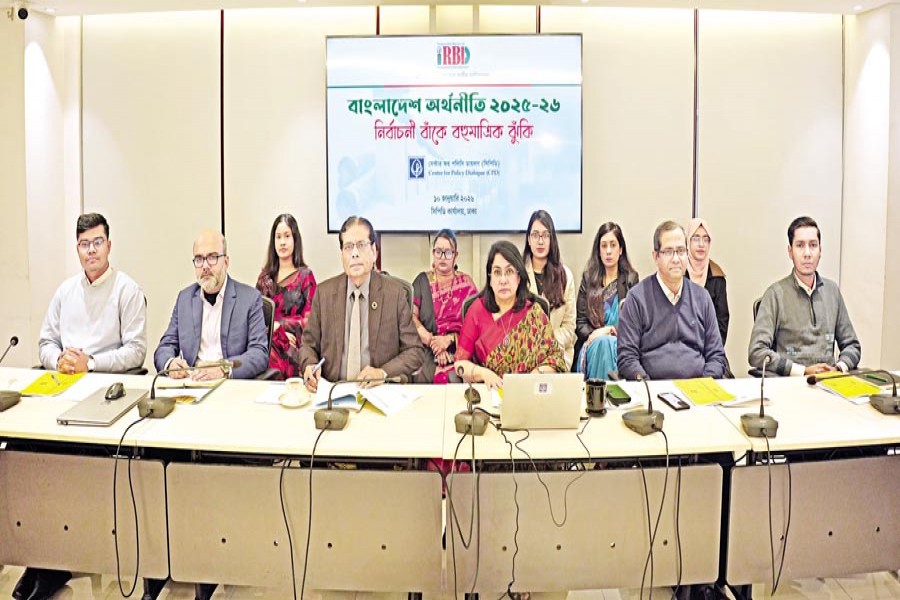
 Noted economists attend an event titled ‘State of the Bangladesh Economy in FY25-26’, organised under CPD's IRBD programme at its Dhaka office on Saturday. — FE Photo
 The Centre for Policy Dialogue (CPD) on Saturday highlighted securing private investment and generating employment as the major challenges for the government to be formed after the upcoming national elections scheduled for February 12.
It called for strong fiscal management to boost domestic revenue, comprehensive reforms in the banking sector to reduce non-performing loans, and effective measures to control inflation and ensure food security in the post-election period.
These remarks came from a briefing titled "State of the Bangladesh Economy in FY2025-26" and organised under the CPD's Independent Review of Bangladesh's Development (IRBD) programme at its Dhaka office.
Dr Fahmida Khatun, executive director of CPD, presented the keynote at the event, saying that addressing these structural and policy challenges would be critical for sustaining economic growth, restoring investor confidence, and protecting vulnerable sections of society, particularly as Bangladesh would graduate from the least developed country (LDC) category this year.
CPD Distinguished Fellow Professor Dr Mustafizur Rahman, Research Director Dr Khondaker Golam Moazzem, and other researchers of the think tank spoke at the event.
Utmost importance must be given to increasing revenue, especially through direct taxes, because the burden of indirect taxes fell directly on the ordinary people, Dr Mustafizur said, responding to a question.
"We are now standing at an important crossroads. The burden of foreign debt is gradually increasing, and at the same time, the pressure of domestic debt is also rising," he said.
He said the growth of investment depended on proper project appraisal, debt sustainability, and efficient resource use.
Before taking foreign loans, it must be ensured that the project's economic and financial returns were properly calculated and implementation was reliable, he said.
He also highlighted the risk of debt trap for the country, comparing it to other nations falling from low-income to the lower-middle-income status.
"Many countries, after moving from low-income to lower-middle-income, fall into the lower-middle-income trap, which in many cases is synonymous with debt traps. This risk is real for us too," he said.
In her keynote, Dr Fahmida said the banking sector in the country faced structural weaknesses, including high non-performing loans and inadequate capital buffers in some institutions, threatening financial stability.
Inflation, particularly food and non-food price pressures, continued to weigh heavily on low-income households, while supply chain bottlenecks exacerbated the problem, she said.
She also said private investment and employment remained subdued due to political uncertainty, policy inconsistency, and energy supply constraints.
The energy sector, especially electricity and renewable energy, required urgent reforms to reduce reliance on costly imported fuel and increase efficiency, she said.
Private investment had declined to 22.5 per cent of the Gross Domestic Product (GDP) and Foreign Direct Investment (FDI) trends were weak, she said.
"Private and foreign investment must be promoted through regulatory simplification, digital service delivery, and reducing policy and political uncertainty, while the energy sector needs immediate focus on institutional reform and renewable energy adoption," she also said.
Externally, Bangladesh faced the dual challenge of LDC graduation and evolving global trade dynamics, requiring export diversification, market expansion, and preparations for World Trade Organisation (WTO) negotiations, she added.
The keynote also identified some social sector concerns, including income inequality, youth unemployment, and uneven access to healthcare and social protection, that further complicated the policy landscape, while climate risks and infrastructure bottlenecks added another layer of vulnerability.
Dr Fahmida recommended strengthening public finance through better revenue mobilisation, rationalising tax exemptions, and ensuring efficient development spending as essential.
Banking reforms, including reducing non-performing loans, implementing the Bank Resolution Ordinance, and safeguarding central bank independence, were critical for financial stability, she said.
Controlling inflation required modernising food supply chains, reducing hoarding, expanding storage and transport infrastructure, and ensuring timely imports, she said.
The paper also analysed the state of the economy in the current fiscal year and revealed that revenue collection in July-September grew 16.7 per cent year-on-year, and achieving the annual target required nearly 33 per cent growth over the following months.
The Annual Development Programme (ADP) utilisation remained the lowest in a decade, slowing infrastructure and social sector projects, it said.
The banking sector's non-performing loans reached nearly 36 per cent of the total credit, with provision coverage only at 38 per cent of the required levels, it also said.
Dr Fahmida also stressed that achieving sustainable growth would require bold political commitment, effective institutional reforms, and timely policy actions.
She said priorities for the new government included restoring fiscal discipline, tackling inflation through supply-side interventions, ensuring food security, reforming the banking sector, boosting private investment and employment, accelerating the transition to renewable energy, and diversifying exports.
Dr Fahmida praised the notable strides by the current interim government in addressing structural weaknesses, with modest growth in revenue collection and several banking reforms, including asset quality reviews, amendments to the Bank Companies Act, implementation of the Bank Resolution Ordinance 2025, and measures to strengthen the Bangladesh Bank's independence.
However, she said the progress in implementation had been uneven, while development expenditure execution remained the lowest in a decade, inflation pressures persisted, supply chain inefficiencies continued, and banking sector vulnerabilities were still high.
Energy reforms were slow, reliance on liquefied natural gas (LNG) imports was increasing, private investment remained subdued, and food security and social protection systems were inadequate to safeguard the most vulnerable, she said, highlighting the failures of the interim government.
jahid.rn@gmail.com
© 2026 - All Rights with The Financial Express