Bangladesh is in higher economic risks than regional peers, despite signs of macroeconomic stabilisation, on five counts of weaknesses as measured by an international watchdog.
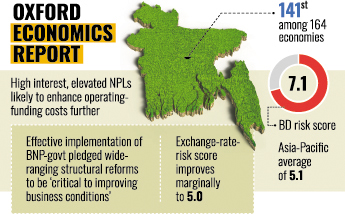
In latest ratings by Oxford Economics, Bangladesh has ranked 141st out of 164 economies, with an overall economic risk score of 7.1, well above the Asia-Pacific average of 5.1.
The agency has evaluated Bangladesh across five categories - market demand, market cost, exchange rate, sovereign credit and trade credit - highlighting structural vulnerabilities despite signs of macroeconomic stabilisation.
The country recorded a market-demand score of 7.0 out of 10, significantly higher than the regional average of 5.1, reflecting vulnerabilities in domestic demand conditions.
Demand remains exposed to regulatory uncertainties, delays in development projects and concerns over the maintenance of critical infrastructure.
"Political polarisation and periodic unrest also weaken the investment climate," the ratings report notes.
It also finds household income stability vulnerable to external shocks, with roughly two-thirds of remittances originating from Bangladeshi workers in Gulf economies, leaving consumption exposed to oil-price fluctuations and economic conditions in the region.
The report says Bangladesh scored 8.0 out of 10 in market costs, one of the highest levels in the assessment, indicating elevated operating and financing costs that deter investment and constrain productivity.
However, the BNP administration has pledged wide-ranging structural reforms, although Oxford Economics notes that effective implementation will be critical to improving business conditions.
"High interest rates and elevated levels of non-performing loans are expected to push up operating and funding costs further, placing upward pressure on domestic lending rates."
The country's exchange-rate-risk score improved marginally to 5.0, remaining above the emerging markets average of 4.3.
Bangladesh formally adopted a floating exchange-rate regime in July 2023, although the central bank continued to intervene in foreign-exchange markets to stabilise the taka.
In January 2024 the authorities announced a shift towards a crawling-peg system, implemented in May, with the longer-term objective of a fully flexible regime.
After a period of sharp depreciation through early 2025, the taka has since stabilised against the US dollar.
Oxford Economics expects relative currency stability over the medium term, supported by reforms under the IMF lending programme aimed at improving external balances and supporting long-term growth.
Bangladesh's sovereign credit-risk score stood at 5.3, higher than the emerging markets average of 4.7.
Weaknesses in the banking sector, low per-capita income and institutional challenges weigh on the sovereign-risk profile, while climate-related risks could affect creditworthiness over the longer term. However, government and external-debt ratios remain relatively low, providing some resilience.
Bangladesh received a trade-credit-risk score of 10.0, substantially higher than the emerging markets average of 6.3, reflecting structural weaknesses in the financial sector.
The report mentions high levels of non-performing loans - particularly in state-owned banks - linked to governance weaknesses, limited credit information and inadequate borrower financial disclosures.
Bank lending remains concentrated in services sectors and among large corporate borrowers, with relatively limited exposure to households and the real-estate sector, the report reads.
jasimharoon@yahoo.com
© 2026 - All Rights with The Financial Express