Bangladesh's energy efficiency targets are within reach as a supportive regulatory framework and rising awareness create a favourable ecosystem, even amid supply disruptions and higher tariffs, according to a new study by an international energy think tank.
The report, released Wednesday, finds that policy consistency and market signals have helped accelerate efficiency gains across the economy.
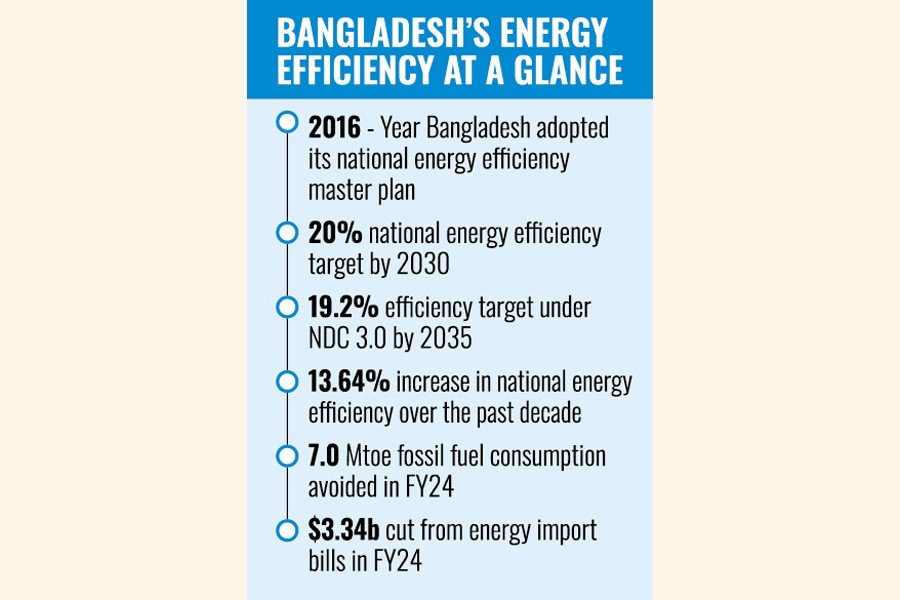
Over the past decade, Bangladesh has improved energy efficiency by 13.64 per cent, equivalent to an average annual gain of 1.52 per cent, according to the Institute for Energy Economics and Financial Analysis (IEEFA).
In FY2023-24 alone, the country avoided fossil fuel consumption of 7.0 million tonnes of oil equivalent (Mtoe), cutting import bills by an estimated US$3.34 billion, the study noted.
The analysis suggests Bangladesh is on course to meet its 2030 energy efficiency target a year ahead of schedule, with households and industry - together accounting for roughly two-thirds of total energy use - identified as priority sectors for further gains.
The report noted that after early progress from FY2016-17, efficiency gains slowed until FY2020-21.
Momentum picked up again as energy supply disruptions and higher tariffs, driven by global fossil fuel price volatility, made efficiency a policy and economic priority.
Bangladesh is on track to achieve its energy efficiency targets a year ahead of schedule, the study said, adding that households and industry, which together consume around two-thirds of the country's energy, should remain the focus for future improvements.
In the buildings sector, the study highlighted the importance of proper standards and labelling, along with passive design features, to ensure optimal energy efficiency.
In industry, improvements in motors, motor drives and captive power generation, as well as a shift to electric boilers, could significantly reduce energy consumption.
The study recalled that Bangladesh devised a national energy efficiency master plan in 2016, driven by energy security concerns and rising import bills. Nine years on, those efforts are delivering tangible results, it said.
Between FY2014-15 and FY2023-24, energy efficiency improved by 13.64 per cent, against a target of 20 per cent by 2030. With an average annual improvement rate of about 1.52 per cent, Bangladesh is likely to meet the 2030 target a year early.
The updated Nationally Determined Contributions (NDC 3.0) include an energy efficiency target of 19.2 per cent by 2035 from 2022 levels. The study found that Bangladesh is also on course to reach this target ahead of time.
Given the dominant share of energy use by households and industry, the report stressed the need to frontload efficiency measures in these sectors to meet both the 2030 and 2035 goals.
It said Bangladesh should build on the strong regulatory foundation laid over the past decade, notably by the Sustainable and Renewable Energy Development Authority (SREDA).
Azizjst@yahoo.com
© 2026 - All Rights with The Financial Express