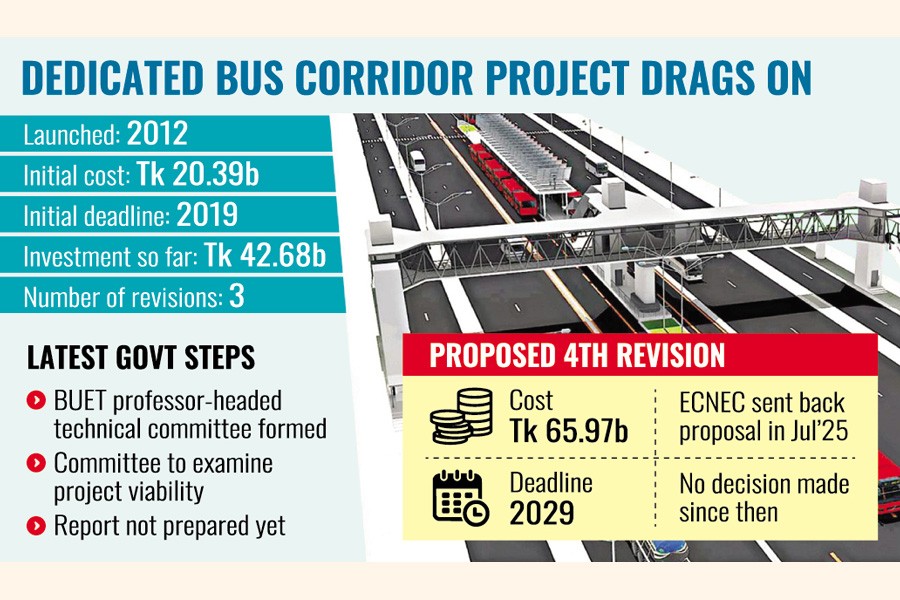
The interim government has failed to decide on the much-awaited Dhaka Airport-Gazipur Bus Rapid Transit (BRT) project, which remains halted for nearly a year, officials say.
They said on Wednesday that the halt had already damaged construction materials, with the prices of new ones expected to escalate day by day.
Undertaken by the toppled Sheikh Hasina government, the project has already seen investments of Tk 42.68 billion, with the latest deadline expiring in December 2024.
When the Roads and Highways Department (RHD) sought the fourth revision in July, the Executive Committee of the National Economic Council (ECNEC) sent the proposal back for some flaws, as well as massive cost and time overrun, according to Planning Commission officials.
No decision on the project had been made during these five months, said RHD officials.
A Bangladesh University of Engineering and Technology (BUET) assessment said the project was "fatally flawed" from its inception, primarily because it attempted to transplant a foreign transport model into local infrastructure that could not support it.
The project, initially estimated to cost Tk 20.39 billion, sought the fourth revision by raising the cost to Tk 65.97 billion and extending the deadline to 2029.
A senior Road Transport and Highways Division (RTHD) official said the government had formed a technical committee, headed by BUET Professor Dr Md Shamsul Hoque, to examine the viability of the project and find ways to make it usable.
He said the committee had not yet prepared the report.
Despite over 13 years of construction and billions of taka spent already, the 20.5km dedicated bus corridor project, once touted as the solution to the north Dhaka traffic nightmare, has become a symbol of planning failure and public suffering.
Planning Adviser Dr Wahiduddin Mahmud has described the project as "monstrous and unplanned", citing significant design flaws that have narrowed the existing lanes for general traffic.
The interim government has signalled that it will not take further responsibility for procuring specialised buses and finishing the complex infrastructure.
An expert committee investigation found that the initial feasibility study was flawed.
The narrow road width at several points makes the dedicated BRT lanes impractical without causing massive congestion in the remaining "mixed-traffic" lanes.
Tenders for the 137 specialised diesel or electric buses have been cancelled or delayed repeatedly due to allegations of corruption and legal disputes with Chinese bidders.
During the 2024 mass uprising, 22 escalators at various stations were vandalised.
Combined with rusting railings and incomplete footbridges, the cost of "fixing" the unfinished work has skyrocketed.
To provide immediate relief to commuters, the government has decided to open the dedicated BRT lanes to general traffic for the time being.
According to the RHD, some 97 per cent of civil works is completed, specialised buses have not been procured, built-in stations and escalators are either incomplete or damaged, the main corridor has been open to general traffic, some flyovers on the route are operational for regular vehicles, and the specialised "rapid transit" service remains a dream.
For now, thousands of commuters travelling between Gazipur and the capital must continue to navigate a corridor that is structurally complete but functionally broken.
Shutting it down would have significant economic, social, and environmental consequences, RHD officials said.
To guide the next steps, the RTHD earlier formed two committees under the RHD.
One of them was tasked with assessing the overall impacts of scrapping the project, while the other would review why the scheme struggled for more than a decade despite repeated revisions.
The BRT initiative, launched in 2012 under the foreign-funded Greater Dhaka Urban Sustainable Transport project, was expected to ease congestion along one of the busiest corridors of the capital region.
Initially scheduled for completion in December 2019, it was revised three times with new deadlines in 2022 and later in 2024.
Cost revisions pushed the budget to Tk 42.68 billion before the latest proposal sought an additional Tk 23.29 billion.
The latest revision was driven by the need to procure buses for both diesel and electric modes, install supporting infrastructure, and establish the Dhaka BRT Company for future operations and management.
These elements had not been included in previous revisions, officials said.
Dhaka Bus Rapid Transit Company officials said as the project was financed by development partners, there was no option but to complete it.
The revenue from BRT operations was expected to help repay the loans, they said.
The Asian Development Bank and France's AFD are providing the lion's share of the project's funds.
Planning Commission officials said it had asked the ministry to engage both local and international experts to justify the project's completion.
© 2026 - All Rights with The Financial Express