The Islamic Development Bank (IsDB) is likely to send a technical mission to Bangladesh in late January as it may lend a record high of $1.0 billion for setting up an oil refinery, officials say.
The delegation aims to finalise the terms of the financing package for the long-delayed Eastern Refinery Limited (ERL) Unit-2 project, says a senior Economic Relations Division (ERD) official.
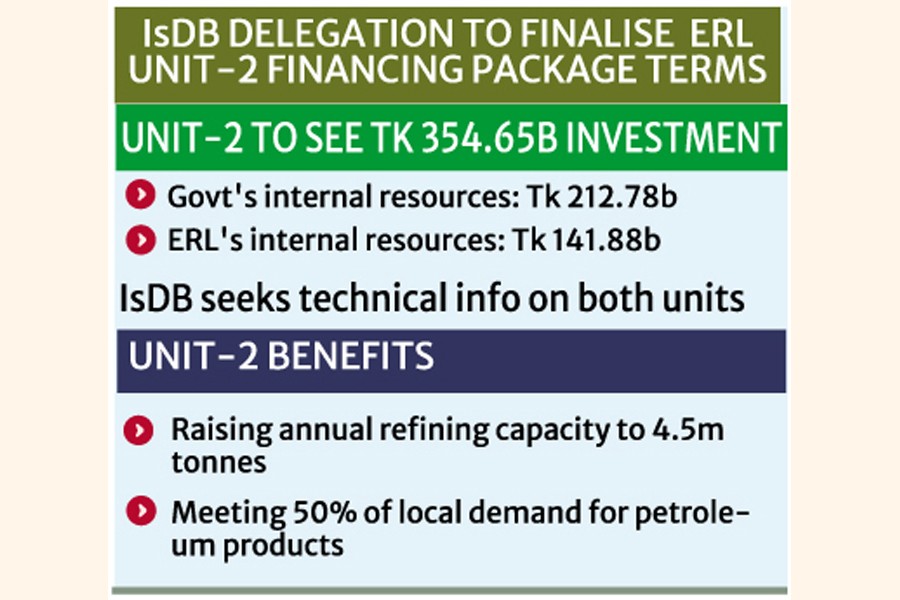
The state-owned ERL will set up its second unit with a crude oil refinery capacity of 3.0 million tonnes per year in Chattogram by investing Tk 354.65 billion ($2.89 billion).
The mission follows a non-binding expression of interest from the IsDB to support the modernisation and expansion of the country's only state-owned refinery, the ERD official says.
If finalised, this will represent one of the largest single-project loans ever extended by the Jeddah-based lender to a member country, he adds.
"In the meantime, the IsDB has asked for some information, mostly technical, on the present ERL-1 and the future one. We will send the details within a week. Then the IsDB will send the technical mission to assess the financing possibility," a senior ERD official says."We are expecting that the mission will arrive on January 25 or 26." The ERL-2 project, which has been in limbo for over 15 years, was recently revived by the interim government as the last Executive Committee of the National Economic Council (ECNEC) approved the scheme at Tk 354.65 billion.
For the project, the government will give Tk 212.78 billion in loans from its internal resources, while the remaining Tk 141.88 billion will come from the ERL's internal resources.
The ERD official says if the IsDB mission gives a final signal on funding, the financing mode in the approved development project proposal (DPP) will be revised.
While the project was initially cleared for self-financing through government funds and the Bangladesh Petroleum Corporation (BPC) after foreign partners remained elusive, the IsDB's entry has significantly altered the fiscal outlook, he adds.
The second unit is designed to triple the refinery's annual capacity from 1.5 million tonnes to 4.5 million tonnes. Currently, Bangladesh can only refine about 20 per cent of its total petroleum demand, forcing a heavy and expensive reliance on imported finished products.
"This expansion is not just about capacity; it is about environmental standards and economic resilience," notes a senior official from the Energy and Mineral Resources Division.
The new unit will produce Euro-5 standard diesel and gasoline, significantly reducing the carbon footprint while saving millions in foreign exchange annually, he says.
The IsDB mission will conduct a final round of due diligence, focusing on basic designs already completed for various crude types, including Arabian Light and Murban, finalising interest rates and repayment schedules, and ensuring the 20 proposed processing units meet international safety and efficiency benchmarks.
The project is currently slated for completion by November 2030.
Once operational, the refinery is expected to meet nearly 50 per cent of the national demand for petroleum products, providing a critical buffer against global market volatility.
"If all goes on schedule, we have a plan to sign the loan deal with the IsDB by June this year," says the ERD official.
The ERL was established in 1968 under the French contractor Technip.
Plans for a second unit were first drawn up in 2010, and the government approved Tk 130 billion for the project in 2013.
However, no progress was made.
In 2022, BPC attempted to proceed using its own funds, raising the estimated cost to Tk 230 billion, but still work did not start.
In early 2024, the controversial S Alam Group expressed interest in constructing ERL-2 at a cost of Tk 250 billion, and the Energy Division approved the proposal on July 9.
However, the project was suspended in August following the mass uprising that led to the fall of Sheikh Hasina's government.
After taking office, the interim government revived the project at Tk 354.65 billion.
Officials say the project can produce 400,000 tonnes of furnace oil, 60,000 tonnes of Liquefied Petroleum Gas (LPG), 600,000 tonnes of Euro-5 gasoline, 1.1 million tonnes of Euro-5 diesel, 200,000 tonnes of lube base oil, and 500,000 tonnes of jet fuel annually.
BPC data shows in FY24, Bangladesh consumed 6.73 million tonnes of petroleum products, of which ERL produced only 1.25 million tonnes, leaving 5.05 million tonnes to imports.
Fuel demand grew at an annual average rate of 5.5 per cent in recent years.
BPC projects that by FY30, demand could reach 10.79 million tonnes, while domestic production will peak at just 4.5 million tonnes.
If ERL expansion is not implemented, the shortfall could rise to 9.29 million tonnes, placing significant pressure on import costs and the country's energy security, officials say.
© 2026 - All Rights with The Financial Express