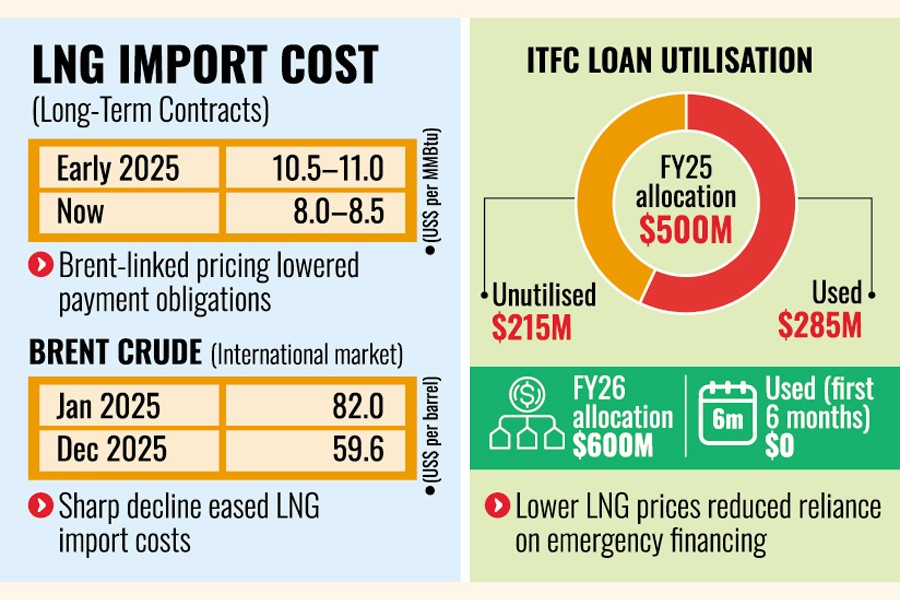
Lower liquefied natural gas (LNG) prices in the international market over the past one and a half years have significantly eased fiscal pressure on Petrobangla, allowing the state-run entity to avoid fully utilising costly external financing, officials said.
As global energy prices softened, Petrobangla required less borrowing to meet its LNG import bills, leaving a substantial portion of its International Islamic Trade Finance Corporation (ITFC) credit lines unused during the last fiscal year.
Officials say improved cash flow management and better coordination also contributed to the reduced dependence on loans.
The development comes as Bangladesh continues to grapple with foreign currency constraints and rising scrutiny over the cost of external borrowing to finance energy imports, particularly LNG, which remains critical for power generation and industrial use.
State-run Petrobangla drew about US$285 million from the Jeddah-based ITFC over the past 18 months to December 18, 2025 to pay LNG import bills, Petrobangla Director (Finance) AKM Mizanur Rahman told The Financial Express on Thursday.
He said Petrobangla had an ITFC loan facility of $500 million available to meet LNG import costs for 12 months during FY2025. However, around $215 million of the allocated amount remained unutilised even after six months of the fiscal year.
Similarly, the ITFC loan worth $600 million allocated for the ongoing FY2026 has remained unused despite six months having passed, the official added.
Market insiders said oil prices in the international market hit a yearly low on Thursday, with Brent crude falling to around $59.63 per barrel, dragging down prices of other energy products, including LNG.
Brent crude had traded as high as around $82 per barrel in January 2025, they noted.
Currently, Petrobangla pays around $8.0-8.5 per million British thermal unit (MMBtu) for LNG imports under long-term supply contracts.
During the price spike in January, the cost stood around $10.5-11 per MMBtu, a senior Petrobangla official said.
Bangladesh imports the bulk of its LNG under long-term supply agreements linked to Brent crude prices, officials explained.
"Improved cash flow, supported by better coordination, has resulted in lower utilisation of ITFC loans," the Petrobangla director said.
After prolonged difficulties in settling LNG import and gas purchase bills, the Ministry of Power, Energy and Mineral Resources (MPEMR) and the ITFC signed a loan agreement in February 2024 to clear outstanding dues to LNG suppliers and international oil companies (IOCs), officials said.
The interest rate on the ITFC facility is fixed at the secured overnight financing rate (SOFR) plus 2.0 per cent, currently amounting to around 5.75 per cent, with SOFR hovering at about 3.75 per cent.
Before the ITFC agreement, repayment delays had worsened to the point where France's TotalEnergies and Gunvor Singapore notified Petrobangla to clear outstanding payments for spot LNG cargoes or risk forfeiture of financial guarantees held with state-owned banks.
Both suppliers demanded full settlement of pending invoices within three working days, warning that dues could be recovered from standby letters of credit (SBLCs) maintained with Agrani Bank Ltd, sources said.
At the time, Petrobangla reportedly owed around $500 million to LNG suppliers.
The company was also struggling to make regular payments to US oil major Chevron, with arrears reaching around $280 million.
Energy experts and consumer rights groups have criticised the ITFC loan terms as "harsh", warning that they could further weaken the already fragile financial position of state-owned energy entities.
"Clearing overdue payments with high-interest loans cannot be a sustainable solution," said Prof M Shamsul Alam, energy adviser to the Consumers Association of Bangladesh.
Such borrowing would also add pressure on the country's dwindling foreign currency reserves, said Prof Ijaz Hossain of the Bangladesh University of Engineering and Technology (BUET).
"The interest rate is very high and punitive," he added, noting that foreign loans carrying interest above 4.0 per cent are generally considered expensive.
Azizjst@yahoo.com
© 2026 - All Rights with The Financial Express