A sharp fall in paddy prices ahead of the peak Boro harvest has triggered fresh concern among farmers, who fear mounting losses unless the government intervenes swiftly.
The decline, driven by early harvesting and rising supply, has already eroded returns from older stocks, according to market insiders.
With harvesting gathering pace in low-lying areas and no procurement announcement yet, market uncertainty is growing. Farmers and traders alike are now looking to the government for a stabilising signal before the main harvest begins next month (May).
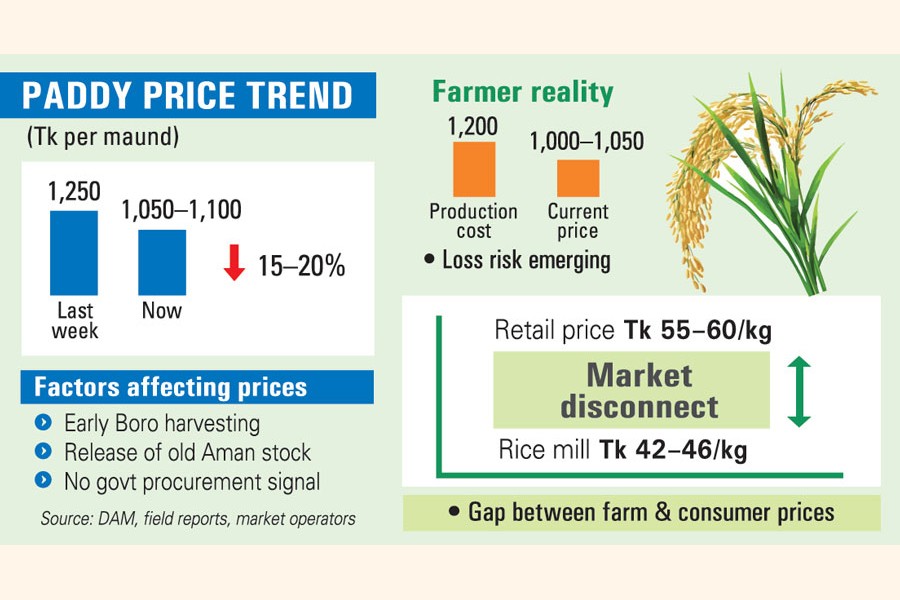
Paddy prices have dropped by 15-20 per cent within a week with the early start of Boro harvesting, raising fears of a deeper fall as peak harvest begins in May.
Paddy from the Aman season, which was selling above Tk 1,250 per maund just a week ago, is now being traded at Tk 1,050-1,100 in Rangpur, Dinajpur, Bogura, Joypurhat and other regions, according to the Department of Agricultural Marketing (DAM).
The sudden drop in older stock has come as a blow for farmers preparing to harvest Boro. As fields turn golden across the country, farmers are now anxiously watching the market and hoping for a timely government signal to avoid losses, insiders said.
Harvesting has already started in haor, baor, beel and other low-lying areas, adding new supply to the market.
Prices have started falling even before full-scale Boro harvesting, indicating rising supply pressure and weak market confidence.
In contrast, the price of husked rice (coarse variety) has remained stable. It is selling at Tk 42-46 per kg in major milling areas, while retail prices stand at Tk 55-60 per kg in Dhaka, Narayanganj and Gazipur, showing a widening gap between producers and consumers.
"We are in panic," said Rahman Ali, a farmer from Mithamoin in the Kishoreganj haor belt.
"I have already harvested three bighas of land, and another 12 bighas are ready. But the price is only Tk 1,000-1,050 per maund, while production costs exceed Tk 1,200 in my area," he said.
A farmer in Mohanganj of Netrakona expressed similar concern, saying rising costs have worsened the situation.
"Fertiliser, diesel, irrigation and harvesting by combine harvesters - all costs have increased," he said, adding that farmers may face losses if prices fall further.
Omar Faruq, a trader in Nilphamari, said the decline is mainly due to early harvesting and the absence of a government procurement announcement, which usually helps stabilise prices.
Md Shahidul Islam, a rice trader in Dinajpur, said some traders had stocked paddy expecting higher profits but are now releasing it due to falling prices.
"The arrival of new Boro from haor areas and the release of old stock have pushed prices down," he said.
He said that a government procurement announcement usually brings stability. "When the government declares procurement prices, it gives confidence to both farmers and traders. Now everyone is waiting for that announcement," he added.
Agricultural economist Prof Golam Hafeez Kennedy warned that the current trend could have serious consequences if not addressed quickly.
He said farmers growing onion and potato have already suffered heavy losses this year due to sharp price drops, and Boro farmers now face a similar risk.
"If prices fall further during peak Boro harvest, farmers may not recover their costs. This could discourage cultivation in the next season," he said.
He urged the government to announce the procurement price immediately and increase procurement volume to support farmers, especially amid the ongoing global fuel crisis linked to tensions in the Middle East.
Bangladesh produced around 20 million tonnes of rice in the Boro season last year, which accounts for about 55 per cent of total annual production. The government has set a higher production target of 20.6 million tonnes for the current season.
tonmoy.wardad@gmail.com
© 2026 - All Rights with The Financial Express