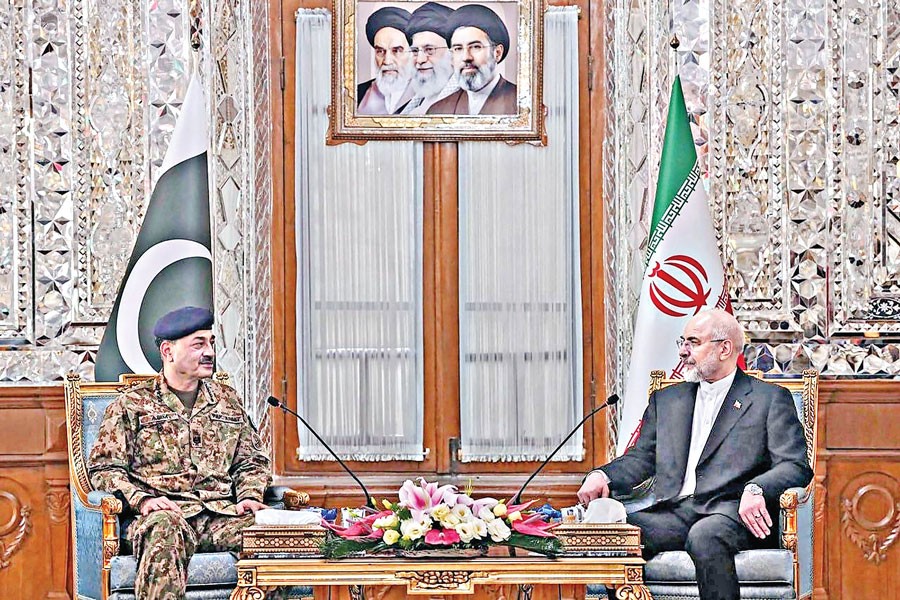
 Iranian Parliament speaker Mohammad Bagher Ghalibaf (R) speaking with Pakistan's Army Chief Asim Munir (L) during their meeting in Tehran on Thursday. — AFP
 WASHINGTON, United States, Apr 16 (AFP): The United States announced Wednesday it is tightening sanctions against Iran's oil industry as Tehran keeps up its closure of the Strait of Hormuz as part of the Mideast war.
The new punishment targets oil transport infrastructure by slapping sanctions on more than two dozen people, companies and ships that operate within the network of petroleum shipping magnate Mohammad Hossein Shamkhani, the Treasury Department said.
 "Treasury is moving aggressively with 'Economic Fury' by targeting regime elites like the Shamkhani family that attempt to profit at the expense of the Iranian people," US Treasury Secretary Scott Bessent said in a statement, alluding to a financial pressure campaign against Iran.
Shamkhani is the son of security official Ali Shamkhani, an advisor to Iranian supreme leader Ali Khamenei, both of whom were killed February 28, the first day of US-Israeli attacks and the start of the Middle East war.
"The United States is acting to decisively limit Iran's ability to generate revenue as it attempts to hold the Strait of Hormuz hostage," the State Department said in a separate communique.
Iran has effectively shut down the Strait of Hormuz, a key conduit for shipping oil and gas, in retaliation for the US and Israeli war campaign.
The United States is now engaged in a naval blockade of Iran's ports.
On Tuesday, the Treasury Department said it would not extend a temporary sanctions waiver that allowed the sale of Iranian oil already at sea. This had been an attempt to ease pressure on oil prices that shot up because of the war.
The United States alleges that the Shamkhani network, which operates in Iran and the United Arab Emirates, dodges sanctions through a group of seemingly legitimate consulting and shipping companies that run the network's fleet.
Last year the United States imposed sanctions against entities linked to the network.
The Treasury Department also announced Wednesday it was imposing sanctions against an Iranian man named Seyed Naiemaei Badroddin Moosavi, whom it described as a financier for the Iran-backed militant group Hezbollah, and "three companies linked to a complex money laundering scheme involving the sale of Iranian oil in exchange for Venezuelan gold."
Lebanese authorities said Israeli strikes on the country's south killed at least three paramedics on Wednesday, as the Israeli army announced it had attacked 200 Hezbollah targets over 24 hours.
Iran-backed armed group Hezbollah claimed attacks on northern Israel and invading Israeli troops, a day after Lebanese and Israeli officials agreed to hold direct negotiations.
Israel has not targeted the Lebanese capital since a series of attacks across the country on April 8 that killed more than 350 people, but has kept up deadly strikes on southern Lebanon as troops push a ground invasion.
"I have ordered that all of the area of south Lebanon up to the Litani (River) line be turned into a Hezbollah terrorist kill zone," Israeli army chief of staff Eyal Zamir said Wednesday during a visit to frontline troops.
Lebanon's health ministry said Israel targeted paramedics working in the southern town of Mayfadun "three consecutive times", killing at least three of them and injuring six others, while one paramedic remains missing.
The US military said Wednesday it successfully turned back 10 vessels that tried to sail out of Iranian ports during the first 48 hours of a naval blockade against the Islamic republic.
"Ten vessels have now been turned around and ZERO ships have broken through since the start of the US blockade on Monday," US Central Command (CENTCOM) said in a post on X.
CENTCOM had earlier put the number of ships turned back at nine, but added a 10th that it said was "redirected" back to Iran by a US guided missile destroyer.
While CENTCOM said no vessels have made it through the blockade, maritime tracking data appeared to contradict that assertion.
Tracking data from Tuesday indicated at least three ships sailing from Iranian ports crossed the Strait of Hormuz, though some vessels taking the route later turned back.
The three ships were among at least seven Iran-linked vessels that passed through the strait after Washington's blockade came into effect at 1400 GMT on Monday, according to maritime data provider Kpler.
© 2026 - All Rights with The Financial Express