For Foishal Rahman, a middle-aged resident of Shantinagar in Dhaka, a simple visit to the local kitchen market has become a source of profound anxiety.
"I grew up in a village where vegetables were practically free during the harvest season. Today, in Dhaka, I am paying nearly four times the price for the same produce I see rotting in my village fields," he says, clutching a small bag of green chillies that cost him more than a kilo of rice.
Foishal's struggle is not unique; it is the face of a mounting economic crisis. Like many urban middle-class families, he has begun cutting down on nutritious food - protein and fresh vegetables -- because the prices have simply outpaced his earnings.
This is the reality of the rural-urban price divide in Bangladesh. While the urban consumer is bleeding money, the rural producer is bleeding hope.
The disparity is not a result of simple scarcity; it is the outcome of a deeply flawed, opaque, and exploitative supply chain that rewards intermediaries while punishing the two most vital ends of the economy -- the farmer and the consumer.
According to the Bangladesh Trade and Tariff Commission (BTTC) and the Department of Agricultural Marketing (DAM), the price difference between rural production hubs and urban retail centres is staggering.
Official data shows perishable commodities regularly fetch significantly higher prices in urban centres.
However, a deeper look at household surveys from the Bangladesh Institute of Development Studies (BIDS) reveals a grimmer picture: rural food inflation reached approximately 15 per cent in late 2023.
This indicates that even in the heart of production, the cost of staples like rice, eggs, and milk is soaring, leaving rural households with little to no surplus.
The Bangladesh Bureau of Statistics (BBS) further reports that rural non-food inflation has occasionally overtaken urban levels.
This is largely attributed to the rising costs of transport and utilities outside major cities, creating a double-edged sword for villagers who earn less but are increasingly forced to pay more for basic services.
The invisible hands: How middlemen dictate the market
The journey of a single cauliflower from a field in Tangail to a dining table in Dhaka is a master class in economic inefficiency.
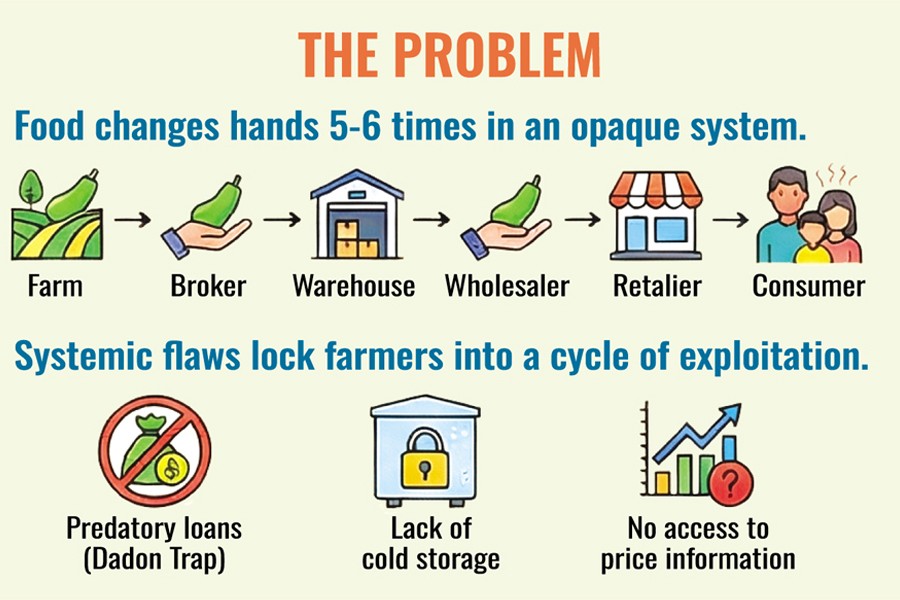
On-the-ground investigations reveal that a typical agricultural product changes hands five to six times.
Hashem Mia is a general vegetable grower in Tangail.
"After harvest, if we cannot sell quickly, the product rots. We do not have cold storage. If we sell in the production area, the farias (brokers) offer us peanuts. If we try to take it to the bigger markets, the chains of brokers block our access," he explains.
He recently sold a batch of gourds for Tk 15-20 each. By the time the gourds reached Karwan Bazar in Dhaka, they were priced at Tk 45 and eventually sold to consumers for Tk 60-70.
The layers of exploitation
Faria (small broker): They buy directly from the farmer at the lowest possible price, often leveraging informal loans (Dadon) given to the farmer earlier in the season.
Aratdar (warehouse owner): They provide the space for aggregation but charges heavy commissions without providing any formal receipts.
Bepari (wholesaler/transporter): They move the goods to the city, absorbing transport costs but adding a significant mark-up to cover "roadside expenses" (extortion/tolls).
Urban wholesaler: They distribute to local city markets.
Retailer: They add the final margin to cover rent and waste.
According to a 2024 report by the Directorate of National Consumers' Right Protection (DNCRP), many of these players operate outside formal systems.
There is no documented pricing, and trading often happens through verbal agreements, making the process of "price formation" entirely opaque.
Structural flaws and the 'syndicate' myth
Dr Mustafa K Mujeri, executive director (ED) of the Institute for Inclusive Finance and Development (InM), argues that the problem is not just "bad people" but a "bad system."
He identifies deep structural flaws as the primary driver of the rural-urban price gap.
"The core problem is the lack of competition," says Dr Mujeri.
"Between the farmer and the consumer, multiple layers -- importers, millers, and wholesalers -- operate with disproportionate market power. When a powerful group controls the logistics, they control the price," he says.
He clarifies that the word "syndicate" is not an abstract conspiracy but a direct outcome of power imbalances.
"When a group of traders control the supply of onions, eggs, or chickens, they create an artificial crisis to maximise profit. They have the capital to hoard and the influence to dictate terms to both the powerless farmer and the desperate consumer."
The Dadon trap: Why farmers cannot fight back
SM Nazer Hossain, vice president of the Consumers Association of Bangladesh (CAB), points to the Dadon system - an informal credit trap - as a primary reason for price disparities.
Farmers, lacking access to easy bank loans, take advance payments from middlemen to buy seeds and fertilisers.
In exchange, they are forced to sell their harvest to those same middlemen at pre-determined, below-market rates.
"This creates a form of price discrimination," Hossain explains.
"The farmer is deprived of a fair price at the start, and the consumer pays three to four times the original cost at the end. The institutions meant to support farmers - like the Department of Agricultural Extension and the Department of Fisheries - must move beyond just production support and take an active role in marketing and distribution also," he believes.
The infrastructure shortfall
A report by market analysts and a study in the All Subject Journal highlight that fragmented distribution channels and a lack of cold-chain infrastructure are responsible for massive post-harvest losses.
In Bangladesh, nearly 20-30 per cent of vegetables are wasted before they reach the consumer.
This waste is factored into the final price, further inflating the cost for urban residents.
Furthermore, farmers lack real-time price information.
While the Department of Agricultural Marketing (DAM) maintains daily reports, that information rarely reaches the farmer in the field in a way that empowers them to bargain.
They are forced to take whatever price the faria offers.
The BTTC perspective: A call for coordinated action
A senior official of the Bangladesh Trade and Tariff Commission (BTTC), speaking on condition of anonymity, confirms that the price gap is a "multi-headed hydra."
It is a combination of supply chain inefficiencies, concentration of power in a few hands, and logistics constraints, he says.
"We see high inflation in rural households and steep retail prices for urban ones. This is not a problem that can be solved by one ministry alone. It requires a rebalancing of power across the entire agricultural chain," the official states.
The path forward: Breaking the chain
Economists and market analysts have called for urgent policy reforms to break the entrenched cycle of exploitation in agricultural marketing.
They stress the need to organise farmers into cooperatives to strengthen collective bargaining and reduce dependence on small brokers.
Experts also recommend direct government procurement and the establishment of farmers' markets near district towns and highways to enable direct sales to consumers.
Investment in cold storage facilities and refrigerated transport is seen as critical to cutting post-harvest losses and stabilising prices.
Additionally, real-time digital price information for farmers and stricter monitoring of intermediaries through mandatory trade licences and documented receipts are essential to ensuring transparency in price formation.
The stories of Foishal Rahman in Dhaka and Hashem Mia in Tangail are two sides of the same coin. One cannot afford to eat, and the other cannot afford to grow.
The middle ground is occupied by a powerful, unregulated network of intermediaries who are pocketing "abnormal profits" at the expense of national food security, experts say.
They say without strengthening the "weak" farmer and ensuring transparency in the "opaque" market, the cycle of exploitation will continue.
Impact on livelihoods and nutrition
The consequences of this system are far-reaching.
Rural households, which already allocate a larger share of income to food, face both high inflation and low returns from agricultural production.
Urban households, meanwhile, struggle with rising living costs that outpace income growth.
Dr Binayak Sen noted at the BIDS Annual Development Conference held in December 2024 that the nutritional and economic consequences for rural and urban households were dire.
It is time for the government to move beyond monitoring and start intervening not just in the markets of Dhaka but also in the fields where the journey of our food begins.
The price of a cauliflower is not just a number on a chalkboard; it is a reflection of the fairness of our economy.
Currently, that reflection is deeply distorted.
rezamumu@gmail.com
© 2026 - All Rights with The Financial Express