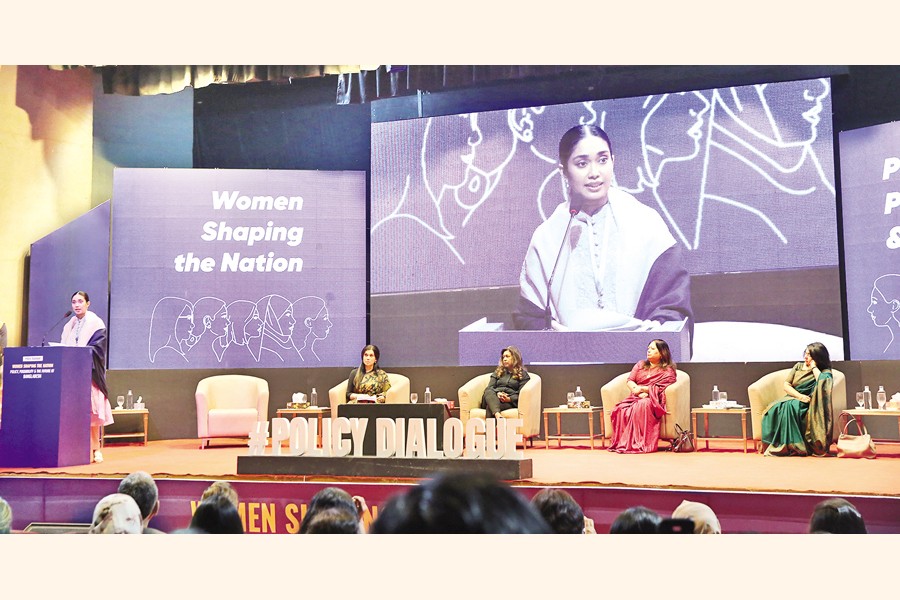
 Barrister Zaima Rahman, daughter of BNP Chairman Tarique Rahman, addressing a discussion titled 'Women Shaping the Nation: Policy, Possibility and the Future of Bangladesh,' organised by Dhaka Forum Initiative in the city on Sunday. — Photo: K Asad-Uz-Zaman
 Gender equality cannot be a sideline issue but be an economic and national issue and women's dignity cannot be kept as a topic within policies, offices and classrooms and it must be recognised both privately and publicly, observes Barrister Zaima Rahman.
"When women are welcomed rather than sidelined, they not only change their own lives, they change the future of their families and the future of the nation," she said while delivering her first-ever public speech in a discussion on Sunday.
Barrister Zaima, only daughter of BNP Chairman Tarique Rahman, also said it is responsibility of all to reach women not only at homes, but also at institutions.
Dhaka Forum Initiative organised the discussion titled 'Women Shaping the Nation: Policy, Possibility and the Future of Bangladesh,' where BNP Standing Committee member Amir Khasru Mahmud Chowdhury, Executive Director of Centre for Policy Dialogue Dr Fahmida Khatun, Managing Director of BRAC Enterprises Tamara Hasan Abed and Managing Director of Berger Paints Bangladesh Limited Rupali Chowdhury also addressed.
Barrister Zaima said policies and access to economic activities including finance alone do not create equality, adding unequal social norms and daily expectation and mindsets often cause hindrances.
"If social norms and daily expectations and mindsets remain unequal, empowerment remains fragile. This is not about overt discrimination. Inequality often survives through habit and comfort," she said pointing out women's unpaid household and care works that remain largely invisible in economic planning and national decision making though these works are valued at 19 per cent of GDP.
When women carry the bulk of responsibility, their participation in the formal economy suffers despite significant gains in girls' education, Zaima opined.
Recalling her family legacy that she inherited from both paternal and maternal grandparents including grandfather Ziaur Rahman, grandmother Begum Khaleda Zia and mother Zubaida Rahman, Zaima said women's dignity recognised both privately and publicly was reflected in her grandparents' lives and leadership beyond family.
"If Bangladesh wants real progress, not symbolic success stories, but sustained national development, then empowerment cannot stop only in classrooms, only in offices or policies," she viewed.
In reply to a comment of Amir Khasru Mahmud as his feeling as minority in the discussion meeting, she said women get the minority feelings at all her life and activities whether at transports.
"I was privileged to grow up surrounded by exceptional women, confident, capable and accomplished. I was equally fortunate to have male role models, including my father and my grandfather, who valued those women and never felt threatened by their strength or ambition,' she recalled.
Replying to various questions, Barrister Zaima said women's true security requires multipronged approaches from digital literacy, psychological confidence from urban improvement, better street light and reliable public transport.
smunima@yahoo.com
© 2026 - All Rights with The Financial Express