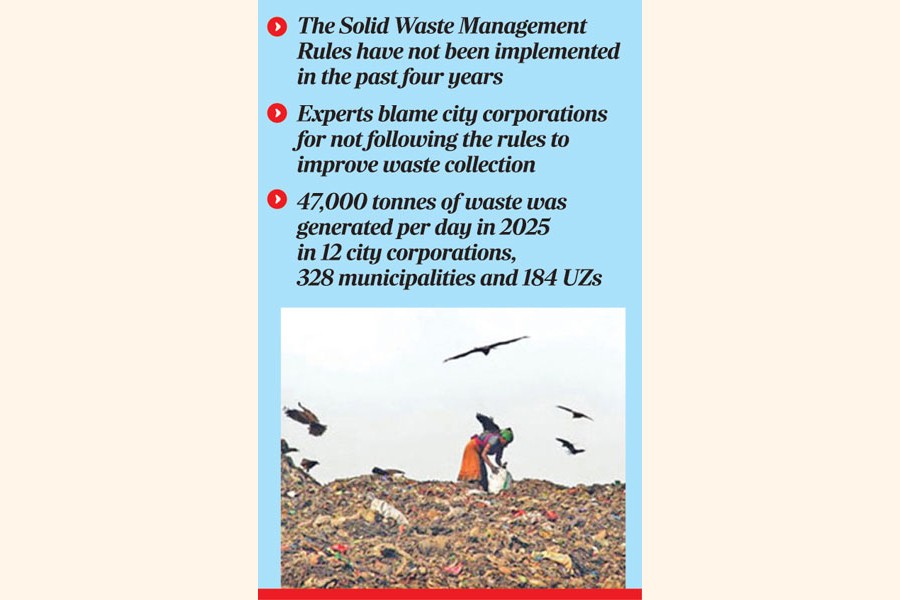
Solid waste management in all urban settings remains untapped despite the yearly doubling trend of its generation in the country as the authorities concerned have not yet implemented the Solid Waste Management Rules in the past four years.
Experts blamed the city corporations and municipalities for not following the rules prepared to improve the waste collection system despite its multi-level impacts on health, economy and climate change.
The Bangladesh Solid Waste Management Rules 2021, enacted under the Environment Conservation Act 1995 on December 23, 2021, aim to improve waste management through mandatory source segregation and the introduction of Extended Producer Responsibility (EPR).
These rules prioritise the 3R strategy (Reduce, Reuse, Recycle) and outline specific duties for citizens and the municipal authorities.
As solid waste generation is very much related to the population growth and urbanisation and economic growth, segregation of all kinds of waste of degradable and non-degradable from the household has been necessary.
Waste Concern (WC), a social business enterprise working in waste, estimated that 47,000 tonnes of waste was generated per day in 2025 in 12 city corporations, 328 municipalities and 184 upazila headquarters, projecting it to increase to 118,199 tonnes by 2040.
Of the total, 80 per cent are food waste in all cases while 7.13 per cent are plastic wastes. Others include e-waste, metal, wood, papers, fabrics and medical waste.
Iftekhar Enayetullah, managing director of Waste Concern, said due to inefficient waste collection, all these materials are mixed up in the landfill and damage the scope of reduce, reuse and recycle.
According to WC's survey data, 58 per cent of the generated waste was collected by all city corporations in 2022 which was 57 per cent in 2021 and 55 per cent in 2020.
Municipality or Pourashava's average collection efficiency was 50 per cent in 2020 and it increased 51 per cent in 2021; but remained same in 2022.
In the absence of a system to collect waste from the households, 52 per cent of waste was dumped in the landfills in 2020 which was increased to 53.64 per cent in 2021 and 58.25 per cent in 2022.
Only six per cent waste was brought under the 3R in 2020 and 2021 but it slightly increased to 7.14 per cent in 2022.
However, official sources said due to lack of coordination among urban authorities, solid waste management in the country remains untapped.
But they said the city corporations and municipalities have taken the time to train their staff and people about the rules.
"We have been informed that the local government has taken the time to groom all engaged in the waste collection system through brainstorming discussion and meeting during these days," said an official of the Department of Environment.
smunima@yahoo.com
© 2026 - All Rights with The Financial Express