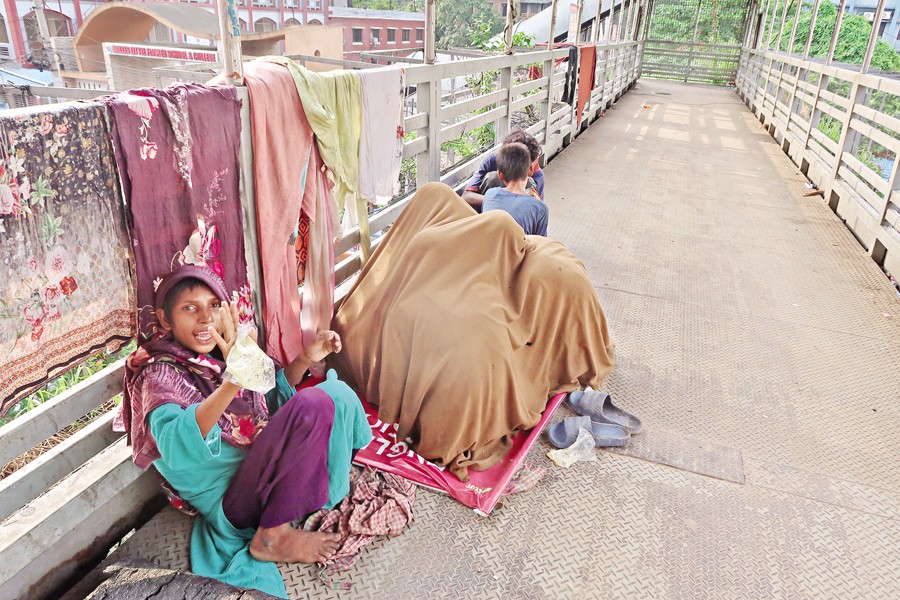
 Some street urchins sniffing 'dandy' (a type of glue) as a cheap drug on the Kakrail Footover Bridge in the capital recently. — FE Photo
 SM Najmus Sakib
Their existence is nowhere - neither in the government registry nor in family - but they brutally exist in open areas like road islands, under flyovers, railway stations, and bus and launch terminals in Dhaka city.
They are the street children often seen roaming in the city, having small polythene bags in their hands that are filled with glue called dandy (gums commonly used in repairing shoes and electronic products) and carrying large sacks to collect recyclable waste. Their sorrows prevail amid poor attention from the state machinery, including inaction to register their birth.
According to the law, the legal guardian is responsible for birth registration, while many of the children are unaware of their parents and the parents' whereabouts.
Bangladesh has a poor 50 per cent birth registration rate, one of the lowest in the world, against the world average of 77 per cent for children under five, according to the United Nations (UN).
It means they are unlikely to get the national ID upon turning 18 years old, not recognising their official existence that will further deprive them of the rights as citizens in a situation when they do not have a place to sleep, food to eat, and toilet facilities in the city.
The High Court in a recent order directed the registration of the births of 3.4 million street children (who have no parents/guardians), presuming the figure to be an estimated number.
However, officials at the social welfare ministry, Department of Social Services, and others have little information about the number of street children in the city and other parts of the country and how they survive in such a hostile environment.
Md Shadhin, a 14-15-year-old malnourished boy, has no address, family, or birth registration to claim his existence.
While talking to the FE, he was surrounded by seven to eight of his fellows in front of a restaurant in Purana Paltan.
They were trying to convince some of the devotees who came to buy iftar.
If any of them got money or food from these people, they would share it in the group.
"I do not know my exact birth date or place. I do not know about birth certificates. As I have no one to take care of me, I named myself Shadhin (independent)," he told the FE.
Some of his friends live on the road island in Purana Paltan, all holding dandy in their hands.
Recounting his ordeal, Shadhin said he tried but could not get a job mainly because no one was there as his guarantor.
"If you do not have a guardian as a guarantor, it is not possible to get a job. So, streets are the place to live and begging is the way to have food," he added.
Raihan, another boy aged 10-11 who was holding dandy in polythene, said he came from Mymensingh after his family was displaced by river erosion.
His family stays in the village, and he lives in the Motijheel area with a group of boys of his age.
They are unaware of the effect of inhaling dandy as they found this to be the only solution amid starvation, he added.
To the opposite of the Bangladesh Secretariat, a group of adolescents, mostly girls, were seen holding babies. They, however, refused to disclose the identities of the babies.
A study in 2025 said 27 per cent of street children have no known parents. It also revealed cases of children being subjected to horrific abuses, such as sexual harassment and gang rape.
Forhad Hossain, founder and executive director of Dhaka-based Local Education and Economic Development Organisation (LEEDO), told the FE this scenario exists in the country as the government failed them.
Hossain, who has worked for street children for decades, said based on their work in four major areas in the city - Kamalapur Railway Station, Mirpur, Gabtoli bus terminal, and Sadarghat - there are an estimated 200,000-250,000 street children.
"This is not the complete figure in Dhaka. We found so many female children sleeping in open spaces in the city. They are often victims of sexual abuse. There are male and female adolescents, and they stay in groups. Therefore, drug and sexual abuse are common crimes in such environments," he added.
"It is not their fault. They were supposed to go to school and get proper state care. The state has failed to ensure children's basic rights of education, food, protection, and home."
Furthermore, their number is on the rise, he believes.
"Since Covid-19 hit the country, we saw the number of poor people rise as so many people lost work and became newly poor. Furthermore, climate change is still a major cause of people coming to cities from vulnerable areas," Hossain explained.
In December 2025, the International Organisation for Migration (IOM) reported that an estimated 4.95 million people are currently displaced due to natural disasters in the country.
According to the PPRC-BIGD latest survey, the Covid-19 pandemic in 2021 created 24.5 million new poor.
Samir Mallik, director (institution) at the Department of Social Services, told the FE there is no certain government data on the number of street children yet.
An initiative was taken during the last interim government's term with support from the Bangladesh Bureau of Statistics (BBS). However, it did not proceed after the end of the term of the adviser concerned, he said.
A fresh initiative is underway with the help of BBS to know the number of street children, he said.
However, referring to the court, he said it is estimated that there are about 3.8 million street children in the country.
The official said the government has some three-four-day hubs for rest and food for street children in the city. They also have 86 government child family organisations with a capacity of 10,000 across the country, he said.
"These are not sufficient. We need more protection centres and rehabilitation hubs," Mallik underlined.
nsrafsanju@gmail.com
© 2026 - All Rights with The Financial Express