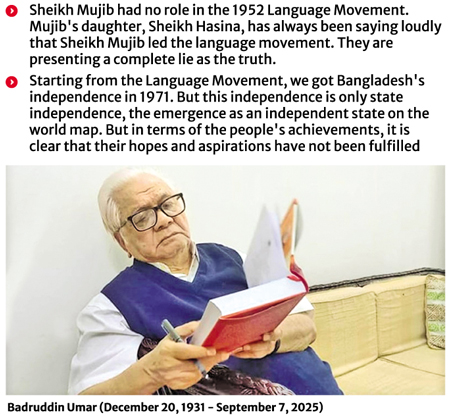
 Late left-wing politician, writer, researcher and historian Badruddin Umar gave an interview to BSS last year on February 20, highlighting various historical aspects of International Mother Language Day and Great Martyrs' Day, which is observed on February 21 in Bangladesh as Amar Ekushey, commemorating the 1952 Language Movement. Given the importance of the content, FE republishes the slightly abridged version of the interview
Do you find any difference in the observance of Amar Ekushey February between the pre-independence and post-independence periods in Bangladesh?
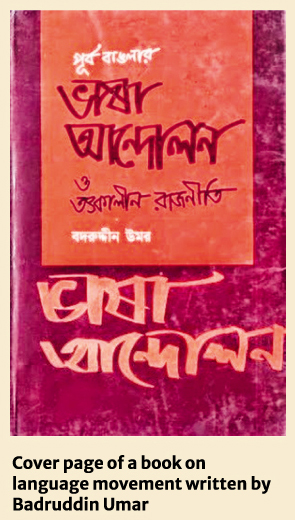
Badruddin Umar: The Language Movement took place more than seven decades ago. Since then there have been discussions on this movement. It can be said that discussions were scattered, but no significant work was done on this movement during Pakistani rule before Bangladesh's independence.
Every February, there were many emotional discussions about the Language Movement, but one significant aspect of the day before independence was that it was observed as a day of protest.
At that time, 'Probhat Pheri' was a very good programme, when youths, along with some middle-aged people, used to bring out a silent procession through the streets in the morning, singing songs of Amar Ekushey.
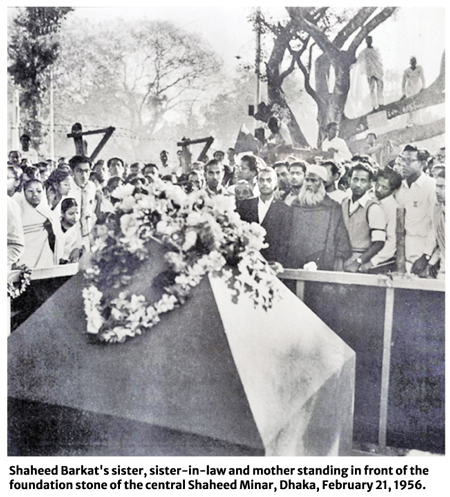
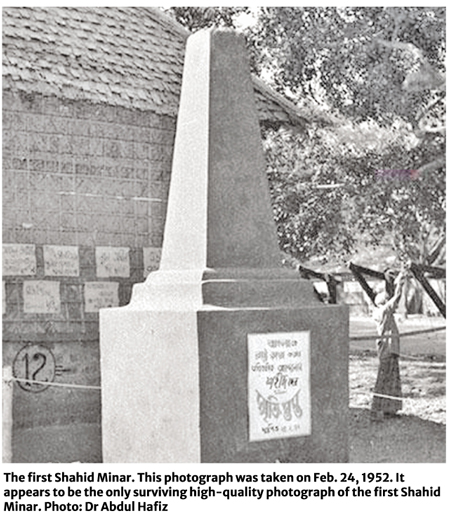
 The way Ekushey February was observed changed completely after 1971, as Sheikh Mujib cleverly turned the 'day of protest' into a 'day of mourning'. For this, he himself attended the Shaheed Minar at midnight on February 21, 1972 and inaugurated the programme. As a result, the Prabhat Pheri was abolished in 1972.
Since then, the language movement that was observed as a day of protest was put to an end, and the day began to be observed as a day of mourning. Thus, the traditional observance of the 21st February, which was stained with the blood of my brothers and people, closed down.
It's more noteworthy that it was marked as a day of rebellion, protest, and resistance than as a day of only expressing grief. I used to say that it was a day of resistance, but Sheikh Mujib very cleverly turned it into a day of mourning. He could sense that the spirit of Language Movement, if continue, might be a counter-product against his misrule. That's why he turned the protest into an occasion of just remembrance.
Since then, you will see no major movement or protest in the country centering 21st February or in the month of February against the rulers. Now the day is being observed merely as a ritual or custom.
Our failure to introduce Bangla at all levels of society is another important issue. We still shed tears over the Bangla language even after so many years. But the Bangla language is yet to be established at all levels. Besides, steps have yet to be taken to improve the Bangla language.
Moreover, the new generation is inclined to learning English and is turning away from the Bangla. A good number of students in our country do not know Bangla, and they feel proud of this. You would find no other nation in the world with this attitude except the Bangalees.
Real passion of the common people for the language movement no longer exists. During Hasina's tenure, the movement's spirit completely flattened out.
In which context did the language movement begin?
 Badruddin Umar: The issue of the language of East Bengal came to the forefront shortly after the country became independent in 1947. It is very important - Bengalis have a nationality based on their language.
Here, Muslims, Hindus, Buddhists, and Christians have all served this language for a long time. When Pakistan was created, it was not said that Pakistan would be a state based on religion. This was not even in the Lahore Resolution, and it was not said during the Pakistan movement. Even Jinnah did not say that. He was also not a practising Muslim. Only Gandhi had a connection with different castes, and he propagated Hindutva. Jinnah was nothing like that.
But after Pakistan came into being, it was told that Pakistan would be an Islamic state, and finally it happened. Before the creation of Pakistan in August 1947, the demand was raised in the then East Bengal that the new state would be non-communal. The People's Azadi League was formed in Dhaka under the leadership of Tajuddin Ahmed, Kamruddin Ahmed and Oli Ahad, who said that a non-communal democratic system should be introduced in this country in the future. On the other hand, there was no unity between the two parts of Pakistan, East and West Pakistan, in terms of language and culture, movement traditions, and social behaviour. Even the ways of practising Islam differed between the people of East and West Pakistan. Yet, in essence, there was a strong bond of Islam between the two regions, which led to the creation of Pakistan in two parts.
From the beginning, they relied on Islam to protect the integrity of Pakistan, and they said that if anyone spoke against the statehood of Pakistan and the Muslim League, it would be treated as a threat against Islam. We have also seen this during Hasina's rule. If someone said anything against her, it was tagged as opposing the Liberation War. This kind of devilry existed before, too.
After the creation of Pakistan, the right wing of the Muslim League did not allow the progressive left wing of the party to be integrated with the mainstream. This was a big mistake by the leaders of the provincial council here. In that situation, the left wing of the Muslim League opposed it. They were active in movements and had launched a language-based movement. Realising this, the right-wing leaders, in a bid to prevent the left leaders, brought the issue of making Urdu the state language of Pakistan in 1948.
It is noteworthy that Urdu was not an Islamic language, and it was not the language of any province or part of Pakistan. Urdu is an Indian language and is spoken in Bihar and Uttar Pradesh.
Instead of making any local language the state language of Pakistan, the rulers opted to make an Indian language the state language of Pakistan, which was mostly spoken by the elite group of India. It should mention that only the Pakistanis were not at the helm of the leadership of Pakistan after liberation. Many of the leaders, including Jinnah, Liaquat Ali Khan, and Chowdury Khaliquzzaman, were Urdu-speaking migrants from India.
Mohammad Ali Jinnah, Liaquat Ali Khan and Chowdhury Khaliquzzaman were Indians. At that time, India also had a problem with the state language; there was a protest against the Congress declaring Hindi as the state language. How did India deal with it?
Badruddin Umar: A few days after the partition in 1947, there was a strong opposition against the Hindi language in Andhra Pradesh, Madras, Tamil Nadu, Kerala and Assam. Those states were not in favour of Hindi, even though the Congress made Hindi the state language of India. There were also gunfights in some places over this dispute. But Nehru handled the situation smartly by reorganising India's provinces on the basis of their languages. He did not let the language problem reach a critical situation. There was trouble only in Assam, which was resolved later. Nehru understood that if opposition began in all regions, it would be difficult to handle. Hindi is not a progressive language, any more than Urdu. Bengali was the progressive language at that time. East Pakistan was the province of one language, unlikely to multi linguistic provinces of India. So, Nehru resolved the language problem by recognising the languages of all states.
Who played the major role in the language movement in 1952?
 Badruddin Umar: The language movement started in 1948. Among those who played an important role in this movement, Tamaddun Majlish was foremost. They were the most organised group. They played a major role in the language movement. Their Sainik newspaper played a strong role in favour of the language movement. Later, in 1952, the movement did not have that status. At that time, the political context changed, and groupings were formed. At that time, the Awami League played a limited role in the movement, but the Jubo League, influenced by the leftists, played an active role.
During the language movement in 1952, you were 21 years old and at Dhaka University. You were an eyewitness to this movement. Would you please share your experience of that time?
Badruddin Umar: I was neither a leader nor an activist of the Language Movement. But I'm a spectator of every incident of the movement. I have never worked linked to any student organisation in my life, and before joining the Communist Party in 1969, I was not associated with any political party. However, I have closely observed various incidents of the Language Movement. I have written it in my book. I had no role in that movement, but I have seen with my own eyes the role of everybody. I have seen all the incidents through the eyes of an ordinary student. I was present at the time of the put the Salimullah Muslim Hall under siege, when the protesters were shot at, and later at the Medical College. I also joined the procession.
What was the role of the political parties at that time in the language movement?
Badruddin Umar: The 1952 language movement was not under the control of any political party. There was no director of the movement. However, compared to the Jubo League's role in the movement, the Awami League played a lesser one. It does not mean that the movement was led by the Jubo League, though they played an active role. At that time, secretary of the Jubo League, Oli Ahad, had played a significant role.
What was the role of Sheikh Mujib in the language movement?
Badruddin Umar: Sheikh Mujib had no role in the 1952 Language Movement. Mujib's daughter, Sheikh Hasina, has always been saying loudly that Sheikh Mujib led the language movement. A writer and novelist wrote in a newspaper under the headline 'Bangabandhu and the Language Movement'. How did he come to that movement? These are the people who are talking about it. They are presenting a complete lie as the truth.
Sheikh Mujib was in jail during the language movement. He was sent from Dhaka to the Faridpur jail on February 17. How will he lead from Faridpur? Sheikh Mujib himself used to lie. He claimed that he used to lead the movement by writing notes from jail and throwing them out the washroom windows. It is a complete lie as he was not in Dhaka on February 21.
Last year, too, Hasina claimed that her father had been jailed repeatedly for the language movement, which is a complete lie. The truth is that Mujib has been landed in jail repeatedly for his involvement with many other movements. But lies never survive. The truth will be revealed. The truth peeked out in my writing, and now the truth has come out. No one can suppress history, because those who are in power cannot stay in power forever.
There are allegations of distortion and lies about the political history of Bangladesh; it is suicidal as a nation. What is the way out of it?
Badruddin Umar: The Awami League is an organisation that first introduced the term 'distortion of history'; we had never heard of it before. They introduced it, but no one has distorted history more than them. They have completely put an end to the practice of history. Therefore, there is a need to write not only about the role of Sheikh Mujib but also about the political history of this country in a truthful and impartial manner. It is hoped that the new generation will discharge that responsibility in the future.
What were the expectations and achievements of the nation from the Language Movement and national independence?
Badruddin Umar: Starting from the Language Movement, we got Bangladesh's independence in 1971. But this independence is only state independence, the emergence as an independent state on the world map. But in terms of the people's achievements, it is clear that their hopes and aspirations have not been fulfilled.
Even after independence, the people did not get anything during the three and a half years of Sheikh Mujib's regime. They only got exploitation, torture, tyranny of the Rakshi Bahini, cruelty, and famine. People got nothing during the rule of Sheikh Mujib. So, it was not surprising that not a single person stood on the street and none expressed grief for Mujib after his killing along with his family members on August 15, 1975. Moreover, thousands of people came out on the streets and expressed joy. They distributed sweets.
However, in January 1972, millions of people in this country welcomed him. They were very fond of him. When he was killed three and a half years later, not a single person came out. What was the reason? This must be sought out, and the Awami League must explain, and Sheikh Mujib's daughter must explain.
The same public reaction we have seen on August 5, when people spontaneously came out on the streets from all sides against Hasina's misrule, and the sculptures and structures of Sheikh Mujib and his group were demolished. They must find an answer to this question: why does this happen? Before drawing a judgment, everyone should ask questions to check the facts. Those who have written history are afraid of fact-checking. Actual facts resolve many problems.
The foundation of the exploitation and torture that we have seen since independence was laid in 1972. Corruption, looting, and smuggling started in 1972 during the Awami regime. Though there was no industry in the country at that time, a class of people related to the government earned millions of money who are representing people in the parliament now and holding the authoritative power in their hands. They are still influencing society even after the departure of Sheikh Hasina, and nothing is beyond their control. The looting class left behind by Hasina is still active.
© 2026 - All Rights with The Financial Express