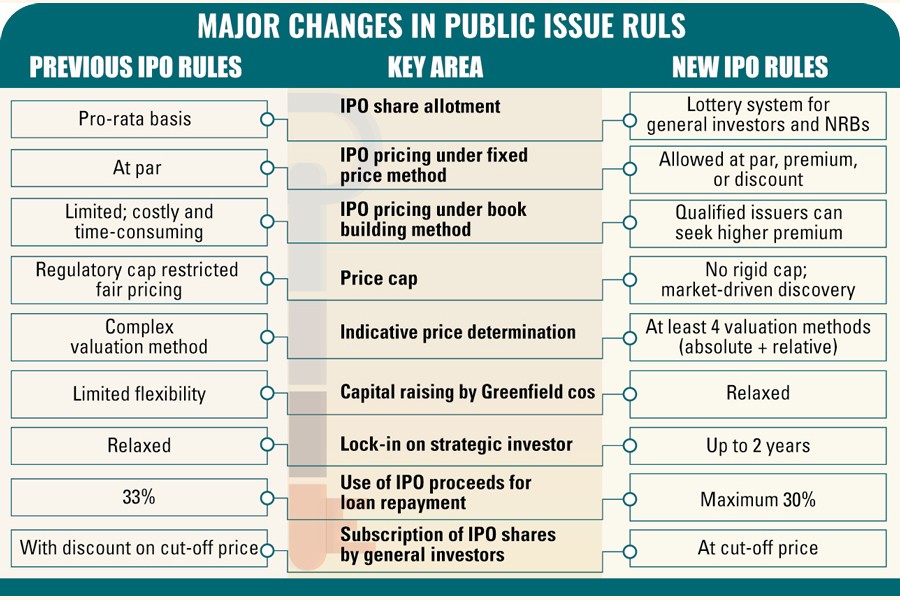
The securities regulator has reinstated the process of allotting IPO (initial public offering) shares through a lottery system, reversing a previous shift to a pro-rata allocation method.
This decision is part of the revised Bangladesh Securities and Exchange Commission (Public Offer of Equity Securities) Rules, 2025, which came into effect on December 30, 2025 through a gazette notification.
At a press briefing on Wednesday, BSEC spokesperson Md. Abul Kalam explained that the reinstatement of the IPO lottery system was based on feedback from general investors on the draft of the new public issue rules.
"The regulator has restored the IPO lottery system following the opinions of general investors on the draft of the public issue rules," he said.
The pro-rata system had been in place since January 2020. It allocated IPO shares based on the size of an investor's bid. This system aimed to expedite company listings and reduce the costs of raising capital.
However, many general investors expressed dissatisfaction in their feedback, arguing that the pro-rata method disproportionately favoured larger investors with greater capital, leaving smaller investors with minimal or no allocations.
As a result, the number of Beneficiary Owner (BO) accounts in the capital market gradually declined.
Kalam said 171 out of 200 investor opinions submitted were in favour of re-introducing the IPO lottery system.
"Considering all such issues, the securities regulator has re-introduced the IPO lottery system, scrapping the system of allotting IPO shares on a pro-rata basis," he said.
Under the revised rules, the IPO lottery system will apply to only general investors and non-resident Bangladeshis (NRBs) under both the fixed price and book-building methods.
Under the fixed price method, 60 per cent shares of a company's public offer will be allocated to general investors and 10 per cent to NRBs.
The remaining 30 per cent shares will be allotted among eligible investors (EIs), mutual funds and permanent employees of the issuer company on a pro-rata basis.
Under the book building method, 35 per cent shares will be available for general investors and 7 per cent shares will allocated to NRBs.
The remaining shares will be allotted to EIs, mutual funds, high-net-worth individuals and permanent employees of the issuer company on a pro-rata basis.
At the press briefing, BSEC spokesperson Abul Kalam said the regulator has finalised the new public issue rules based on the opinions received from all types of stakeholders, including general investors.
"We've tried our best to ensure fair valuation of IPO shares," he said, adding that any parties trying to manipulate share valuations during the bidding would face strict penalties.
In response to business concerns, the revised rules also allow companies to repay bank loans with IPO or Rights Public Offering (RPO) proceeds. However, there is a condition that the repayment of non-performing loans with such funds will not be allowed.
Initially, this provision was scrapped to discourage companies from using public funds to clear debts. However, after further deliberation, the BSEC decided that loans taken for business expansion or modernisation could be repaid using IPO proceeds.
In that case, the auditor's reports on utilisation of bank loans for projects and BMRE purposes will be mandatory to seek the regulatory approval on the IPO proposal.
Among others, the new rules stipulate that issue managers, auditors and credit rating agencies must conduct on-site visits to the issuing company's facilities.
Also, the stock exchanges and any other expert shall have the right to visit factory, business office and seek relevant books of accounts and documents to facilitate appropriate due diligence certificate and report for IPO application.
The revised rules also introduce new capital requirements for IPO eligibility.
As per the new rules, a company must have a minimum paid-up capital of Tk 300 million to float an IPO under both fixed price and book-building methods.
On the other hand, the post-IPO paid-up capital will be at least Tk 500 million and the minimum public offer will be at least 10 per cent of the post-IPO capital.
For companies using the fixed price method, the post-IPO paid-up capital cannot exceed Tk 1.25 billion. However, there is no upper limit for companies using the book-building method.
For large companies, including multinational corporations, the BSEC has allowed a public offer worth less than 10 per cent of a company's post-IPO capital if that post-IPO capital exceeds Tk 5 billion.
"The public issue rules have been finalised based on the opinions of the stakeholders. We expect the new rules will help ensure transparency," said the BSEC Spokesperson.
farhan.fardaus@gmail.com
mufazzal.fe@gmail.com
© 2026 - All Rights with The Financial Express