For more than a decade, Bangladesh's digital journey has been defined by the mobile phone for its multiple usages. Cheap handsets and expanding 3G and 4G coverage allowed millions to leapfrog fixed lines and enter the internet age through their palms. Today, however, that mobile-first story is quietly changing. Recent data from 2025 and early 2026 suggest a decisive shift: while mobile internet use is cooling, fixed broadband-particularly fibre-optic connections-is steadily gaining ground.
According to figures from the Bangladesh Telecommunication Regulatory Commission (BTRC), mobile internet subscriptions declined by several million in late 2025, falling to around 115-116 million users. Though still dominant in absolute terms, the drop marks the first sustained contraction in the mobile-data market. Fixed-broadband subscriptions, by contrast, have remained stable, and gradually rising, reaching approximately 14.6 million connections. The quality gap is equally striking. Median fixed,- broadband download speeds now exceed 60 Mbps, compared to roughly 35-37 Mbps on mobile networks, even as mobile speeds continue to improve year on year.
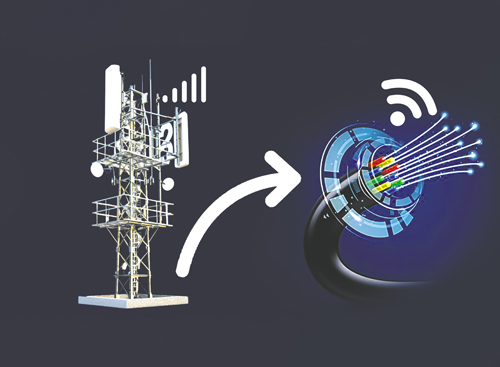
The reasons behind this rebalancing are largely economic. Mobile data in Bangladesh remain expensive for heavy users. A few hours of HD streaming, online classes or cloud uploads can exhaust a monthly data pack quickly. In contrast, a shared household broadband connection priced at around Tk500 per month offers unlimited usage. As inflation squeezes household budgets, families are increasingly opting to consolidate their digital spending into a single, reliable home connection rather than multiple individual mobile packages.
Regulatory measures have also contributed to the slowdown in mobile subscriptions. SIM re-verification drives and stricter enforcement of ownership limits-capped at five SIMs per national ID-have eliminated millions of inactive or secondary connections. While intended to improve security and governance, these measures revealed how inflated mobile subscription numbers had become, particularly for data-only SIMs with marginal use.
Beyond cost and regulation, the nature of internet use in Bangladesh has fundamentally changed. The country has emerged as one of the world's largest freelancing hubs, with hundreds of thousands of active professionals earning foreign currency through digital platforms. For these users, connectivity is not about casual browsing but about stability, low latency and reliability. Long video conferences, live collaboration and multi-gigabyte file uploads remain inconsistent over mobile hotspots, making fibre broadband a professional necessity rather than a luxury.
Government policy has quietly reinforced this trend. The "One Country, One Rate" initiative standardised broadband pricing nationwide, narrowing the long-standing gap between urban and rural access. As fibre networks expand beyond major cities, villages that once relied entirely on unstable mobile signals are now gaining access to fixed connections suitable for education, work and digital services. For rural students attending online classes, the difference has been transformative.
Each mode of connectivity still has its strengths and limitations. Fixed broadband offers higher speeds, lower latency and greater reliability, supporting multiple devices within a household. It underpins online education, remote work, gaming and the growing culture of shared screens, from smart televisions to family laptops. Its drawbacks lie in limited portability and dependence on local ISP infrastructure, which can vary in quality. Mobile internet retains the advantage of mobility and instant access, with improving 4G performance and limited 5G rollouts. Yet data caps, fair usage policies and indoor signal degradation continue to frustrate heavy users.
In the Bangladeshi context, the broader impact is significant. Reliable broadband has become a cornerstone of the digital economy, supporting e-commerce, freelancing, telemedicine and digital public services. Homes are evolving into hybrid spaces where work, study and entertainment coexist, shifting digital consumption from individual screens to shared household use.
Globally, Bangladesh's experience mirrors patterns seen earlier in developed markets. Mobile data initially drove mass adoption, but as digital economies matured, fixed broadband re-emerged as the backbone for high-intensity use. Some countries are now experimenting with fixed wireless access using advanced 5G as a substitute for fibre, a path Bangladesh may explore once network density and affordability improve.
Looking ahead, several developments could accelerate the transition. The commissioning of the SEA-ME-WE 6 submarine cable, expected around 2026, is set to expand international bandwidth capacity and reduce latency. Low Earth orbit satellite services also hold promise for riverine and hilly regions where fibre deployment is impractical. Meanwhile, growing adoption of IPv6 will prepare networks for more connected devices and smarter homes.
As Bangladesh moves towards its "Smart Bangladesh 2041" vision, the current shift from mobile-heavy access to a more balanced, broadband-centred model marks a quiet but important milestone. The national conversation is no longer about merely getting online, but about the quality and purpose of that connection. In that sense, the move from airwaves to fibre signals not a retreat from mobility but the country's digital coming of age.
© 2026 - All Rights with The Financial Express