Imagine streaming an 8K film, attending a virtual class, and managing a house full of smart devices-all at once, without a glitch. That level of seamless digital living is no longer a distant dream. With the emergence of Wi-Fi 7, Bangladesh is on the cusp of a transformative leap in how it connects, communicates, and innovates.
While most people are familiar with the evolution of mobile networks from 4G to 5G, few realise that Wi-Fi technology has also been advancing in parallel. From Wi-Fi 4 and 5 to the now widespread Wi-Fi 6, each generation has delivered incremental improvements in speed, reliability, and capacity. However, Wi-Fi 7-officially designated as IEEE 802.11be, or Extremely High Throughput (EHT)-marks a revolutionary step forward.
What is Wi-Fi 7?
In early 2023, the Wi-Fi Alliance-the global certification body for Wi-Fi devices-launched the "Wi-Fi Certified 7" programme, setting the stage for standardised global deployment. So far, over 60 countries have fully or partially opened up the critical 6 GHz spectrum band required for the new technology.
How is Wi-Fi 7 Different from
Wi-Fi 6?
Wi-Fi 7 brings a new level of performance to wireless connectivity, offering exceptional speed, enhanced capacity, and ultra-responsive connections. Its data transmission rate can reach up to 23 Gbps-nearly three times faster than Wi-Fi 6. One of the most significant technical upgrades is the use of 4096-QAM (Quadrature Amplitude Modulation), which increases data throughput by 20% compared to its predecessor.
Another key innovation is Multi-Link Operation (MLO), which allows devices to simultaneously utilise multiple frequency bands-2.4 GHz, 5 GHz, and 6 GHz. This greatly enhances throughput, reduces interference, and increases reliability, especially in congested network environments.
The adoption of 320 MHz channel bandwidths, double that of Wi-Fi 6, further accelerates data transfer-making Wi-Fi 7 ideal for high-demand applications like 8K video streaming, AR/VR platforms, and real-time gaming. With its ability to support more connected devices at higher speeds and with far lower latency, Wi-Fi 7 is poised to be a foundational technology for both consumers and industries.
Use Cases of Wi-Fi 7
Wi-Fi 7's real-world applications are broad and impactful.
In education, it enables real-time, interactive digital classrooms. In healthcare, it powers lag-free telemedicine, remote diagnostics, and real-time patient monitoring. In manufacturing and logistics, it boosts the precision and uptime of industrial IoT systems. In finance, it supports high-frequency trading and data analytics with minimal latency. Even daily life will change-through faster video calls, immersive VR experiences, and smarter, more responsive homes and cities.
Wi-Fi 7 in Bangladesh
Wi-Fi is already a primary mode of connectivity across the country and is expected to grow substantially in coming years. However, to fully benefit from Wi-Fi 7, both the router/access point and connected devices (phones, laptops, IoT devices) must be compatible. While some flagship smartphones already support Wi-Fi 7, many households and offices will need to upgrade their routers.
Huawei Leads the Way
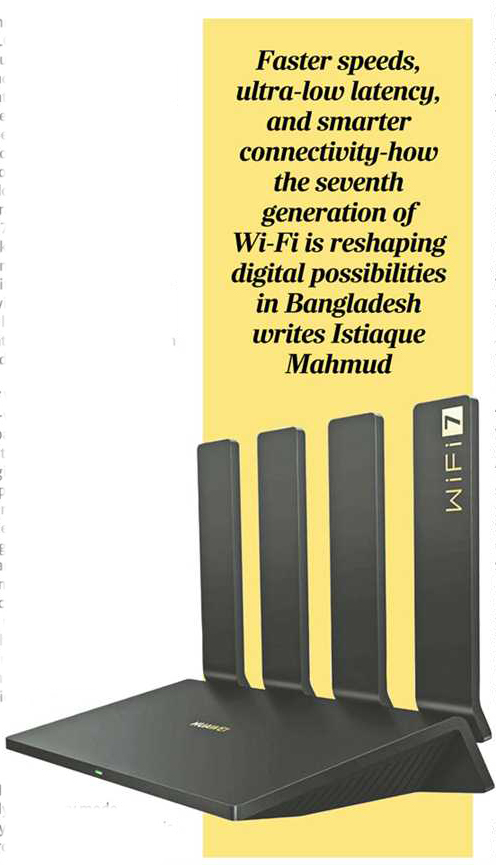
In Bangladesh, Huawei has become the first company to launch six Wi-Fi 7 access point (AP) models, positioning itself at the forefront of the country's wireless modernisation.
These include the AirEngine 5773-21, 5773-22P, 5773-23H, 5773-23HW, 5776-26, and 6776-56TP-designed for environments ranging from compact institutional settings to large venues such as stadiums and auditoriums.
Equipped with smart antennas that double the signal strength of previous generations, the devices also feature Wi-Fi Shield security, which protects against unauthorised data access. Notably, they offer backward compatibility-enhancing connectivity even for devices that are not yet Wi-Fi 7-ready.
The Road Ahead
With the rise of Artificial Intelligence, Cloud Computing, and the Internet of Things (IoT), the need for faster, more secure wireless networks has never been greater. For Bangladesh to sustain its digital momentum, hospitals, universities, and corporate institutions will need not just high-speed internet, but also robust, secure, and scalable networks.
Several local institutions, including BRAC University, Southeast University, East West University, and the Bangladesh University of Textiles (BUTEX), have already embraced Wi-Fi 7 technology-laying the groundwork for broader adoption.
In essence, Wi-Fi 7 is not just a technological upgrade; it is a catalyst for Bangladesh's digital transformation-bringing the country closer to its vision of becoming a knowledge-based, smart economy.
© 2026 - All Rights with The Financial Express