State-owned mobile operator Teletalk Bangladesh Limited has proposed three small-scale projects involving a combined cost of Tk 1.40 billion to expand 4G services to universities, medical colleges, key national highways and remote tourist destinations.
However, the Planning Commission officials have raised concerns over the rationale behind the proposals, noting that a much larger Tk 22.38 billion project to roll out 5G services nationwide has already been under implementation since 2021, sources said.
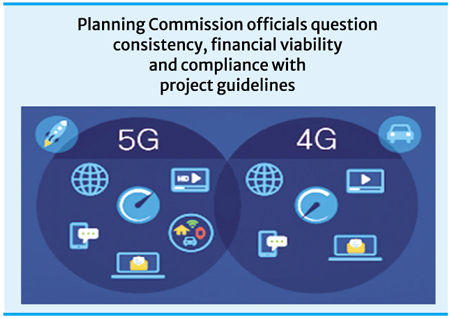 Planning Commission officials argue that the move to pursue separate 4G expansion projects for selected locations appears inconsistent with the broader objectives of the ongoing 5G initiative.
A senior official from the ECNEC, NEC and Coordination wing of the Planning Division alleged that the three proposals violate clear government directives discouraging fragmented project design.
"Instead of taking multiple small projects of similar nature and objectives, a single integrated project should be undertaken," the official said, referring to the 2022 guidelines for public sector development projects.
The official also noted that projects costing below Tk 500 million do not require mandatory feasibility studies and can be approved by the planning minister outside the ECNEC framework, which may have influenced the structuring of the proposals into smaller units.
The Physical Infrastructure Division of the Planning Commission is set to hold Project Evaluation Committee (PEC) meetings next week to review the three proposals submitted by the Posts and Telecommunications Division.
According to meeting documents, each project is estimated to cost between Tk 456 million and Tk 477.8 million, with around 60 per cent of financing expected from government loans and the remainder as equity investment.
However, the proposals reportedly lack detailed assessments of past government support and return on investment, raising concerns over financial viability and accountability.
Despite the criticism, Teletalk officials defended the initiatives. D. M. Nurul Huda, general manager (planning and implementation) at Teletalk, said that although the core objective of the three projects is to expand voice and data services, the projects are designed to address different service needs across highways, educational institutions and tourist areas, with technological variations in each case.
He added that although the projects will initially roll out 4G services, the infrastructure will be 5G-ready, allowing future upgrades without significant additional investment.
Kabir Ahamed, who is overseeing the Physical Infrastructure Division and will preside over the PEC meetings, said any inconsistencies in the proposals would be examined during the review process.
He, however, acknowledged the necessity of such initiatives for expanding Teletalk's service coverage, adding that the ministry may have opted against proposing a single large project due to prevailing financing constraints.
One of the projects, estimated at Tk 477.8 million, aims to strengthen network coverage along major corridors including Dhaka-Chattogram, Dhaka-Sylhet, Dhaka-Mymensingh and Dhaka-Patuakhali through installation of 70 BTS sites with 2G and 4G technology and network upgrades.
Another project, costing Tk 465.5 million, proposes to use satellite technology to extend 4G services to remote and tourist-heavy areas across seven divisions, including installation of 100 BTS sites using satellite-based backhaul in regions where fibre connectivity is difficult.
The third project, estimated at Tk 456 million, targets universities and medical colleges, with plans to install 95 BTS sites to improve campus connectivity with 4G coverage.
Working papers prepared for the PEC meetings also flagged concerns over the apparent mismatch between the proposed 4G expansion and the broader 5G modernisation initiative. Officials questioned whether prioritising 4G at this stage could affect future high-speed bandwidth demand and alignment with the National ICT Policy 2018.
Officials further identified weaknesses in project design and cost estimates, noting that some equipment costs were significantly higher than comparable projects.
They also raised issues regarding inconsistent project naming, unrealistic procurement timelines and lack of alignment between financial and physical implementation plans.
jahid.rn@gmail.com
© 2026 - All Rights with The Financial Express