Export diversification remains a critical development objective for Bangladesh as the country seeks to reduce its heavy reliance on readymade garments (RMG). Within this context, the handicraft sector presents a viable alternative export avenue due to its strong backward linkages with rural employment, cultural heritage, and environmentally sustainable production. Despite its long tradition and growing global relevance, the sector has not achieved commensurate success in international markets.
GLOBAL MARKET TRENDS IN HANDICRAFTS: The global handicraft market has experienced sustained growth over the past decade, driven by increasing consumer awareness of sustainability, ethical sourcing, and cultural authenticity. Handmade and eco-friendly products are increasingly preferred in developed markets, particularly in Europe and North America. Moreover, the expansion of e-commerce platforms has reduced entry barriers for small producers, enabling artisans from developing countries to access global value chains. Artworks and traditional crafts are also gaining recognition on humanitarian and cultural grounds, further strengthening demand.
The global market size of handicrafts-encompassing textile, metal, wood and stone, ceramic, pottery, vegetable fiber-based handicrafts, as well as eco-friendly products-is estimated at US$ 1,107 billion and is projected to reach US$ 2.3 trillion, growing at a CAGR of 10.15 per cent.
EXPORT PERFORMANCE IN HANDICRAFTS: Bangladesh's handicraft exports are concentrated largely under HS Chapter 46, which includes manufactures of straw, esparto, and other plaiting materials such as basketware and wickerwork. Although exports have shown gradual growth, Bangladesh's global market share remains very insignificant compared to major exporters like China and India. Weak branding, limited product diversification, and inadequate promotional efforts have restricted the sector's ability to scale up exports despite favorable global demand conditions. The export performance of the last five years is furnished in table 1.
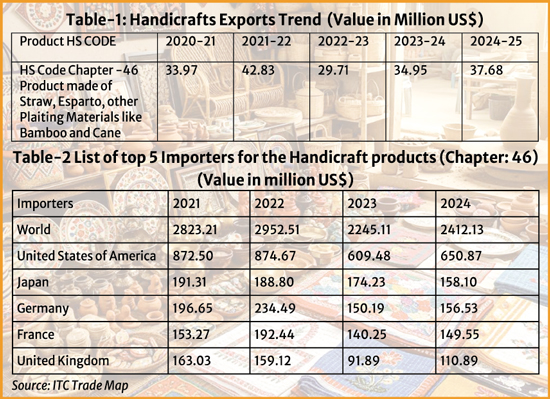 There is a significant strategic planning gap between Bangladesh's export performance and the market size of the leading importing countries. Bangladesh can further increase its market share by deepening penetration in existing markets and pursuing product and market development.Import data of the leading countries for the last four years are presented below:
Beyond HS Chapter 46, exports from other segments of the handicrafts sector-classified under HS codes 560900, 420221, 420211, 340600, 630590, 570500, 570210, 530310, 531010, and 480210-are estimated at approximately USD 380 million. The global market size for these segments is estimated at USD 31.93 billion, of which Bangladesh accounts for only 1.18 per cent of the world market share.
COMPETITIVE ADVANTAGES OF BANGLADESH: Bangladesh possesses several intrinsic strengths that support the development of a competitive handicraft export sector. These include an abundant supply of skilled artisans with traditional craftsmanship, a strong raw material base in jute and natural fibers, and alignment with global sustainability trends. In recent years, there has also been progress in design development and export compliance, enhancing the sector's readiness for international markets. These advantages provide a solid foundation for future growth if supported by targeted interventions.
INTERNAL CONSTRAINTS AND STRUCTURAL WEAKNESSES: Notwithstanding its strengths, the handicraft sector faces significant internal challenges. The absence of dedicated research and development (R&D) and design centres limits innovation and product upgrading. Access to finance remains constrained, particularly for small producers and informal enterprises. The sector also suffers from a shortage of skilled artisans, inconsistent availability of raw materials, rising input costs, and inadequate infrastructure for storage and transportation. Furthermore, weak institutional coordination and insufficient government support have resulted in poor integration between local producers and global markets.
EXTERNAL CHALLENGES AND COMPETITIVE PRESSURES: Externally, Bangladesh's handicraft exports face intense competition from established producers, notably China and India, which benefit from scale economies, advanced design capabilities, and strong country branding. The proliferation of low-cost substitute products further erodes price competitiveness. Additionally, the lack of a coherent national branding strategy and limited international promotion reduce the visibility of Bangladeshi handicrafts in global markets.
EMERGING OPPORTUNITIES: Despite these challenges, several emerging trends offer new opportunities for the sector. The global shift toward sustainable lifestyles, growing demand for eco-friendly and locally made products, and the availability of donor funding for artisan development create a favourable external environment. Government policy initiatives aimed at product upgrading, combined with the rapid growth of e-commerce, present additional pathways for enhancing export performance.
POLICY IMPLICATIONS AND STRATEGIC RECOMMENDATIONS: To realise the full export potential of the handicraft sector, a comprehensive and updated policy framework is essential. Key measures should include the establishment of R&D and design centres, improved access to finance through targeted credit facilities and incentive schemes, and strengthened skill development and capacity-building programmes. Investments in infrastructure, logistics, and digital platforms are also critical to enhancing market access and export competitiveness.
The Handicrafts Policy 2018 (or existing policy) has not yet been revised to adequately reflect the current global market dynamics and the evolving challenges faced by sector stakeholders. Immediate government intervention is, therefore, necessary. In addition, nationwide cluster mapping to develop an accurate and updated database of artisans and enterprises is crucial for evidence-based policymaking and effective government support.
Equally important is the development of a strong country branding strategy and proactive participation in international trade fairs and online marketplaces. Emphasis on sustainable and eco-friendly production should remain central to policy interventions.
The handicraft sector offers Bangladesh a strategic opportunity to promote export diversification, rural employment, and sustainable development. While the sector faces both internal and external constraints, favourable global trends and emerging market opportunities provide a strong rationale for renewed policy attention. With coordinated institutional support, targeted investment, and effective global positioning, Bangladesh can enhance the competitiveness of its handicraft industry and secure a stronger role in the international handicraft market.
Abu Mukhles Alamgir Hossain is Director (Current Charge), Export Promotion Bureau (EPB). amahepb75@gmail.com
© 2026 - All Rights with The Financial Express