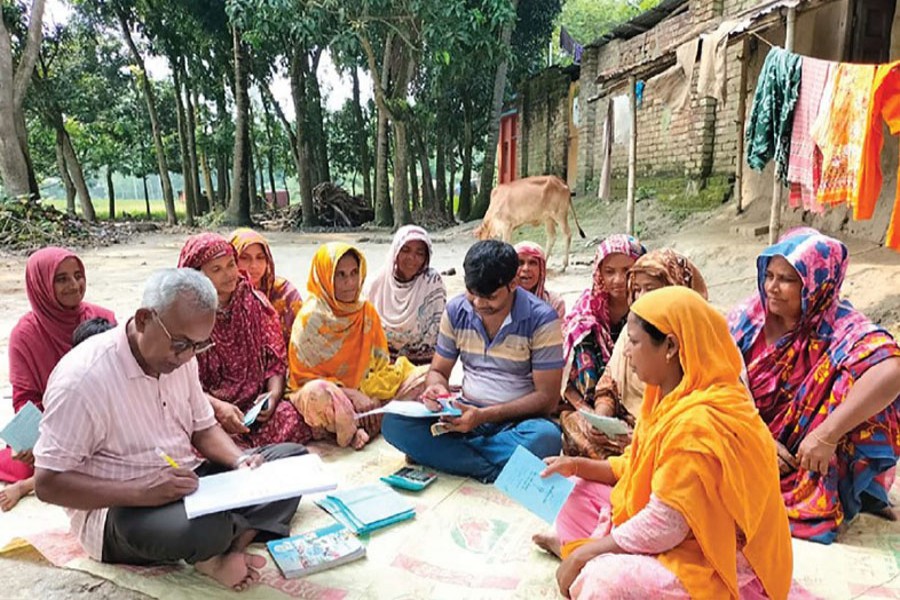
 Staffs updating status of the microcredit borrowers of a MFI in Bangladesh —Collected Photo
 Bangladesh's microcredit sector is not a conventional financial industry; it is the outcome of decades of social mobilisation, institutional innovation, and an integrated development philosophy that blends finance with health, education, disaster response, and livelihood support. The draft ordinance issued by the Financial Institutions Division of the Ministry of Finance on December 15, 2025-proposing the establishment of Microcredit Banks (MCBs)-therefore marks a profound departure from the country's proven development trajectory. Rather than strengthening financial inclusion, the proposal risks destabilising a socially embedded ecosystem that has delivered resilience, poverty reduction, and grassroots empowerment for more than four decades.
The ordinance allows only one month for public feedback, with consultation closing on January 15, 2026. This short timeline overlooks the scale and complexity of the sector: nearly 700 licensed microfinance institutions (MFIs), about 40 million client families, half a million employees, and a "microfinance-plus" model that has become a global reference point. A reform of this magnitude demands broad, structured consultation. Its absence signals a rushed and insufficiently grounded policy approach that could unintentionally reverse long-standing development gains.
A SECTOR OF $13 BILLION AT RISK: Bangladesh's microfinance sector manages outstanding loans of about US$ 13 billion, supported by member savings of US$ 5 billion-nearly 43 per cent of the loan portfolio. Bank borrowing accounts for 18 per cent of sector financing, while PKSF contributes 7 per cent. This structure has allowed MFIs to remain largely self-reliant while reinvesting surpluses into social programmes such as skills training, entrepreneurship development, health services, education, and disaster preparedness.
Transforming MFIs into bank-like entities would fundamentally alter this balance. Microfinance in Bangladesh began as a development intervention, not a profit-driven banking product. A bank-centric regulatory framework focused on capital adequacy, balance sheets, and profitability would inevitably prioritise financial metrics over social outcomes. This shift would hollow out the "microfinance-plus" model just as Bangladesh faces greater vulnerability from climate shocks and economic transition. According to World Bank estimates, about 40 per cent of the population still lives under or near the poverty line, where resilience, not income alone, defines economic security.
POST-2026 REALITIES AND UNEQUAL COMPETITION: The timing of the proposal is concerning. As Bangladesh approaches middle-income status after 2026, external donor funding for NGOs has steadily declined. For more than two decades, foreign aid has played a negligible role in financing microcredit operations. Today, MFIs fund their development activities almost entirely from internal surpluses. Introducing Microcredit Banks now would squeeze these resources, as banking regulations and shareholder expectations crowd out socially oriented spending.
The draft ordinance also creates an uneven competitive landscape. Proposed MCBs would have recovery powers under the Public Demands Recovery Act of 1931, the ability to take collateral, unrestricted retail banking with non-members, and implicit dual regulation involving Bangladesh Bank. NGO MFIs, regulated by the Microcredit Regulatory Authority (MRA) and the NGO Affairs Bureau, would be at a structural disadvantage, especially small and medium institutions in remote and climate-vulnerable regions. This imbalance would accelerate sectoral concentration and risk the extinction of grassroots MFIs that form the backbone of rural financial inclusion.
BANKING SECTOR STRESS AND POLICY MISALIGNMENT: Bangladesh already hosts 62 commercial banks, including 43 private institutions. Recent public rescues of four banks have reportedly cost the exchequer around Tk 20,000 crore, while several non-bank financial institutions remain distressed, with non-performing loan ratios exceeding 50 per cent. In regional comparison, Thailand operates with 18 banks, Malaysia with eight, and Singapore with five-highlighting that financial stability depends on strength and governance, not numerical expansion.
Against this backdrop, creating a new category of Microcredit Banks appears misaligned with systemic priorities. The real challenges facing microfinance-borrower duplication, staff misappropriation costing an estimated 1-2 per cent of capital annually, rising defaults, limited access to subsidised wholesale funds for small MFIs, and cumbersome RJSC registration-remain unaddressed. Tools such as the Credit Information Bureau and Staff Information Bureau introduced by the MRA are promising but need stronger implementation, not institutional overhaul.
The proposed Microcredit Bank framework does not resolve the structural challenges of Bangladesh's microcredit sector; instead, it introduces new risks: mission drift, unequal competition, regulatory confusion, institutional fragility, and the erosion of civil society space. At a time when development financing is tightening and economic resilience is crucial, dismantling a self-financed, socially embedded model would be strategically unsound.
Bangladesh needs not more banks, but smarter reform: strengthening existing institutions, expanding subsidised wholesale lending windows within current banks for NGO MFIs, improving governance tools, and protecting the social mission that made microfinance a global success story. Financial inclusion should reinforce development, not undermine it.
The writer is Executive Director, COAST Foundation. reza@coastbd.net
© 2026 - All Rights with The Financial Express