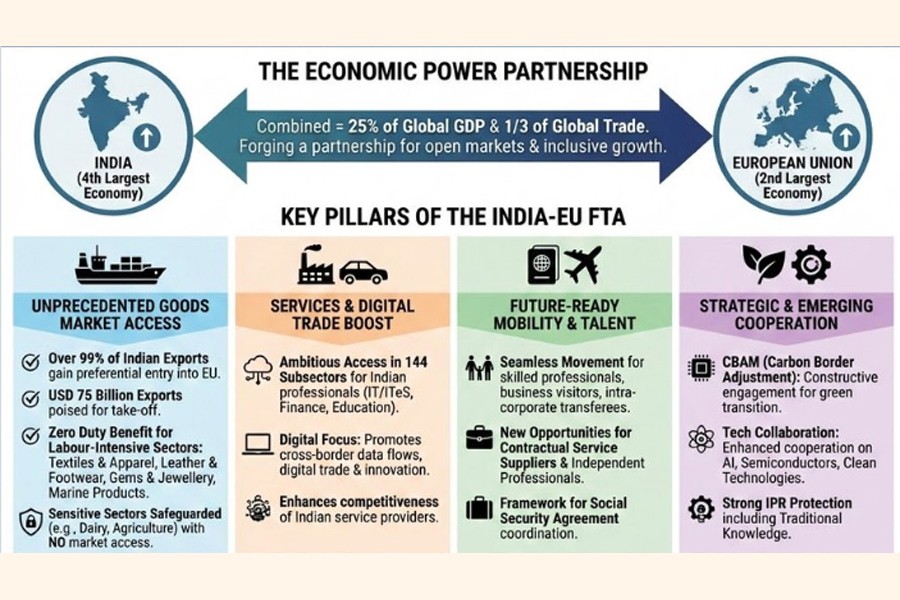
 Graphic source: www.drishtiias.com
 The European Union (EU) and India is signing free trade agreement that both sides have hailed as 'the mother of all deals'. The agreement came together after over nearly two decades of intermittent negotiations and during a geo-economic crisis triggered by United States President Donald Trump's trade war. The deal between India and the 27-nation EU covers about 2 billion people and represents a combined market of nearly US$ 27 trillion and about 25 per cent of the global gross domestic product (GDP). It is expected to significantly reduce tariffs for India and the EU as the deal is India's largest and most comprehensive trade agreement and covers goods, services and investments across the EU's customs union.
European Commission President Ursula von der Leyen and European Council President Antonio Costa were in New Delhi as honorary guests for the Indian Republic Day and its annual military parade and was joined by Indian Prime Minister Narendra Modi.
In 2023, the EU withdrew its generalised system of preferences (GSP) for India, exposing its exporters to higher tariffs. The new deal, analysts noted, could give India an edge in several sectors, including textiles, pharmaceuticals, machinery, steel, petroleum products and electrical equipment.
Overall, the EU is giving India access to 144 services subsectors while India is opening 102 subsectors to the EU, including in the financial, maritime and telecommunications industries.
Negotiations to reach a trade deal between India and the EU broke down in 2013 over New Delhi's reluctance to open its automobile sector. Under the deal announced on Tuesday last, however, New Delhi will open its domestic automobile market to EU imports, slashing tariffs on most cars from the EU to 30 to 35 per cent, which are to be then phased down to 10 per cent over several years.
HOW WILL THE DEAL BENEFIT THE EU: Indian tariffs on 30 per cent of goods imported from the EU will fall to zero immediately. Overall, tariffs on 96.6 per cent of EU goods exports to India will be eliminated or reduced, EU officials said. The deal will save up to 4 billion euros ($4.74bn) a year in duties on European products.
Besides the relaxation of tariffs on car imports from the EU, existing Indian tariffs of up to 44 per cent on machinery, 22 per cent on chemicals and 11 per cent on pharmaceuticals will, for the most part, be eliminated.
Tariffs on EU aircraft and spacecraft will also be eliminated for almost all products while those on optical, medical and surgical equipment will be eliminated for 90 per cent of products.
Meanwhile, spirits and wines imported to India from the EU, currently tariffed at 150 per cent, will be cut to 20 to 30 per cent for wines, 40 per cent for spirits and 50 per cent for beer.
India will also provide improved access for EU firms in financial and maritime services, and both sides will simplify customs rules and provide stronger intellectual property protections.
HOW WILL THE DEAL BENEFIT INDIA: The EU will scrap all tariffs on 90 per cent of Indian goods, and within seven years, that will be extended to 93 per cent of Indian goods.
Among those benefitting from zero tariffs immediately are marine/seafood products, such as shrimp and frozen fish (currently levied at up to 26 per cent); chemicals (12.8 per cent); plastics and rubber (6.5 per cent); leather and footwear (17 per cent); textiles (12 per cent); apparel (4 per cent); base metals (10 per cent); and gems and jewellery (4 per cent).
There will be partial tariff cuts and quotas for about 6 per cent of Indian goods, bringing the EU's average tariff rate down from 3.8 per cent to 0.1 per cent. Overall, 99.5 percent of bilateral trade will benefit from some form of tariff concession.
India is still seeking improvements in tariff-free steel export quotas, and the outcome of these talks is due by June 30 before EU rules take effect on July 1. Under the deal as it stands, India would be allowed to export 1.6 million tonnes of steel to the EU duty-free, but this is only about half of what it exports annually at present.
The EU has not granted India an exemption from its carbon border adjustment mechanism (CBAM), which taxes "carbon-intensive" goods - those that require large amounts of energy to produce, such as steel, cement, fertiliser and electricity.
Only countries that are associated with the EU, such as Norway, Iceland, Liechtenstein and Switzerland are exempt from these due to their participation in the EU emissions-trading system or related agreements. Countries whose emissions-trading systems are linked directly to the EU's, such as Switzerland, are also exempt.
The US remains the biggest overall trading partner for both India and the EU. However, over the past decade, goods trade between India and the EU has grown substantially, rising from about $74bn in 2020 to $136bn in 2024-2025, making the EU India's largest goods trading partner.
India is the EU's ninth largest trading partner, accounting for 2.4 per cent of its total trade, compared with 17.3 per cent for the US and 14.6 per cent for China.
From 2019 to 2024, India-EU trade in services also grew with Indian exports rising from $22.5bn to $44bn while EU exports increased from about $17bn to $34bn. The two mainly traded in business consulting and IT services. Currently, India has a favourable trade surplus with the EU of more than $15bn as its exports of $75.85bn outpace imports of $60.68bn. EU exports are heavy on machinery, transport equipment and chemicals while India mostly exports chemicals, base metals, mineral products and textiles. The two sides hope to increase that to about $200bn by 2030.
The EU says about 6,000 European companies operate in India while about 1,500 Indian companies have a presence in the EU.
TENSIONS WITH THE US: Despite Modi having relatively good relations with the US president, India is one of the most heavily tariffed countries by the US - at 50 per cent on goods - as a result of Trump's trade war. Half of that is punishment for India's continued purchase of Russian crude oil, which White House officials said is financing the Kremlin's war on Ukraine.
EU tensions with the Trump administration have been building as well, particularly over Trump's insistence that the US be allowed to buy Greenland, which is a territory of EU member Denmark.
This month, Trump threatened additional tariffs of 10 per cent - rising to 25 per cent in June - against eight European countries that had objected to Trump's demand to buy Greenland. Both Greenland and Denmark have repeatedly stated that the island, which is politically part of Europe but is geographically located in North America, is not for sale.
The EU is still subject to up to 15 per cent tariffs by the US under an EU-US trade deal signed last year. Experts said the finalisation of the India-EU trade agreement has been expedited, in part, in response to this pressure from the Trump administration.
The White House has already criticised the agreement. US Treasury Secretary Scott Bessent lashed out at the EU over the pact with New Delhi.
IMPACT ON BANGLADESH: With Bangladesh set to graduate from LDC status in November 2026, and its preferential access to the EU market expected to erode after a three-year transition period, the timing of this deal could not be more unsettling. While trade agreements of other countries lie beyond Bangladesh's control, this one demands utmost seriousness in assessing how competitive conditions would reshape in its most important export destination, and what that implies for preparedness, policy priorities, and the sustainability of an export model built largely on preferential margins rather than enduring competitiveness.
For decades, Indian exports of garments, textiles, leather, and footwear entered the EU facing substantial tariffs. The EU-India FTA dismantles this constraint almost entirely. For instance, it would slash duties on footwear from 17 per cent to zero, and apparel and textiles from 9-12 per cent to zero, substantially strengthening India's competitiveness.
Moreover, given the safeguard provisions embedded in the EU's Generalised System of Preferences, there is a genuine risk that even if Bangladesh qualifies for GSP+ after graduation, its garment exports could still face full MFN tariffs, fundamentally altering the competitive balance in the EU market.
The structure of exports to the EU differs sharply between India and Bangladesh. In 2024, India exported about $80 billion worth of goods to the EU from a diversified basket dominated by engineering goods, chemicals, minerals, pharmaceuticals, and agricultural products, with textiles and apparel accounting for less than 10 per cent. Bangladesh's exports, by contrast, amounted to about $21.4 billion in FY25, more than 90 per cent of which came from garments. Such concentration leaves Bangladesh particularly vulnerable to shocks in a single sector, with limited scope to offset losses through diversification.
Muhammad Zamir, a former Ambassador is an analyst specialised in foreign affairs, right to information and good governance.
muhammadzamir0@gmail.com
© 2026 - All Rights with The Financial Express