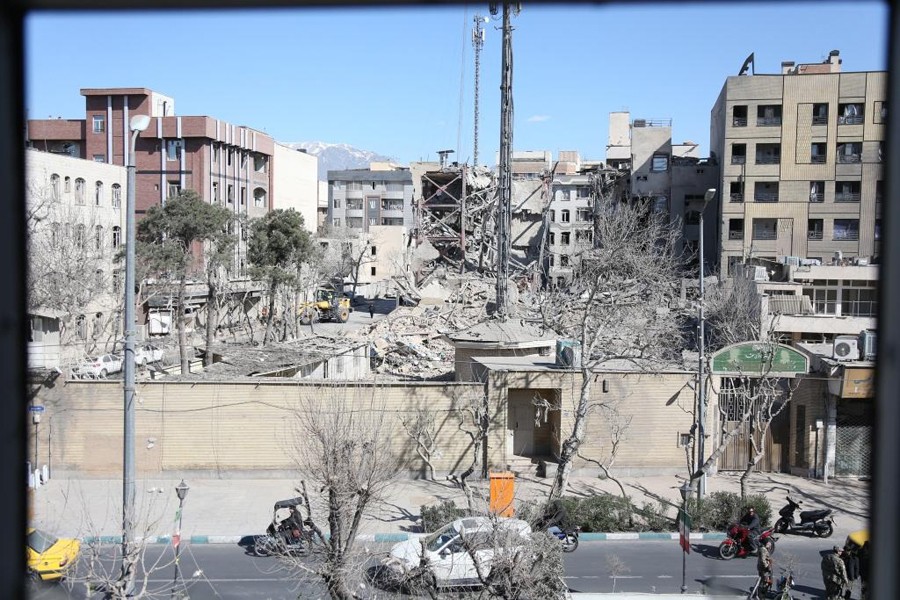
 This photo taken on March 3, 2026 shows damaged buildings and debris after airstrikes by the United States and Israel in Tehran, Iran —Xinhua Photo
 The Middle East has once again emerged as the epicenter of a geopolitical maelstrom whose consequences are being felt beyond its boundaries and territories. While the current conflict in the region was initially perceived as a bilateral or perhaps trilateral issue, its scope and implications have expanded to the point that the very structure of the international order is at stake. The question is no longer merely about the escalation of war in the region or its potential spillover effects on other territories and nations. Rather, the more important and worrisome question is whether the international order, which has already shown signs of weakness and instability, will be able to survive another major disruption in its structure.
History has shown that conflicts in the Middle East, while initiated or centered in this strategic region, rarely remain confined to its borders. Since the oil embargo of 1973, the international order has witnessed numerous instances of war and conflict in this region that have had a profound impact on its structure and functioning. Today, tensions in the region are reminiscent of those days when the international order was in flux and disruption. However, the current tensions seem to be more critical and perhaps more dangerous than their antecedents.
THE EROSION OF NORMS IN A POST-MULTILATERAL ERA: The current tensions in the Middle East and their implications for international order can be explained by the erosion of norms in international relations and the rise of a new, more dangerous order of unilateral and bilateral relations.
The international order established in the aftermath of World War II was based on a set of norms that included state sovereignty, diplomatic engagement, cooperation within international institutions, and the establishment of rules and mechanisms to manage conflicts in the international arena. While this order was not always ideal and was often breached in favor of more important interests, it at least provided a set of guiding principles that helped manage conflicts in the international arena and kept the international order in balance.
However, this order is currently under threat and is visibly strained due to the rise of unilateral military actions, targeted assassinations, economic coercion in the form of sanctions, and rhetoric in international relations. While the rhetoric of deterrence has replaced the rhetoric of dialogue in international relations, international institutions that were once believed to be the platforms that facilitated dialogue and cooperation in international relations seem to have failed or are perceived to have failed due to political divisions among major world powers or due to a lack of confidence in their ability to manage conflicts in the international arena.
This leaves us with a dangerous vacuum. When norms are weakened, power rushes in. And when power operates freely, small nations are at risk of coercion, while large nations play a game of strategic brinkmanship.
The Middle East today is not just a scene of conflict; it is also a test bed for the limits of the current international system.
STRATEGIC CALCULATIONS AND THE LOGIC OF ESCALATION: The current tensions are not occurring in a vacuum. They are taking place at a time of changing global balances of power. The global strategic rivalry, especially between the United States (US), China, and Russia, has been on the rise. However, during episodes of regional crisis, these powers are not able to present a united front, at best only symbolically.
This leads us into a paradox. The international system is moving towards a multipolar distribution of global power, but at the same time towards greater fragmentation in decision-making.
When regional conflict combines with global-level rivalries, the potential for escalation is high. Military actions, alliances, proxy wars, and economic sanctions are closely intertwined in a complex web of deterrence and provocation. Each side feels like it is defending itself, while the other feels like an aggressor.
Furthermore, war is no longer just conventional. Modern conflict encompasses cyber war, drone strikes, information war, and economic war. This means that the scope of war is much broader than before, and there is no formal declaration of war.
THE ILLUSION OF REGIME ENGINEERING: One theme often repeated in contemporary geopolitical conflicts is that external pressure, in some form or another, will reshape a country's political structure. However, history does not support this contention.
The reason is that such attempts at regime change underestimate a country's political structure and its cultural and social legitimacy. Political systems are complex and have developed mechanisms for survival and perpetuation, especially when rooted in revolution or political ideology.
Far more important is the fact that such attempts at regime change have unintended consequences, leading to fragmentation, radicalization, and instability. The collapse of political systems does not lead to political stability and democracy; rather, it leads to instability and disorder.
The assumption that coercive diplomacy will lead to rapid political change is therefore strategic optimism rather than strategic reality.
THE ENERGY-GEOPOLITICS NEXUS: There is also a deeper dimension beyond ideology and security issues. This is the energy geopolitics nexus.
The Middle East is still at the heart of global energy supply chains. The oil and gas market is highly sensitive to political instability in this region. The perceived risk of instability is as dangerous as actual instability because it could lead to volatility in oil and gas prices and significantly impact inflation and economic growth in developing nations, such as those in South Asia and Africa.
Energy supply chains are strategic assets and strategic vulnerabilities. The Strait of Hormuz is a chokepoint that could have serious consequences for global energy supply chains.
Hence, military escalation in the Middle East is not just a matter of politics; rather, it is economically very significant, changing the economic landscape, supply chains, investments, insurance, and financial planning in the capitals thousands of miles away.
THE HUMAN COST AND CRISIS OF MORAL AUTHORITY: In the midst of these strategic calculations, the human cost is often lost. However, it is civilians who bear the brunt of the conflict. Missile strikes, sanctions, displacement, and destruction have severe humanitarian consequences.
International humanitarian law was established precisely to limit these consequences. However, the crisis of authority in international humanitarian law stems from the fact that the very institutions charged with enforcing these laws are increasingly unable to do so, and accountability has been politicized.
The UN, despite criticism for inefficiencies, is the only platform for international dialogue. However, the UN's very framework, especially the veto powers held by the five permanent members of the UN Security Council, limits the UN's ability to act in international crises, particularly those involving the interests of the major powers.
This crisis of authority, coupled with international institutions' inability to take preventive action, only leads to further erosion of trust in international cooperation.
SOUTH ASIA AND THE RIPPLE EFFECT: South Asia, in this context, is very closely connected with the Middle Eastern crisis. It is because of Middle Eastern supplies of petroleum products, and millions of migrant workers whose livelihoods depend on Middle Eastern economies. Escalations can have severe economic consequences, including remittance risks, inflation, and financial instability.
Besides economic consequences, the Middle Eastern crisis can have severe strategic consequences on South Asia. Major powers are distracted from the South Asian region, and the ideological divisions, especially those arising from the Middle Eastern crisis, can have severe social consequences on South Asian societies.
Hence, what appears distant in terms of geography is very closely connected in terms of structure.
A SYSTEMIC CROSSROADS: The present moment could be more than just another episode in the history of turbulence in the Middle East. It could be a sign of systemic change.
The post-Cold War unipolar moment is past. The multipolar moment has yet to emerge as a coherent order. The world is in an interregnum-an unstable period of time between orders. During such periods, norms are in disarray, institutions are under strain, and power politics are on the rise.
The question is not just whether war is expanding its footprint. The question is whether global actors will be able to re-anchor international relations in principles of restraint, dialogue, and mutual security before competitive escalation is beyond reversal.
Stability in the Middle East cannot be ensured by military deterrence alone. It will also require diplomatic engagement, regional security systems, economic integration, and robust conflict-resolution mechanisms. It will also require recognizing that stability is built on legitimacy, not imposition.
If the current trajectory of competitive escalation continues unabated, it is possible that the fault line on which the contemporary world order could fracture lies in the Middle East. But if diplomacy can reassert itself-as it should have in the first place-the current crisis could yet be a turning point that catalyzes a new imagination of global order.
History does turn at moments of brinkmanship. The question is whether this is a moment of collapse or correction. The answer will not be found in words but in deeds.
Dr Serajul I. Bhuiyan is a professor and former chair of the department of journalism and mass communications at Savannah State University, Savannah, Georgia, USA. sibhuiyan@yahoo.com
© 2026 - All Rights with The Financial Express