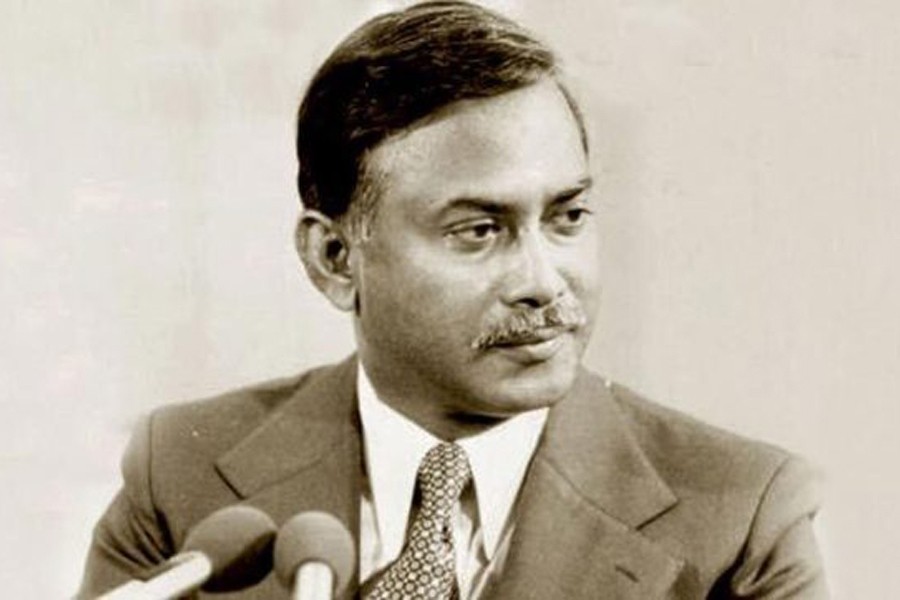
 Born in Bogura's Bagbari on January 19, 1936, Ziaur Rahman founded the Bangladesh Nationalist Party in 1978 and became the country's seventh president. He was assassinated by a group of army officers at Chattogram Circuit House on May 30, 1981.
 An abyss of uncertainty was prevailing in the political arena of Bangladesh towards the end of March 1971. When the failure of the political leadership to provide direction became acute, when the people were dazed and dumbfounded by the barbarous brutality of the Pakistani military forces, the young military officer Major Ziaur Rahman provided direction to the struggling nation by declaring the independence of Bangladesh. His name would have been written in golden letters in the history of the nation even if he had not played any other role throughout his life. Even then the nation would have recalled him with great respect. The masses would have assembled at the place where he was laid to eternal sleep with bouquets of gratitude.
But a man who had so dearly loved the people and the soil of Bangladesh, to whom Bangladesh was always the first priority in life and death, how could he stop there? If the political outline of the subsequent period is analysed after he assumed power to fill the vacuum created in the backdrop of the sepoy-people revolution of 7 November 1975, it can be said without any hesitation that the political culture of Bangladesh was transformed. New melodies were added to that politics and new rhythms were incorporated. That politics became both creative and productive. The appeal of that new politics of Ziaur Rahman was universal. It was modern; it was welfare-oriented; it was people’s politics; it was nation-based politics.
In the underdeveloped third world, the resolve for people’s rights never materialises out of its own volition. A people’s leader is needed everywhere – a revolutionary soldier, a person representing the spirit of the age, or somebody who pioneers an era. This visionary in the political arena of Bangladesh has been the greatest son of this nation Ziaur Rahman. Touched by the touchstone of his successful leadership, waves of change were created in the hearts of millions of people in rural Bangladesh. This made the people think anew about their role in the politics of the country. This made them conscious about their rights and responsibilities. Ziaur Rahman had identified rural Bangladesh as the focal point of his endeavour. He pinpointed the uplift of the rural populace – neglected for centuries – as his political priority. He also identified the rural people as the hero and superhero of his creative politics, who would bring about changes for their own benefit. By arousing sky-high confidence in them, by opening up a thousand doors of contentment through solving their problems, Ziaur Rahman wanted to write a new chapter of progress based on proper utilisation of available resources in the country. In this way, he initiated the programs of grassroot development.
It was he who established the ‘Gram Sarkar’ for the first time in this country, so that the people could solve their own problems through discussions among themselves. Village Defence Party was also constituted in this country through his initiative for ensuring security at the village level. Establishment of youth co-operative complexes was done under his direction for proper utilisation of the youth force in the villages. It was he who took the initiative to identify and solve the problems of the rural areas by means of ‘Rural Development Board’. Rural Electrification System was similarly developed under his guidance. In this manner, he was the first to develop rural irrigation system for flourishing the agricultural sector of Bangladesh. Avenues were also opened up for developing the fisheries sector in the villages. Arrangements for healthcare and adult education of the rural people were also made under his direction. The aims of all these efforts were on the one hand to integrate the rural masses with the administration; and on the other hand, to make the country self-reliant and self-sufficient in food. His success was notable on both fronts.
For observing the weal and woe of the common people of the country through his own eyes, he did not glance from a higher level as was the practice with the feudal lords or kings and emperors of the past, who sat at their glittering royal courts in beautiful palaces of the capital. He went to the masses, made them sit beside him, enquired about their wellbeing, and talked to them. He talked to the peasants, the fishermen, the porters, and the labourers. He talked to the mothers and sisters. He used to arouse a kind of unremitting resolve in them, a new craze for changing one’s lot. Professor of Political Science Lawrence Ziring has given a detailed account of the mass-oriented activities of President Zia: “Zia integrated himself with the peasant masses. They received his primary attention, and whenever his schedule permitted, he helicoptered around the country, dropping out of the sky often unannounced to view peasant conditions first hand, and to discuss the methods and resources available to raise them from their poverty”.
Describing one such incident, AKM Shamsul Bari Mohan Mia wrote: “While returning from a meeting, President Zia suddenly entered a peasant’s dwelling house. He said to the housewife: ‘Please allow me to sit’. Sitting on a wicker stool, he asked: ‘Mother, what will you give me to eat’? The lady did not know who he was. So, she said, ‘What would you eat’? He replied, ‘Papaya’. The lady said, ‘We do not have papaya’. He said, ‘Then what have you got? Banana, lemon, coconut’? The lady replied, ‘None of these’. ‘Then you must have milk. Please give me that’. The lady said, ‘We are poor people, we don’t have cow’. Zia said, ‘You can at least rear a goat. And it is quite easy to plant lemon, banana, papaya trees. Not much space is needed for that. Please plant those, I shall again visit you as a guest, okay’. In the meantime, the owner of the house arrived home. In parting, the lady said, ‘I shall wait for you, son, after planting lemon, papaya, and banana trees, and after purchasing a goat”. President Zia did not get the opportunity to go back to that house. The cruel hand of the merciless assassin took him away from his dear ones; it was at a time when his presence was most needed in this society.
But Ziaur Rahman could generate a wave of new awakening in rural Bangladesh within a very short time. He could involve millions of people in rural Bangladesh in the overall development process through the canal-digging revolution. He generated hopes for a new future among the rural populace through the mass literacy program. He added a new chapter in the traditional lifestyle of rural Bangladesh through the auspicious introduction of family planning. In the economic front, he provided direction by properly equipping the economy, rectifying the wasteful and corrupt practices of socialism, invigorating private initiative, raising production in the industrial sector, and by increasing exports; he restored national pride by erasing the ill-reputation of a ‘bottomless basket’. Consequently, Zia’s politics has been acclaimed as distinctive and ideal for this country.
But how could that become a reality? How could a professional soldier get transformed into a great fighter of national development? Without looking for the causes of such transformation, we can find many such examples when we look at the pages of history. Criticised, condemned and subjugated as the ‘Sick man of Europe’, Turkey needed one Kamal Ataturk to change her destiny. One Kamal Naser was needed to raise Egypt from the ashes. De Gaulle was needed by the FourthRepublic to bring France to the path of illumination. The French nation still acknowledges his contributions unhesitatingly. Similar was the contribution of General Zia in Bangladesh.
Those leaders not only resembled Zia in profession, their spirit was also similar. All of them were first-class patriots. They were all nationalists. They all carried the same light in their eyes: ‘My country, my nation shall never bow down to anyone, shall never extend hand to anybody for begging’. They all wanted politics that never became power-politics. Rather, they sought politics that could unite the nation through welfare of the people. This is why they are still alive in their national consciousness as the greatest sons of the soil. Who could forget them? Who can afford to forget Zia?
They all wanted to build a self-reliant nation so that one’s freedom was not passed on to another entity. These leaders can never pass into oblivion because they are forever alive in the spiritual ethos of the nation. Whenever we visualise an ideal form of Bangladeshi politics, whenever we look for an appropriate outline for our political milieu, we shall discover that the politics of Ziaur Rahman is making a comeback through the front-door; Bangladesh is getting back her cherished possession.
The writer was a leading academic of the country, former Professor of Political Science and Vice-Chancellor of Dhaka University. The piece is translated from Bangla to English by Dr Helal Uddin Ahmed (retired Additional Secretary and ex-Editor of Bangladesh Quarterly. hahmed1960@gmail.com)
© 2026 - All Rights with The Financial Express