Bangladesh Bank's ambitious move to establish Bangla QR as the country's unified digital -payment platform represents one of the most significant reforms undertaken by the central bank for the retail payment system.
By introducing a single interoperable QR (quick response) code that can be used across banks and mobile financial-service providers, the central bank hopes to accelerate the country's transition towards a less-cash economy, reduce the cost of currency management and strengthen financial inclusion.
More than a year after its launch, however, adoption has fallen short of policymakers' expectations. Although around 1.3 million machine-readable Bangla QR codes have already been distributed nationwide, transaction volumes remain relatively modest.
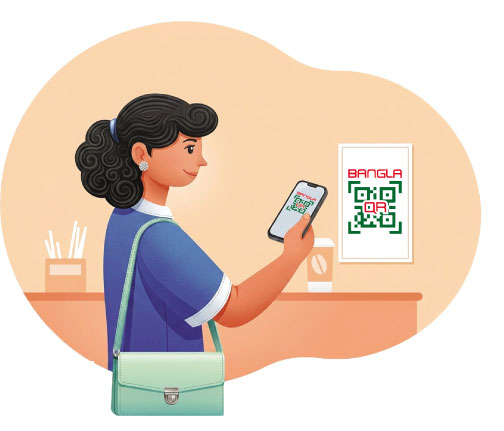 Industry participants say the challenge is no longer technological but behavioural. Many consumers and merchants remain unfamiliar with the platform's interoperability and continue to rely on proprietary QR codes or cash.
The integrated digital mechanism allows customers of different banks and MFS providers to make payment using a single code, eliminating the need for merchants to display multiple QR codes in the stores.
Bangladesh Bank believes the initiative will reduce fragmentation in the digital payments market while making electronic transactions more convenient for consumers and businesses.
A SWOT analysis conducted by the FE highlights both the promise and the problems facing the platform.
Strengths: The greatest strength of Bangla QR is its interoperability. Unlike proprietary QR systems operated by individual payment providers, Bangla QR allows users of different banks and mobile financial- service providers to pay through a single platform. This reduces market fragmentation and simplifies payment acceptance for merchants.
The platform also enjoys the backing of Bangladesh Bank, giving it a significant institutional advantage. As the country's central bank and payment regulator, Bangladesh Bank can establish technical standards, coordinate financial institutions and encourage market-wide adoption. Regulatory support also enhances consumer confidence because users generally perceive central bank-backed payment systems as more secure and reliable.
Another key strength is the potential to reduce the country's dependence on physical cash. Bangladesh spends substantial resources each year printing, transporting, securing and replacing currency notes. Wider adoption of digital payments could lower those costs while reducing the risks associated with handling large volumes of cash.
Bangla QR also supports the government's broader agenda of digital transformation. Digital payments generate transaction records that improve transparency, strengthen tax administration and reduce opportunities for informal cash transactions. Greater formalisation of retail payments can contribute to stronger economic governance over time.
Promotion is another area where Bangla QR holds a competitive advantage. Because the initiative is backed by the central bank, awareness campaigns can be coordinated across commercial banks, mobile financial- service providers, government agencies and educational institutions.
Bangladesh already possesses much of the infrastructure needed for expansion. Mobile financial services have become widely used to person-to-person transfers, salary payments, utility bills and e-commerce. Bangla QR builds on this existing digital ecosystem rather than creating an entirely new one.
Large public institutions could further accelerate adoption. Schools, universities, hospitals, government offices, shopping malls and public transport operators collectively process millions of small-value transactions daily. If these institutions widely adopt Bangla QR, consumers will become familiar with the platform through everyday use.
For example, institutions such as Motijheel Ideal School and College, large public universities, medical colleges and government hospitals could serve as anchor users by enabling students, patients and visitors to make digital payment through a single interoperable quick-response code.
Weaknesses: Notwithstanding its strengths, Bangla QR faces several structural challenges that could slow its adoption.
The most immediate concern is limited public awareness. Many consumers remain unfamiliar with the concept of interoperability and often see little difference between Bangla QR and the proprietary QR codes already offered by banks and mobile financial service (MFS) providers. Without a clear understanding of its advantages, users have little incentive to change their payment habits.
Another major obstacle is the cost of digital payments for merchants. Merchant discount rates (MDRs) and other transaction-related charges discourage some businesses from accepting digital payments, making cash the cheaper option.
Bangla QR also suffers from uneven merchant coverage. While supermarkets, shopping malls and organised retailers have increasingly adopted digital payments, many small businesses-including grocery stores, meat and fish markets, roadside vendors and rural shops-continue to rely almost exclusively on cash. A cashless payment system cannot become mainstream unless it reaches these everyday businesses.
Digital infrastructure presents another challenge. Although smartphone ownership and internet penetration have risen steadily, millions of Bangladeshis still lack reliable internet access or compatible smartphones. These constraints are particularly evident in rural areas, where digital-payment adoption remains relatively low.
Behavioural factors also matter. Bangladesh has long been a cash-based economy, and many consumers continue to prefer physical currency because it is familiar, widely accepted and free of transaction charges. Some businesses also favour cash because it provides immediate liquidity and allows parts of their transactions to remain outside the formal financial system.
From a policy perspective, wider digital payments could gradually reduce the central bank's seigniorage income-the revenue earned from issuing currency.
Finally, implementation may be slowed by bureaucratic coordination among banks, payment-service providers and regulators, particularly during the transition from proprietary QR systems to a fully interoperable platform.
Opportunities: If implemented successfully, Bangla QR could become a cornerstone of Bangladesh's digital economy.
For consumers, the most immediate benefit is convenience. Carrying less cash reduces the risk of theft or loss while allowing faster and more secure transactions.
For businesses, digital payments create electronic records that simplify bookkeeping, inventory management and financial reporting. These records can also improve access to formal credit by providing banks with better evidence of business cash flows.
At the national level, wider adoption of Bangla QR could increase the share of transactions conducted within the formal financial system. Greater transaction transparency would strengthen tax administration, improve economic data and reduce opportunities for informal cash transactions.
The platform could also support financial inclusion, particularly if combined with low-cost digital accounts and simplified onboarding procedures. Small merchants, street vendors and rural entrepreneurs would gain access to electronic-payment networks without investing in expensive payment terminals.
As digital payments expand, they can support e-commerce, public transport, healthcare, education and government services, creating a more integrated digital economy.
There is also considerable potential for government adoption. Utility bills, licence fees, passport services, hospital payments, school fees and public transport fares could all be integrated into the Bangla QR ecosystem. Large institutions such as schools, universities and hospitals could act as catalysts for widespread consumer adoption.
International experience offers encouraging examples. India's UPI, Thailand's PromptPay and Singapore's SGQR demonstrate that interoperable payment systems can transform retail payments when supported by strong public awareness, affordable merchant costs and broad institutional participation.
Threats: The platform also faces external risks.
Cybersecurity remains one of the biggest concerns. As digital payments increase, fraud, phishing, identity theft and cyberattacks are likely to become more sophisticated. Maintaining public trust will require continuous investment in cybersecurity, fraud detection and consumer protection.
Equally important is the legal and regulatory framework. Consumers who fall victim to digital fraud need quick dispute-resolution mechanisms and confidence that offenders will be investigated and prosecuted. Weak enforcement could undermine confidence in the entire payment system.
Resistance from parts of the informal economy also poses a challenge. Businesses seeking to avoid taxation or financial-reporting requirements may be reluctant to adopt digital payments that create transparent transaction records.
Conclusion: Public-awareness campaigns should explain the platform's interoperability and practical benefits in simple terms. Merchant charges should be reviewed to make digital payments more affordable, particularly for small businesses.
The central bank should also encourage adoption across schools, universities, hospitals, shopping centres, transport operators and government agencies, where millions of routine transactions take place each day. At the same time, continued investment in digital infrastructure, cybersecurity and consumer protection will be essential.
jasimharoon@yahoo.com
© 2026 - All Rights with The Financial Express

