For many Bangladeshis, buying a home is the only decision where excitement and anxiety sign the agreement together - right below the bank's logo. In the past decade, the Bangladeshi middle class has nearly mastered an interesting equation, turning a long debt into a symbol of stability and wise investment for a forever home.
With land scarce and dreams of a forever home not easily abandoned, the modern middle class is discovering that owning a home is less about saving money - and more about borrowing it wisely. This is where the opportunities and products offered by private banks in Bangladesh come in - the home loan.
Taking out a home loan is a major financial decision that can impact the buyers' financial planning for years to come. Buying a home in general requires huge financial assistance and most buyers are likely to rely on financial assistance such as taking a home loan to buy the property. A home loan can help to fulfil the dream of owning a house without straining your finances.
The interest rates on home loans are very low as compared to other loan products such as car loans, personal loans, etc. Nevertheless, taking a home loan remains a significant financial decision. Usually, people take home loans for a period between 10-20 years; hence, a home loan can take up a sizeable part of one's disposable income for years.
The urban lifestyle in Bangladesh has already been financially straining, especially for the urban middle class. The dreams of having a place of their own, not having to live on the whims of the landlord, increasing rent every year, the hassle of changing houses, the instability of not being able to call this - 'my home' - all are different factors that accelerate the ways to seek out other options and assistance. This assistance is offered mostly by the private banks in Bangladesh, with the public sector lagging a bit behind. Banks and other financial institutions offer home loans in large margins to them with other facilities to materialise this dream. From these banks, home loans are more accessible structurally, but financial pressure is also increasing - making it an ever tough call to take out a loan.
A Dhaka-based Senior Banking Professional, Mr Hedayat Ullah Khan, HSBC Bangladesh, says in this regard, "For me home loan is an asset building process. I have availed this process and trusted the bank with lower rate of interest along with faster and easy disbursement process."
Asset building - a term becoming extremely difficult with the day to day with financial pressures. Bangladesh Bank recently increased the loan cap to Taka 4 crore (40 million). This provides an opportunity to start building an asset mid-way through your career whereas it has been a common practice to invest in self-owned residences later in life.
Mir Mohammad Shams Uddin, a Senior Analyst at HSBC Bangladesh, says, "With home loans, you build an asset over time instead of paying increased rent. Eventually, you can sell it when the instalments are paid off. Other than depreciating asset costs, you have a strong addition that will add to your investment portfolio. You can start building assets comparatively sooner in your life rather than later years."
Now, home loans are not a one-size-fits-all solution. They are a range of financial options that people explore at different points in life. For many first-time buyers, apartment purchase loans serve as the first step towards owning a home. Home construction loans are often preferred by those building on inherited or newly acquired land.
As families grow or circumstances change, home renovation loans allow homeowners to upgrade or expand their living spaces without relocating - like turning their one-storied houses into apartment complexes or multi-storied apartments. Others turn to balance transfer loans to shift their existing mortgages to institutions offering lower interest rates, seeking relief from rising repayment burdens.
Meanwhile, loans against property (LAP) provide an option for those who draw on existing assets to meet broader financial needs. These products reveal how borrowing for housing is closely tied to life transitions, from starting out to scaling up, and sometimes, simply staying afloat. Banks and non-banking financial institutions in Bangladesh offer a range of products that cater to different necessities and requirements of the potential buyer.
Beyond the financial side of things, home loans often play a powerful role in people's lives by enabling social advancement. The discipline of paying monthly EMIs builds a regular savings habit, encouraging borrowers to manage their finances more carefully over the long term. According to Mr Hedayat, 'Building an asset requires discipline and careful planning of your finances. With all the challenges, if your organisation has a steady employee development process, this management process becomes way easier. That's why taking out a home loan worked out well for me."
To some of the homeowners who have taken a loan from a bank, the repayment of instalments has also been challenging with the rapid change in the national economy. A retired businessperson based in Dhaka (65) shares his experience of taking a home loan from a private bank by saying, "The decisions are generally largely influenced by the bank that you are choosing to go in contract with. It is really important to pick out your best fit because the relationship may last about 15-20 years or even longer. I chose a reputed and trusted bank for my home loan."
Private banks in Bangladesh such as BRAC Bank, Mutual Trust Bank, Dutch-Bangla Bank, City Bank, Eastern Bank, and Standard Chartered offer diverse home loan options to different borrowers. Typically, loans cover 70-80 per cent of property value with tenures up to 25 years and EMI-based repayment. Approval depends on income, job stability, and credit history, with some institutions also offering joint loan facilities.
Non-banking financial institutions (NBFIs) have become increasingly popular sources of home loans in Bangladesh, offering greater flexibility and borrower-friendly services, albeit at slightly higher interest rates than traditional banks. Leading players such as IDLC Finance, LankaBangla Finance, Delta Brac Housing (DBH), and IPDC Finance serve a wider range of borrowers that include freelancers and self-employed professionals often underserved by banks. With faster processing and specialised products for home extension, renovation, or apartment completion, NBFIs provide a convenient and accessible alternative for those who may not meet conventional lending criteria. The introduction of customised repayment planning also brings fresh options and some relief to borrowers.
Those who are searching for Shariah-compliant home financing solutions in Bangladesh have several banks and NBFIs that offer Islamic home loan facilities such as Ijara, Murabaha, or Musharaka.
Behind the promise of homeownership lies a much quieter strain. Rising interest rates turn EMIs into an unpredictable monthly anxiety, especially for the middle class. Long-term 20-year loans can create constant psychological pressure, while hidden costs like registration and legal fees add to the burden. At times, mismatched property prices and loan values deepen the financial unease rather than easing it.
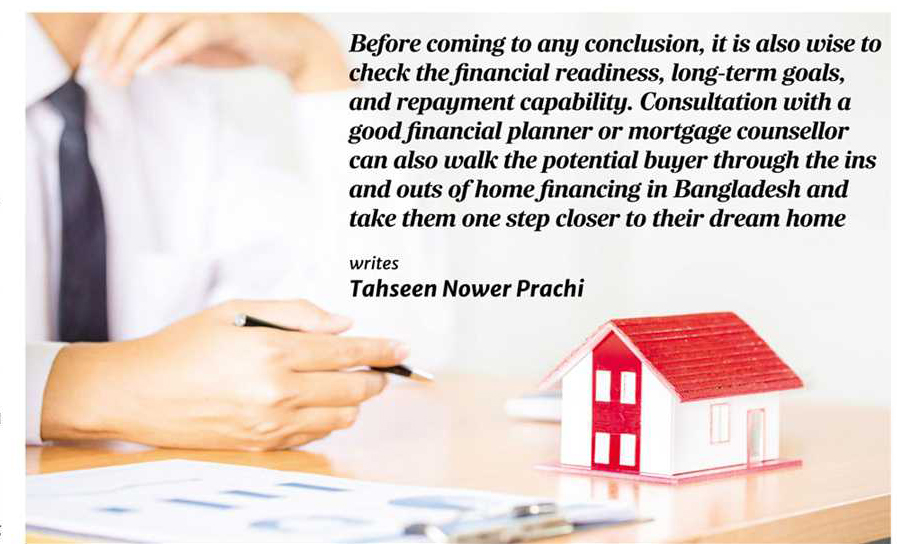
Before coming to any conclusion, it is also wise to check the financial readiness, long-term goals, and repayment capability. Consultation with a good financial planner or mortgage counsellor can also walk the potential buyer through the ins and outs of home financing in Bangladesh and take them one step closer to their dream home. In the end, a home loan is not just another debt you carry - it is a bridge between where you are and where you dream to be, built one EMI at a time, toward a door that finally opens to your own name.
nowertahseen@gmail.com
© 2026 - All Rights with The Financial Express

