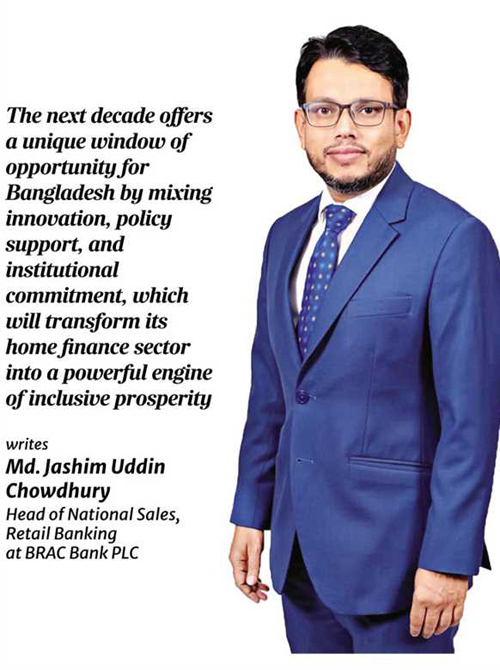
As Bangladesh advances toward upper-middle-income status, its housing sector stands at a critical crossroads. While demand for homeownership continues to rise - driven by rapid urbanisation, demographic shifts, and a growing middle class -- the country's home loan industry remains significantly underdeveloped relative to its potential. Bangladesh's home loan industry is still not demand-constrained; it is supply and structure-constrained. The country does not have a housing problem; it is a housing finance architecture problem.
Despite notable macroeconomic achievements over the past decade, Bangladesh's home finance sector remains significantly underdeveloped relative to its huge potential. According to various industry estimates and central bank data, the country's mortgage-to-GDP ratio remains in the 3-5 per cent range, far below regional comparators such as India (10-12 per cent) and Malaysia (over 30 per cent). This gap underscores both the limited reach of formal housing finance and the scale of opportunity that lies ahead. The sector is, therefore, at a critical inflexion point.
Where the industry stands today vs its real potential
A structurally narrow market
Though over the years, banks and non-bank financial institutions (NBFIs) in Bangladesh have developed a reasonably structured home loan market. Improvement is reflected in the credit appraisal process, product offerings, and customer service. But this progress has largely been confined to a specific borrower profile-urban, salaried, and middle- to upper-income.
This particular concentration has led to a structurally narrow market. More than 80 per cent of the labour force in Bangladesh is employed in the informal sector, where income is often undocumented, irregular or not captured through formal channels. For such persons, access to formal housing finance remains very limited, not due to a lack of repayment capacity, but because traditional underwriting frameworks lack acceptable income documentation. And as urbanisation accelerates rapidly. The urban population is expected to exceed 40 per cent of the total population by 2035, up from roughly 39 per cent today.
Dhaka alone continues to absorb a significant share of this migration. It will create immense pressure on housing supply and affordability. Other divisional cities and city corporations are also gradually getting overcrowded, which will lead to similar problems. Still, formal mortgage penetration remains shallow, indicating a clear mismatch between demand and access to financing.
The inclusion gap: Scale and consequences
The unmet demand for housing finance is particularly pronounced among low- and lower-middle-income households, rural populations, and informal earners. For many customer segments it is either not possible to document the entire income or partial income that excludes the majority of the populations, example: the Freelancers who often do not bring their full income to Bangladesh's economy due to unfavorable ecosystem rather they keep their hard earned income in different OPGSP accounts, the remittance-earners or their beneficiaries unable to provide required formal documents, healthcare professionals i.e. nurses, medical technologists, therapists (physical therapist, psychological therapist, speech therapists, acupunctural therapists etc.) do have salary & consultation income where the full amount cannot be documented, teachers having salary and tuition income or only tuition income, entrepreneurs from e-commerce / f-commerce, small businesses, other discouraging sectors like cash salary, fee-based income, real-estate employees, contractors and many more.
These segments collectively represent a huge population but remain largely excluded from the formal financial system in the context of housing. Bangladesh is estimated to have a housing deficit of over 6 million units, and this gap is growing each year due to population growth and urban migration. Most of this deficit is in the affordable housing segment. The implications of this gap are both economic and social. From an economic standpoint, housing finance has strong multiplier effects. The construction sector contributes around 7-8 per cent of GDP and supports millions of jobs, both directly and indirectly. Enhanced access to housing finance can stimulate demand across related industries such as cement, steel, ceramics, and transportation. From a social perspective, limited access to formal finance leads to incremental, self-funded housing development. Such housing often lacks proper planning, structural integrity, and resilience in climate-vulnerable areas. Reducing this inclusion gap is thus not just a target of the financial sector. It is, however, central to sustainable urban development and economic efficiency.
Digital transformation as a Key to Rethinking Housing Finance
The rapid expansion of digital financial services in Bangladesh offers a promising pathway to address some of these structural challenges. With over 200 million registered MFS accounts and increasing adoption of digital payments for utilities, tuition fees, internet bills, etc., the country has already witnessed significant growth in that sector.
If we want to rethink housing finance, we can leverage the digital footprint. Mobile transaction histories may work as an alternative data source. Utility bill payments, savings patterns, and small-business cash flows can also provide valuable insights into the creditworthiness of informal borrowers.
These inputs can support more inclusive credit assessment models by combining both data analytics and machine learning. AI-driven credit scoring is no longer a new technology. It turns passive, archaic data into active, real-world opportunities, helping build a new way to financial inclusion.
End-to-end digital loan processing can significantly reduce turnaround times and operational costs, making it more viable for lenders to serve smaller ticket-size loans. Digitisation of land records and property information is still evolving and can be improved to maintain transparency, reduce fraud, and enhance collateral verification processes.
Registration, mortgage procedures, authenticity of non-encumbrance certificate/encumbrance certificate, and the search process for land documents should be made easier and quicker, avoiding unnecessary hassle.
However, digital transformation must be approached with prudence. Robust risk management frameworks and regulatory oversight will remain essential.
Policy and regulatory priorities
The housing finance market achieves scale and inclusiveness goals through strong policy support and institutional development, at least, global experience shows. If we look at Bangladesh, several priorities stand out:
1. Long-term funding mechanisms
Right now, banks get most of their money from short-term deposits (money people can take out quickly). However, they use that money to make long-term home loans that take many years to repay. This creates a "mismatch" because the timing doesn't align. In India, the National Housing Bank (NHB) helps address this by supporting home loan companies.
To fix the mismatch, Bangladesh needs to strengthen its own "refinancing" programs (where the central bank gives money to other banks specifically for home loans).
2. Risk-sharing frameworks
Banks are often afraid to lend money to people who aren't wealthy. To fix this, the government can offer "safety nets" like insurance or guarantees. This way, if a borrower can't pay, the bank doesn't lose everything. When banks feel safe, they are more willing to help everyone. To make this work, lenders, builders, and officials need to sit down and solve problems together.
3. Land and Property Reforms
We need to move property records to computers and simplify the rules. Right now, it's confusing to figure out who actually owns a piece of land. Because paperwork takes forever and is often messy, banks are reluctant to make loans. Cleaning up these records will make it much easier for people to get the money they need for a home.
4. Incentives for Affordable Housing
Special programs can help make homes more affordable for families with limited income. This includes lowering taxes, offering lower interest rates, or having the government and private companies work together.
5. Supporting New Ideas
Bank rules should allow them to test new ways to decide who can get a loan. This includes using digital tools and various methods to check credit scores, as long as the financial system remains safe. Government leaders and banks must work together to make these changes work. Bangladesh can learn from nearby countries that have grown their home loan markets.
India, for instance, has increased home loan availability through special housing companies, government support, and programmes that make homes more affordable.
On the other hand, Indonesian government helped low-income families get loans by offering subsidies and guarantees. Vietnam showed how important it is to match housing rules with the fast growth of cities. Bangladesh cannot simply copy these models because its situation is different. In Bangladesh, government and financial organisations are still building the strength and systems needed to manage such a large task.
Also, the way people earn money is different. Because so many people work in the informal sector, their incomes do not resemble those of workers in other countries. To fix this and include everyone, both the government and private businesses must work together over the long term.
A 2035 perspective
Bangladesh has the opportunity to significantly deepen its home finance market over the next decade. With having the right policy environment and industry innovation, mortgage penetration could be double. It will bring millions of new borrowers into the formal financial system. There are several key qualities needed to have a more mature home finance market by 2035 -
l Broader access across income segments, including informal earners
l Expanded geographic reach beyond main urban centres/cities
l Greater use of digital platforms in origination and servicing
l Better transparency and efficiency in property transactions
l Stronger linkages between housing finance and affordable housing supply
Such a transformation would not only improve housing outcomes but also contribute to macroeconomic stability, asset creation, and employment generation.
A strategic imperative
The future of Bangladesh's home finance sector will depend on whether it continues to operate within its current narrow boundaries or evolves into a broader national development. Elevating housing finance to a strategic priority requires a shift in perspective from viewing it as a product for a selected segment to recognise it as a platform for inclusive growth.
The next decade offers a unique window of opportunity for Bangladesh by mixing innovation, policy support, and institutional commitment, which will transform its home finance sector into a powerful engine of inclusive prosperity. The question is no longer whether this transformation is necessary-but whether it will be pursued with the urgency and scale it demands.
The author is the Head of National Sales, Retail Banking at BRAC Bank PLC. mdjashimuddin.chowdhury@bracbank.com
© 2026 - All Rights with The Financial Express

