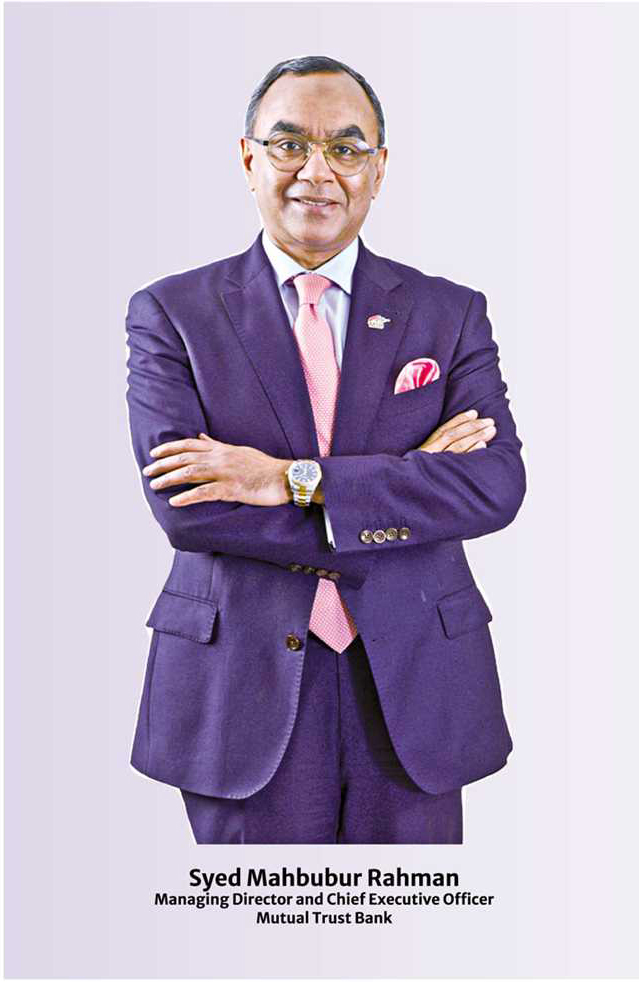
Despite various challenges, the long-term outlook for the housing finance sector remains fundamentally positive, says Managing Director and Chief Executive Officer of Mutual Trust Bank (MTB) Syed Mahbubur Rahman.
In an interview with The Financial Express, he says Bangladesh continues to grapple with a substantial housing deficit, ensuring that the underlying demand remains strong.
As economic stability improves and favourable policy frameworks are established, the sector is well-positioned to recover its growth momentum and address the nation's evolving residential needs, he adds.
To capture the growing demand for home financing, MTB continues to intensify its footprint in the mortgage sector, where the ratio of non-performing loans (NPLs) remains relatively low, says Rahman.
He says the home loan landscape in Bangladesh has shifted from a period of robust expansion to a more measured and cautious trajectory.
Just a few years ago, the sector experienced significant growth, primarily fuelled by the burgeoning middle-income and salaried demographics, he says.
This upward trend was underpinned by rapid urbanisation, a structural shift toward nuclear family units, and the proliferation of developer-led shared land projects, all of which bolstered the housing demand, he explains.
Over the last 24 months, however, persistent macroeconomic headwinds dampened this initial momentum. A combination of elevated inflation, rising lending rates, and tightening liquidity within the banking system constrained the market, he says.
Furthermore, the surging cost of construction materials has adversely affected affordability, while global geopolitical tensions, including those involving the US and Iran, have introduced uncertainties that impact local investors' confidence and the broader economic stability, according to the seasoned banker.
Within this environment, he says, commercial banks maintain their dominance in the mortgage sector, leveraging their relatively lower costs of funds and extensive distribution networks to remain competitive.
While non-bank financial institutions (NBFIs) continue to be active participants, they face greater operational hurdles due to higher funding costs, which limit their ability to capture market share compared to their banking counterparts, Rahman says.
Regarding the key factors that lenders consider before approving home loans, the experienced banker says the home loan approval process in Bangladesh is a meticulous evaluation that balances borrower affordability with institutional risk management.
He says the primary determinant of approval is repayment capacity, typically quantified through the Debt Burden Ratio (DBR). This metric ensures that the borrower's monthly obligations remain within manageable limits relative to their income.
Lenders verify this through rigorous income analysis, focusing on salary stability for employees or business continuity and cash flow for entrepreneurs, he says.
Rahman says banks rely heavily on Credit Information Bureau (CIB) reports to analyse past repayment behaviours and identify any history of default.
Simultaneously, legal due diligence is performed on the collateral to verify clear ownership, conduct accurate valuations, and ensure the property is free from any existing encumbrances or legal disputes, he says.
Ultimately, Rahman says, the mortgage underwriting process is designed to promote responsible lending.
By aligning individual financial profiles with regulatory expectations and internal risk appetites, financial institutions aim to build a high-quality loan portfolio that supports sustainable homeownership while safeguarding the integrity of the banking system, he says. About the groups or professions that are currently taking home loans the most, he says, this market in Bangladesh is largely driven by the salaried segment, which remains the most preferred group for lenders due to stable and predictable income streams.
Employees of multinational companies, banks, and reputed corporate bodies form a significant portion of this segment, he also says.
Alongside salaried individuals, there is strong participation from businesspersons and professionals such as doctors, engineers, and consultants. Overall, the demand is concentrated within middle- and upper-middle-income groups, particularly in major cities, he says.
In response to the instalment performance of home loans, the top MTB executive says this segment continues to be a premier asset class within the retail lending landscape, characterised by exceptional resilience and performance.
"At Mutual Trust Bank, for instance, the non-performing loan ratio for the home loan segment is maintained at below 2.0 per cent. This figure is a testament to the bank's stringent underwriting standards and robust portfolio management, reflecting a high level of credit quality compared to more volatile retail products," he says.
Furthermore, the stability of this segment is reinforced by rigorous institutional screening and proactive monitoring mechanisms, he says.
Recent regulatory support, such as the Bangladesh Bank circular regarding the enhancement of home loan limits, underscores the central bank's confidence in the sector's health, he says.
Regarding the complete process from application to disbursement and repayment, he says the home loan process is structured and relatively more detailed compared to other retail loans.
To enhance customer experience, MTB has introduced a 48-hour preliminary conditional approval, allowing customers to quickly understand their eligibility, he says.
At the initial stage, he says, customers submit basic documents such as bank statements, proof of income (salary certificate, LOI, or trade licence), and identification documents.
Based on these, the Retail Finance Centre conducts a preliminary assessment, including CIB checks, and issues a conditional sanction, he says.
Following this, customers interested in taking loans complete full documentation, including property ownership papers, legal vetting, valuation, and technical assessments. Upon satisfactory verification, the loan is disbursed, he continues.
At MTB, customers can avail the highest home loan limit of Tk 40 million, notes Rahman.
Repayment is made through EMIs, where tenure plays a key role. Longer tenures reduce the instalment size but increase the total interest cost, he explains.
Speaking about the benefits and risks of home loans from both the customer's and the bank's perspectives, he says home loan serves as a powerful instrument for capital preservation for the borrower, enabling homeownership without the immediate depletion of significant liquidity.
This structured approach to financing allows individuals to engage in sophisticated long-term financial planning by leveraging Equated Monthly Instalments (EMIs) to manage cash flow, he says.
However, this commitment introduces specific risks, including exposure to interest rate volatility, the burden of long-term debt obligations, and the potential for financial strain, should an unexpected disruption in income occur, he cautions.
From a lender's perspective, he says, the home loan segment is highly attractive due to its inherent security and the historical trend of low default rates.
These assets provide a predictable, long-term revenue stream while serving as an anchor product to foster enduring customer relationships, he says.
Furthermore, because the loans are secured by tangible real estate, they represent a lower risk profile compared to unsecured retail products, contributing to a healthier and more stable balance sheet for the institution, Rahman explains.
Nevertheless, he says, both parties must navigate a complex landscape of systemic and specific risks.
Market volatility can impact property valuations, while the legal intricacies of title documentation and encumbrance verification remain constant operational challenges, he says.
Additionally, broader macroeconomic pressures, such as inflationary shifts or regulatory changes, can influence a borrower's repayment capacity, necessitating rigorous risk assessment and proactive portfolio management to ensure the continued stability of the mortgage market, he adds.
© 2026 - All Rights with The Financial Express

