A parliamentary election was held for the first time in Pakistan's 23-year-old history on December 7 1970. Initially, the election was set for October, but was postponed due to floods in the eastern province. Meanwhile, a catastrophic cyclone hit East Pakistan on November 12, and polls in nine National Assembly and 18 Provincial Assembly seats were postponed as a result. Earlier, President and Chief Martial Law Administrator General Yahya Khan had taken over power in March 1969 following the fall of President Ayub Khan in a mass upsurge. He promised in his first address to the nation over radio that he would hand over power to the elected representatives after holding the parliamentary polls.
Yahya lifted the restrictions on political activities from the first day of 1970 and also annulled the single-unit status of West Pakistan, thereby giving rise to four provinces. Then he promulgated the Legal Framework Order on March 30 1970, which called for establishment of Islamic ideology, democratic rights, strong central government, maximum autonomy for the provinces (with regard to judiciary, administration, and economic matters), and allocation of state-resources among provinces based on their population.
The elections were held for a total of 290 seats in the Pakistan National Assembly, of which 162 were allotted to East Pakistan. In the polls, the Awami League (AL), led by Sheikh Mujibur Rahman, achieved a landslide victory by winning 151 seats (all in East Pakistan), followed by 88 for Zulfikar Ali Bhutto's Pakistan People's Party (PPP) in West Pakistan. The AL's tally rose to 160 after the holding of by-elections for the remaining seats. Although the Bhashani-led National Awami Party (NAP) amalgamated with Bhutto's PPP in West Pakistan, many leaders in its East Pakistan branch were secretly aligned with the Communist Party, and debates were raging inside the party regarding its political line and course of action. However, most of the NAP leaders were in favour of an armed insurrection and the boycott of parliamentary election.
Therefore, despite having a sizeable following in the province, the NAP-Bhashani leadership took a stand against participation in the polls. Instead, it reiterated its demand for a sovereign East Bengal after the devastations of November 12 cyclone. The sweeping victory of the Awami League at the national and provincial levels was, therefore, largely facilitated by NAP-Bhashani's boycott of the election. This, however, gave rise to a constitutional crisis because of Yahya's tacit support for Bhutto's dubious ploys and claims. One such bizarre ploy was Bhutto claiming the mandate for West Pakistan, similar to AL's mandate in East Pakistan.
The AL became vocal for framing a constitution based on its six-point demands after winning the election. Bhutto, on the other hand, said that no move could be made for constitutional reforms or formation of the central government without his support. Disputes also arose regarding the venue for the first session of the National Assembly. The AL was in favour of Dhaka, while Bhutto demanded its holding in West Pakistan. A meeting was then organised in Dhaka between Bhutto and the AL leader Sheikh Mujib, but it proved to be futile.
Yahya Khan was eager to make the most out of this contentious situation. He came to Dhaka after holding meeting with Bhutto in his home-town of Larkana under Sind province. Although Yahya's stated intention was to meet Mujib, he had other designs. Before leaving Dhaka, he spoke about the need for agreement between the AL and the PPP; on the other hand, he told the power-thirsty Awami League leaders that Sheikh Mujib would be the prime minister of Pakistan. A few days later, an announcement was made about holding the first session of the National Assembly in Dhaka on March 3 1971.
Bhutto was remonstrating even then that he would not visit Dhaka without reaching an agreement with the AL. He was ready to accept only the first and last points of Awami League's six-point charter of demands, not the remaining ones. However, among the West Pakistani political leaders, he was supported by only Abdul Qayyum Khan of the Council Muslim League. The others felt that Bhutto should join the National Assembly session in Dhaka. The NAP's leader Moulana Abdul Hamid Khan Bhashani categorically said on February 16 that East Bengal would never bow down to threats and pressure. On the same day, Sheikh Mujib was elected as the leader of Awami League's parliamentary party. Mujib again urged the West Pakistani leaders on February 21 to hold discussions. But instead, Yahya Khan held a meeting with the provincial governors, military administrators, and the chiefs of navy and air force on the same day, and probably finalised a blueprint for his future course of action.
From the last week of February, the Pakistani military was put on high alert and the transfers of army-men were undertaken on a massive scale. Bhutto and the secretary of National Security Council Major General Ghulam Omar started to issue threats to West Pakistani parliamentarians to prevent them from going to Dhaka for attending the National Assembly session. Despite these intimidations, 36 MNAs from West Pakistan arrived in Dhaka on March1, in addition to MNAs from East Pakistan. But by bowing to Bhutto's pressure, Yahya suddenly announced postponement of the session on the same day. The reasons cited were apprehensions arising from boycott by the largest political party of West Pakistan (alongside few others) as well as tense situation prevailing at the Indo-Pak border.
Public life in Dhaka completely broke down after this announcement by Yahya. The citizens came down to the streets by leaving their offices, shops, firms, and factories. Slogans were spontaneously raised in favour of independence. After emerging from a meeting of the AL's parliamentary party at Hotel Purbani on the day, Sheikh Mujib announced strike programs as well as a public meeting to be held in Dhaka on March 7. He also called for civil disobedience movement across the province. Soon, blood of the agitators started to be spilled everywhere in the province including capital Dhaka. Everything almost came to a standstill.
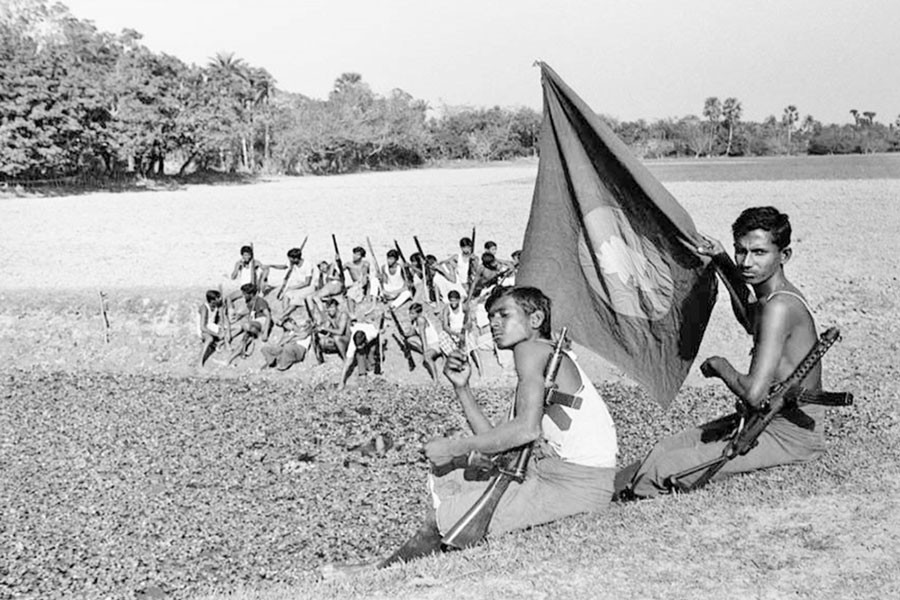
Meanwhile, the flag of independent Bangladesh was raised by the 'Independent Bangladesh Students' Action Council' at Dhaka University and the Paltan Maidan. The national anthem 'Amar Sonar Bangla' started to be sung in a chorus by the demonstrators. Various political parties urged Mujib to declare independence through forming a national government. But Mujib was hesitant. On the other hand, the 'Butcher of Baluchistan' Tikka Khan was sent to Dhaka as the military chief and governor of East Pakistan. But none of the judges at Dhaka's High Court including the chief justice agreed to administer his oath of office. Sheikh Mujib delivered his historic speech at Dhaka's Ramna race course ground on March 7. Yahya finally arrived in Dhaka on March 16 as a last-ditch effort, ostensibly for hoodwinking the public.
Discussions were held between Yahya and Mujib between 16 and 25 March. But the ordinary citizens could not know what was being discussed. Meanwhile, fresh military reinforcements, troops, weapons and munitions were arriving from West Pakistan every dayin large quantities during this interregnum. Lives were lost when the Bangalis obstructed the unloading of arms from a ship in Chattorgram seaport. News also circulated that the Bangali members of the armed forces were either being disarmed or kept under surveillance. Overall, Yahya's intent was crystal-clear, although Mujib was still hesitant about making a final call for independence and armed struggle. In this backdrop, Yahya quietly left Dhaka in the evening of March 25, setting the stage for a genocide and the independence war.
When the non-cooperation movement against the Pakistani military regime was gaining momentum in March 1971, many in East Pakistan felt the impending need for an armed struggle. Discussions on the issue were held between the veteran army officer Colonel M A G Osmany and the Awami League chief Sheikh Mujibur Rahman on March 19. Many Bangali officers from the East Bengal Regiment also met Mujib at that time; but Mujib was not inclined to a violent and combative course. He did not issue any directive for war preparation, but at the same time did not oppose the spontaneous rehearsals taking place all over Bangladesh. Students and youths were already receiving training on armed resistance, and on March 21, Colonel Osmany took salute at a parade of former soldiers in Paltan Maidan. But overall, preparations were not directed towards an armed war. Thus, March 25 1971 came as a shock to all, especially to those Bangali members of the army who put up the initial resistance.
On the night of March 25 1971, genocide was started in Dhaka from 11.30 p.m. The military campaign started according to the blueprint 'Operation Searchlight' drafted in Dhaka cantonment on March 18. Between March and December 1971, the Pakistani Army was encouraged to undertake indiscriminate armed assaults against unarmed Bangali civilians in the name of Islam.
The Chattogram radio station played a crucial role during the initial stages of resistance. After the midnight of March 26, a call by the Bangali Major Ziaur Rahman was transmitted through the Kalurghat transmission centre urging resistance against the invading forces. The station was declared as 'Revolutionary Radio of Independent Bangla'; but later, the term 'revolutionary' was omitted. Through this radio centre, Major Zia (later president of the country and exponent of Bangladeshi Nationalism) informed the world about the independence of Bangladesh through consecutive announcementson 27, 28, and 30 March. When the Bangali population were apprehensive and confused about the whole situation, Major Zia played a crucial role by proclaiming independence during the early hours of the independence war.
Dr Helal Uddin Ahmed is a retired Additional Secretary and former Editor of Bangladesh Quarterly. hahmed1960@gmail.com
© 2026 - All Rights with The Financial Express

