The world is shutting its doors, and the implications for developing countries are profound. Between January and May 2025, USA consulates issued roughly 95,000 F-1 visas, marking the lowest issuance total in three years, whilst the Department of Homeland Security proposed limiting students' length of stay to four years, directly at odds with the six-year average it takes to complete a physics PhD. Canada reduced study permits by 10per cent to 437,000 for 2025, the UK government announced plans to cut the graduate route visa from two years to 18 months, and Australia maintains a complex points-based permanent residency system requiring years of regional work experience.
What was once a reliable pathway to prosperity has become a gamble with increasingly unfavourable odds. Major UK, USA, Canadian employers are also cutting international graduate hiring for consecutive years, according to many students currently struggling there. For Bangladeshi families spending US$30,000-50,000 annually per student, the return on investment has evaporated in ways that would have seemed unthinkable a decade ago. This crisis, rather paradoxically, presents Bangladesh with an opportunity disguised as an imperative: instead of exporting talent and capital to increasingly hostile destinations, the country must build internationally credible higher education infrastructure domestically.
The Illusion of Expansion
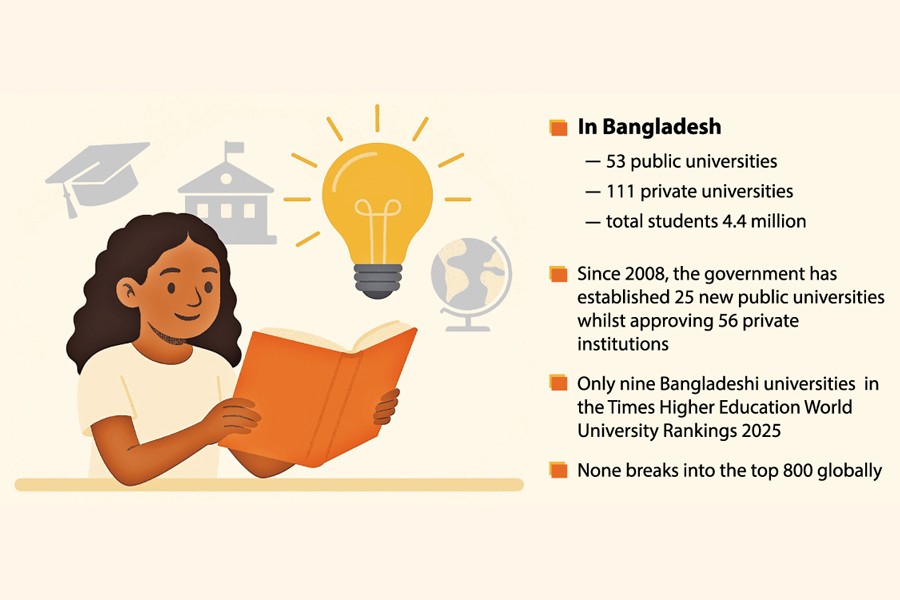
Bangladesh operates 53 public and 111 private universities enrolling 4.4 million students, and since 2008, the government has established 25 new public universities whilst approving 56 private institutions. What has not expanded is quality: only nine Bangladeshi universities appear in the Times Higher Education World University Rankings 2025, and none breaks into the top 800 globally. This is sad reality given the fact that we have demographic dividend, neighbouring nations like India and SEA countries are doing much better than us.
The employment data reveals what students already understand intuitively. Centre for Policy Dialogue research shows 46per cent of employers struggle to find skilled applicants, whilst one-third of university graduates remain unemployed for up to two years. In 2022, at least 49,151 Bangladeshi students went abroad for studying in 58 countries according to UNESCO data, up from 16,609 in 2008, and this tripling exposes an uncomfortable truth: infrastructure expansion without quality improvement merely replicates mediocrity at scale.
Strategic Partnerships as Infrastructure
The solution involves bringing global education standards to Bangladesh rather than exporting students permanently. Joint degree programmes like SOAS University of London's partnership with BRAC University for a joint PhD in Applied Development Economics demonstrate viability, allowing students to receive internationally recognised training without permanent relocation. Universal College Bangladesh pioneered delivering programmes from UK universities including the University of Lancashire, offering students internationally recognised qualifications at approximately one-third the cost of studying abroad.
Foundation programmes provide another crucial bridge. The NCUK International Foundation Year delivered at MIE Pathways offers guaranteed progression to over 100 partner universities worldwide, with students completing pre-university qualifications in Dhaka for GB£4,500-5,000 rather than GB£15,000-30,000 abroad, democratising access for middle-class families previously unable to afford foreign education.
Remote Models and Microcredentials
The pandemic validated what sceptics had long doubted: remote doctoral education can function effectively when structured properly. Bangladesh should aggressively pursue hybrid PhD arrangements where students spend 18 months abroad completing coursework, then return to complete dissertations remotely whilst contributing to local institutions, reducing costs by 60-70per cent whilst preventing permanent brain drain. Professional master's programmes in business analytics, public policy, and data science suit remote delivery particularly well, allowing universities to partner with institutions like Harvard Kennedy School or LSE to deliver evening classes synchronously to Dhaka cohorts.
The traditional four-year bachelor's degree increasingly fails to serve economies experiencing rapid technological change. Micro-credentials offer agility through short, focused certifications allowing continuous skill development. Global employers now value demonstrated competencies over degree pedigree, which explains why Google, IBM, and Microsoft offer professional certificates carrying substantial weight in hiring decisions. Bangladesh should integrate micro-credential pathways into university programmes systematically, allowing students to emerge with both academic credentials and verified skills that employers actually require.
Industry Integration and University Reform
Co-operative education programmes, where students alternate academic terms with paid industry placements, solve the skills mismatch plaguing Bangladeshi graduates. Universities in Bangladesh should mandate 12-18 months of industry experience before graduation, supported by tax incentives encouraging corporate participation. Companies hiring co-op students might receive tax reductions proportional to training investments, creating pipelines where firms identify talent early whilst students gain genuine experience and professional networks.
BUET graduates leave Bangladesh at rates approaching 40-50per cent per batch because domestic opportunities cannot compete internationally. Reversing this requires autonomy from political interference, merit-based faculty appointments, and research budgets comparable to regional peers. International accreditation provides external discipline, forcing transparency around outcomes whilst establishing global credibility that domestic reforms often fail to achieve.
Private universities, operating with greater flexibility, should pioneer new approaches by expanding partnerships aggressively and responding faster to market demands. Collaboration between public and private sectors through joint research centres, business incubators, and faculty exchanges would spread innovation whilst elevating standards systematically across the entire higher education ecosystem.
Economic Calculation and Regional Comparison
Consider the financial logic underlying current arrangements. Some 70,000-90,000 Bangladeshi students travel overseas for higher studies yearly, spending conservatively US$30,000-50,000 annually, which translates to US$2.1-4.5 billion flowing out of Bangladesh yearly. Investing even half that amount into upgrading universities, attracting international faculty, and subsidising partnerships would transform the landscape within a decade through effects that compound over time.
South Korea, Singapore, and China built world-class university systems within single generations through state-directed educational transformation. South Korea's investment in higher education during the 1980s-1990s directly enabled its transformation from aid recipient to technological powerhouse, whilst Singapore's strategic partnerships with institutions like MIT created research capacity far exceeding what its small population would suggest possible. Bangladesh possesses demographic advantages neither enjoyed: a young population provides both abundant talent and substantial domestic market for educational services.
A Framework for Action
Transformation requires coordinated effort across stakeholders. Universities must pursue international collaborations systematically, establishing dedicated offices for partnership development and prioritising partnerships producing measurable outcomes. The government should establish clear frameworks for joint programmes whilst granting public universities genuine autonomy, because political appointments destroy meritocracy and performance-based funding rewards institutions producing employable graduates. Corporations must recognise that co-operative education represents strategic investment rather than charitable expense, with tax benefits offsetting short-term costs.
Development partners should shift from scholarship programmes sending students abroad to investments building domestic capacity through faculty development, research facilities, and subsidised partnerships. Families and students must abandon assumptions that foreign credentials inherently surpass domestic ones, a shift requiring transparent data on graduate employment outcomes that universities must publish rigorously.
Why This Time Will Be Different
Previous reform efforts failed because conditions did not support transformation. Several factors suggest the landscape has shifted fundamentally. First, the economics have changed: when foreign education guaranteed immigration and high-paying employment, families rationally invested despite costs, but those guarantees have evaporated as UK employers cut graduate hiring whilst Canada maintains strict permit caps. Second, technology now enables what was previously impossible, with institutions having developed robust delivery models for remote and hybrid programmes. Third, Bangladesh's economic transformation creates both demand for skilled labour and resources to invest meaningfully in talent development simultaneously.
The alternative to transformation is continued decline along a trajectory that becomes harder to reverse yearly. Each cohort that departs represents lost opportunity costs compounding over decades: the technology companies they might have founded, the research they might have conducted, the innovations they might have produced all occur elsewhere. This reflects systematic underinvestment in human capital that cannot be easily replicated but must be cultivated patiently through sustained commitment to educational quality.
The Imperative for Immediate Action
International education trends now favour partnership models that bring quality to students rather than extracting students to quality. Bangladesh must seize this moment with appropriate urgency, because the tools already exist in proven form: joint programmes successfully implemented elsewhere, micro-credentials gaining employer acceptance globally, co-operative education models demonstrating clear returns, and remote doctoral studies producing graduates whose research output matches traditional programmes.
The question confronting policymakers is whether they will muster political will to make necessary changes before another half-million talented youth depart permanently. Every semester of delay means another cohort lost, every year of inaction means another US$2-4 billion exported, and every decade of hesitation means another generation consigned to substandard education. Countries that educate their citizens well prosper across generations, whilst those that fail to invest systematically decline relative to competitors. Bangladesh must choose consciously and soon, because this crisis, properly understood and addressed with appropriate seriousness, represents the country's opportunity to finally build the higher education system that its citizens need, its economy requires, and its future demands.
Rounak.marium@gmail.com
© 2026 - All Rights with The Financial Express

