Bangladesh stands at a critical juncture. With over one-third of its population aged below 30, the future of the nation will be determined not by policy, but by the ideas, skills, and leadership qualities of the youth. Climate change, increasing inequalities, employability, and the disruptor role of the digital age are no longer distant threats, they are realities. The debate is no longer about engaging the youth in addressing the issues, but about preparing them for the task.
This is where the Youth Connect programme of the British Council has come up with a quiet transformative force in youth leadership development. The manner in which it has redefined youth leadership development and turned ideas into action has brought about this transformation in the world of youth.
Youth Connect is a Global Youth Leadership Programme designed to build a fairer, more inclusive and resilient world. In Bangladesh, it has become something even more powerful -- a platform that recognises young people not only as participants, but as changemakers capable of leading solutions rooted in their own communities.
Two flagship global components of the programme-- Youth Connect Live and 90 Youth Voices -- illustrate this philosophy. Youth Connect Live connects youth with their peers across the globe to enable them to gain new skills through dynamic, non-formal learning experiences while 90 Youth Voices brings 90 young leaders from around the world together to grow, to connect and to tackle global challenges.
The true strength of Youth Connect lies in how it adapts global vision to local realities. During the British Council's 2025-26 financial year, the programme in Bangladesh has been expanded and tailored through two strategically designed initiatives -- the Youth Green Entrepreneurship Project and the Digital Citizenship and Misinformation Resilience Project.
The Youth Green Entrepreneurship Project is the embodiment of the recognition that the challenges of climate crisis and joblessness are not distinct problems, rather they are intertwined. This project aims to equip the youth with leadership qualities, an entrepreneurial mindset, and green vision while infusing sustainability and resilience for climate into every step of enterprise development.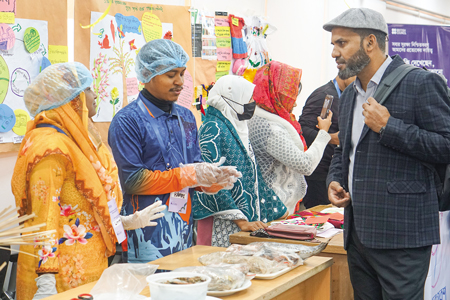 The project aims to benefit around 1,000 youth, with most being from marginalised communities, covering different districts including Chuadanga, Jhenaidah, Meherpur, Rangpur, and Dinajpur. There has been an emphasis on women and marginalised groups, since growth must come with inclusive leadership. The project is being implemented in partnership with Wave Foundation, Democracy Watch, and SERAC Bangladesh, ensuring deep community engagement and contextual relevance.
The participants attend intensive five days of training in green entrepreneurship fundamentals, values-based leadership, vision development, planning, marketing, and presentation. But training, as the British Council emphasises, is only the beginning. Youth are expected to independently design, test and implement green business ideas, addressing not only market opportunities, but also systemic barriers such as access to finance.
Md. AbdurRahaman Khan, British Council Programme Manager for Non?Formal Education, said: "While we promote the aspiration that programme participants will become entrepreneurs, this outcome may not materialise for every individual in practice. However, the competencies they gain through the initiative-such as problem?solving, leadership, sustainability literacy, and business planning-remain transferable employability skills in the job market."
To deepen impact, two intensive bootcamps are being organised, selecting 60 most promising participants from among the 1,000 coming from project regions. These bootcamps focus on scaling 15 green business ideas through advanced discussions on financial planning, marketing strategy, green business canvases, and gender and social inclusion. Participants are challenged to consider who their products serve, whether they exclude or include women, persons with disabilities, or marginalised groups, and how green enterprises can drive social equity alongside environmental sustainability.
This initiative builds on the British Council's long-standing commitment to social enterprise development and on the findings of its Next Generation Research 2024, which captured youth aspirations, frustrations and priorities across Bangladesh while British Council's previous programmes -- from green entrepreneurship initiatives in 2022-23 to social enterprise capacity-building in 2015-16 -- have laid the foundation of the latest project.
If climate action defines one axis of youth leadership, the digital sphere defines another. The Digital Citizenship and Misinformation Resilience Project addresses misinformation and disinformation, a challenge that has rapidly become existential for democratic discourse and social cohesion.
Next Generation Research findings revealed a stark reality. Social media has become the primary news source for young people. More than 40 per cent of the respondents in the research report learning many things online while one in three male respondents expressed disagreement with the idea that men and women are equal. These findings underscored an urgent need - not just for digital skills, but for critical thinking, ethical engagement and responsible citizenship in the digital age.
Being implemented in partnership with the University of Liberal Arts Bangladesh (ULAB) at nine universities, including Chattogram University, BCG Trust University, World University of Bangladesh, Rajshahi University, Jahangirnagar University, Port City International University, Cumilla University, and Daffodil University, the project has trained 600 students through a 20-hour hybrid programme combining face-to-face and virtual learning.
Participants at the training acquire soft leadership skills, fact-checking knowledge, media literacy and information literacy in addition to algorithm understanding, AI-generated content, and digital safety. Gender equality, social inclusion, environmental stewardship, and sustainability are also integral parts of the curriculum. The content itself is a global knowledge product, developed by British Council's international teams and consultants, ensuring world-class standards while remaining locally relevant. The ambition of the project is long-term -- to transform participating universities into hubs for fact-checking and responsible digital engagement.
Learning in this project is not confined to the classroom. The trainees are expected to prepare around 40 social action or community and social action projects ranging from online campaigns to social awareness campaigns. They will try to solve problems in society with the fact-checking, digital citizenship, and soft leadership skills that they are acquiring. There is a chance that the British Council will expand the coverage to 1,000-2,000 youth under the same 9-university network.
The impact of the training is already visible. For many participants, the training has been transformative - not just in skills, but in mindset. They believe the Digital Citizenship and Misinformation Resilience project are guiding students through the complexities of today's digital world, from staying safe online to spotting AI generated deepfakes.
"I never realised how algorithms shape what I see online. This training didn't just teach me tools; it changed my mindset. I feel more confident protecting my digital footprint and helping my family spot rumours," said a student participant from BGC Trust University.
"These sessions go beyond awareness. They are preparing young people to take action. Students are now brainstorming Community Action Projects to bring these lessons back to their own communities."
The initiatives under the Youth Connect project, together, contain a clear vision of youth leadership that is 'be ethical and informed'. The project promotes solutions that are not 'quick-fix' answers. Rather, it realises that when the right tools and setting are provided for growth, youth will design more solutions that institutions alone cannot.
In a country often described in terms of challenges, Youth Connect insists on possibility. It recognises that Bangladesh's greatest resource is not only its resilience, but its young people. By connecting local ambition to global purpose, and learning to live action, the programme is helping to build a generation ready not just to inherit the future, but to lead it.
rahmansrdk@gmail.com