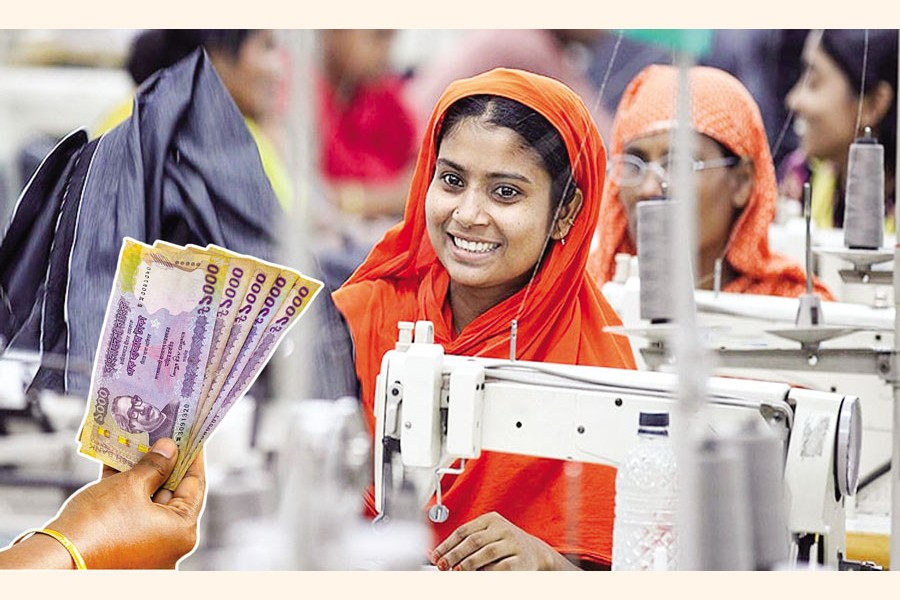
Every year, as the moon of Ramadan wanes, a singular question occupies the minds of Bangladesh's salaried workforce: where does the Eid bonus go? Across sectors from banking and civil service to garments, telecoms, and NGOs, millions of jobholders receive their festival bonus and must decide, often under considerable pressure, how to divide it. With over four million workers in the readymade garment industry alone entitled to a bonus under the Bangladesh Labour Rules 2015, the collective spending power released in the weeks before Eid is enormous. Yet with inflation averaging 10.04 per cent in FY2024-25, the highest in 14 years, that money stretches far less than it once did.
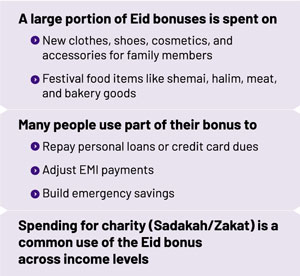 Generally, a large portion of the salary and Eid bonus goes towards shopping: new clothes for every family member, shoes, handbags, cosmetics, and accessories. A comparable sum is spent on food items such as shemai, halim, meat, bakery goods, and other necessary groceries befitting the festival.
Some people set aside a portion to repay personal loans, which limits their budget for clothing and food. Jobholders with higher incomes extend gifts to relatives and friends. Across all income levels, one ritual is nearly universal: giving charity to the underprivileged.
Those living away from their families must also set aside a portion for travel; for large families, the cost is considerable given the seasonal surge in fares.
Arifur Rahman, Head of Human Resources at Apollo Imperial Hospital, Chattogram, puts it plainly: the Eid bonus in Bangladesh is not just extra money. It carries family expectations, religious obligations, social responsibility, and personal happiness all at once. Accounting for the rising cost of living, he divides his bonus across four areas: family shopping, support for parents and relatives, emergency savings, and charity.
"Last year, I spent a bigger portion on shopping and lifestyle. But this year, I am more careful. As a father and HR professional, I now think more about financial security. Economic uncertainty has made many middle-class families more cautious, and so the mindset has changed from celebration-focused to responsibility-focused," he added.
Mr. Arifur Rahman observes that Eid bonus mainly goes to four areas in Bangladesh, especially in urban areas like Chattogram: family first, extended family and social responsibility, Sadakah (Zakat), and savings & EMI adjustments.
According to him, most people prioritise family first: children's clothes, gifts, and special food. For many parents, seeing their children happy on Eid morning is reward enough. Many also support parents in village homes or help struggling relatives out of a sense of social responsibility.
Eid is a time when we feel more responsible to share. For practicing Muslims, a part of the Eid bonus naturally goes to charity. This is not just a religious duty; it is a social balance.
In recent years, a remarkable change has been seen among many professionals, who are using Eid bonuses to pay loan instalments, clear credit card dues, and build emergency savings.
This reflects that the spending pattern is slowly shifting from pure celebration to financial management.
The picture is sharply different for lower-income workers. For those whose wages have failed to keep pace with inflation, the Eid bonus is less a windfall and more a lifeline. Research shows that real wages in Bangladesh stagnated for an extended period as price pressures mounted, leaving many families with little room to manoeuvre. Jobholders with lower salaries receive a proportionately smaller bonus; for most, Eid is the one occasion in the year when they can afford new clothing at all. Managing both clothing and grocery costs within a single bonus remains a genuine struggle.
Sometimes they need to sacrifice their own clothing due to a limited budget. Mohammad Sumon, an Office Assistant of a reputed private company, said, "As I have a small income, I can't manage any savings from my monthly salary. I need to spend my whole monthly salary on buying food items, bearing medical expenses, and paying house rent. Last year, I bought new clothes for my mother, wife, and children with the Eid bonus I received, and this year I am planning to do the same.
"Once in a while, I could manage only a single shirt or a pair of trousers for myself after managing shopping for all family members," he added.
Mohammad Mizanur Rahman, an Internal Auditor at a private company in Chattogram, has a carefully considered plan for his bonus. As the eldest son and sole earner of his family, he prioritises clothing for family members and vulnerable relatives above all else.
Mr. Mizan mentioned, "My first priority is family members such as my younger sister, brother, father, mother, and my favourite aunt who lost her parents within a short period of time and now lives alone for a long time. Being the eldest son, I realise a strong sense of responsibility as my father is no longer able to shoulder any economic burden."
"I want to offer a gift to my relatives, though I couldn't do so last year. Nevertheless, I have some personal loans and expect to spend the remaining amount for repaying the loan, even though the amount is not sufficient for doing so," he said.
For people of other faiths, the Eid bonuscarries different significance. Many of them travel with family members. Jobholders, especially women, prefer shopping as new fashionable dresses appear during the festival. Eid in Bangladesh reflects layered social bonds, cultural expression, and a spending pattern that is quietly but unmistakably changing.
Tushar Chakrabarty, Assistant Manager of the Accounts and Finance Department at Apollo Imperial Hospitals, Chattogram, said, "I am not going for any tour this year, though I visited Kashmir, India, in the 2022 Eid festival. I prefer to meet my financial obligations."
It is widely said that Eid is for children, because it is the adults who shoulder the weight of making it so. From clearing debts to clothing the family and giving to those in need, the Eid bonus is spent not on the self, but on everyone else. That, ultimately, is the answer.
shafiul0019@gmail.com
© 2026 - All Rights with The Financial Express

